
接受基于多替拉韦的抗逆转录病毒治疗的感染艾滋病毒孕妇的促生长激素改变与较低的婴儿1岁体重Z评分相关。
Growth-promoting hormonal alterations in pregnant women living with HIV receiving dolutegravir-based antiretroviral treatment are associated with lower infant 1-year weight z-scores.
作者信息
Powis Kathleen M, Jao Jennifer, Legbedze Justine, Dunk Caroline, Mmasa Keolebogile N, Kgole Samuel W, Masasa Gosego, Mohammed Terence, Makhema Joseph, Moyo Sikhulile, Geffner Mitchell E, Abrams Elaine J, Serghides Lena
机构信息
Departments of Internal Medicine and Pediatrics, Massachusetts General Hospital, Boston, MA, United States.
Department of Immunology and Infectious Diseases, Harvard T.H. Chan School of Public Health, Boston, MA, United States.
出版信息
Front Pediatr. 2025 Jul 25;13:1559877. doi: 10.3389/fped.2025.1559877. eCollection 2025.
BACKGROUND
Several maternal hormones regulate fetal growth, but concentrations of these hormones in pregnancy among women living with HIV and associations between hormone levels and infant anthropometrics is limited.
METHODS
Pregnant women with HIV receiving dolutegravir/tenofovir/emtricitabine and HIV-seronegative women and their infants prospectively enrolled in the Botswana-based Tshilo Dikotla study were included in this analysis. Estradiol, sex-hormone binding globulin (SHBG), progesterone, cortisol, pituitary growth hormone-1 (GH1), insulin-like growth factor-1 (IGF-1), and insulin-like growth factor binding protein-1 (IGFBP-1) concentrations were measured in maternal plasma collected between 24 and 29 weeks' gestation. Bioavailable estradiol was derived using estradiol and SHBG concentrations. Generalized linear models were fit to evaluate associations between HIV status and each maternal hormone. Similar models were fit to assess effect modification by HIV status on the relationship between each maternal hormone and infant anthropometrics at birth and 1-year of age.
RESULTS
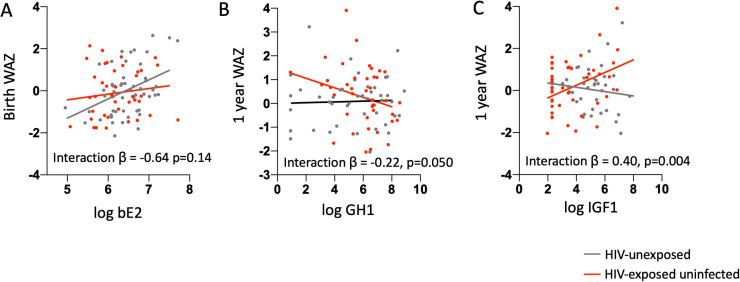
Maternal plasma specimens were available from 114 women (46 with HIV). Women with HIV had lower mean log bioavailable estradiol (β: -0.22, = 0.031), cortisol (β: -0.22, = 0.001), and IGF-1 (β: -0.81, = 0.007), but higher GH1 (β: 0.91, = 0.007) than women without HIV. Infant HIV-exposure status modified associations of log GH1 (β: -0.21, = 0.05) and log IGF-1 (β: 0.40, = 0.004) with infant 1-year weight-for-age z-score (WAZ), adjusting for maternal age, BMI, exclusive breastfeeding duration, and birth WAZ. Among infants who were HIV exposed uninfected, lower GH1 and higher IGF1 levels were associated with higher WAZ at 1 year of age. These associations were not observed in HIV-unexposed infants.
CONCLUSION
Associations between maternal growth-promoting hormones and infant weight at 1 year of life differ significantly by maternal HIV status, reflecting potential perturbations in the maternal-fetal-infant growth axis among pregnant women with HIV. Additional research is needed to identify mechanisms and possible interventions.
背景
几种母体激素调节胎儿生长,但感染艾滋病毒的女性孕期这些激素的浓度以及激素水平与婴儿人体测量学之间的关联有限。
方法
本分析纳入了参与博茨瓦纳的奇洛·迪科特拉研究的接受度鲁特韦拉/替诺福韦/恩曲他滨治疗的感染艾滋病毒的孕妇及其婴儿,以及未感染艾滋病毒的女性及其婴儿。在妊娠24至29周期间采集的母体血浆中测量雌二醇、性激素结合球蛋白(SHBG)、孕酮、皮质醇、垂体生长激素-1(GH1)、胰岛素样生长因子-1(IGF-1)和胰岛素样生长因子结合蛋白-1(IGFBP-1)的浓度。利用雌二醇和SHBG浓度得出生物可利用雌二醇。采用广义线性模型评估艾滋病毒感染状态与每种母体激素之间的关联。采用类似模型评估艾滋病毒感染状态对每种母体激素与出生时及1岁时婴儿人体测量学之间关系的效应修正作用。
结果
114名女性(46名感染艾滋病毒)提供了母体血浆样本。感染艾滋病毒的女性平均对数生物可利用雌二醇(β:-0.22,P = 0.031)、皮质醇(β:-0.22,P = 0.001)和IGF-1(β:-0.81,P = 0.007)水平较低,但GH1水平较高(β:0.91,P = 0.007)。在调整了产妇年龄、体重指数、纯母乳喂养持续时间和出生时体重别年龄z评分(WAZ)后,婴儿的艾滋病毒暴露状态改变了对数GH1(β:-0.21,P = 0.05)和对数IGF-1(β:0.40,P = 0.004)与1岁时婴儿体重别年龄z评分(WAZ)之间的关联。在未感染艾滋病毒的婴儿中未观察到这些关联。
结论
母体促生长激素与1岁时婴儿体重之间的关联因母体艾滋病毒感染状态而异,这反映了感染艾滋病毒的孕妇母婴生长轴可能受到干扰。需要进一步研究以确定其机制和可能的干预措施。

 Zotero 插件