
轻柔、局部负荷(4.9 - 7.4 N)且接触面积狭窄时的肌肉放松效果:关于关昭和传统手法治疗的叙述性综述
The Muscle Relaxation Effects of Gentle, Focal Load (4.9-7.4 N) With a Narrow Contact Area: A Narrative Review of Kanshoho and Conventional Manual Therapies.
作者信息
Sakato Takashi, Amitani Haruka
机构信息
Physiology (Fascia), Japan Health Organization, Chuo Ward, Tokyo, JPN.
Department of Psychosomatic Internal Medicine, Kagoshima University Graduate School of Medical and Dental Sciences, Kagoshima, JPN.
出版信息
Cureus. 2025 Aug 8;17(8):e89646. doi: 10.7759/cureus.89646. eCollection 2025 Aug.
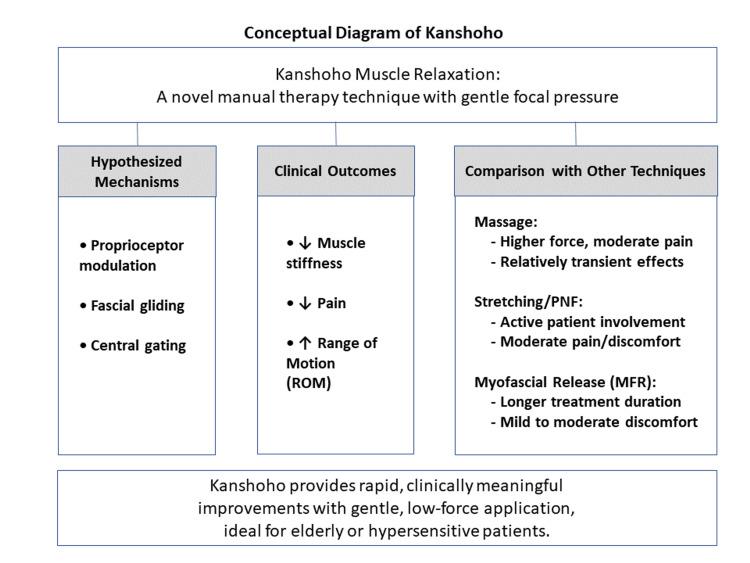
In this narrative review, we summarize the immediate effects of Kanshoho, a novel manual therapy, in the context of chronic musculoskeletal pain. Excessive muscle stiffness is closely linked to chronic pain, highlighting the need for safe and rapid methods to relieve this tension. Kanshoho, a novel low-pressure muscle-relaxation technique developed in Japan in 2007, is characterized by the application of a very gentle, focal load (approximately 4.9-7.4 Newton (N), or 500-750 gf) to a small area of the body's surface while the patient performs guided active movements. This review summarizes the immediate effects of Kanshoho and identifies optimal application parameters from existing reports, and it compares Kanshoho's outcomes with those of other common manual muscle-relaxation techniques. In patients with chronic nonspecific low back pain, a brief Kanshoho session has been associated with immediate reductions in muscle stiffness and relief of pain. Furthermore, exploratory studies on technique parameters suggest that using a moderately gentle pressure (around 5-7 N) over a narrow contact area (1-2 cm in diameter) yields the most pronounced muscle-relaxation effect. By contrast, substantially lower or higher pressures, or using a much broader contact area, appear less effective for achieving immediate stiffness reduction. Compared to conventional manual therapies, such as massage, static stretching, proprioceptive neuromuscular facilitation, and myofascial release, Kanshoho produces similar or even greater improvements in muscle relaxation and pain relief, typically in a shorter amount of time and without causing post-treatment soreness. Its non-pharmacological and minimally invasive nature makes it especially suitable for elderly or hypersensitive individuals who might not tolerate more intense interventions. These findings highlight Kanshoho as a promising conservative approach for managing chronic myofascial pain (particularly nonspecific low back pain). However, further well-controlled studies are warranted to confirm its efficacy and to better understand the underlying mechanisms. As a narrative review, no formal statistical synthesis methods were applied.
在这篇叙述性综述中,我们总结了一种新型手法治疗——关少法(Kanshoho)在慢性肌肉骨骼疼痛背景下的即时效果。肌肉过度僵硬与慢性疼痛密切相关,这凸显了需要安全且快速的方法来缓解这种紧张状态。关少法是2007年在日本开发的一种新型低压肌肉放松技术,其特点是在患者进行引导性主动运动时,对身体表面的小区域施加非常轻柔的局部负荷(约4.9 - 7.4牛顿(N),即~500 - 750克)。本综述总结了关少法的即时效果,并从现有报告中确定最佳应用参数,同时将关少法的结果与其他常见的手动肌肉放松技术的结果进行比较。在慢性非特异性下腰痛患者中,简短的关少法治疗疗程与肌肉僵硬的即时减轻和疼痛缓解相关。此外,对技术参数的探索性研究表明,在狭窄的接触区域(直径约1 - 2厘米)使用适度轻柔的压力(约5 - 7 N)可产生最明显的肌肉放松效果。相比之下,压力显著更低或更高,或使用更宽的接触区域,在实现即时僵硬减轻方面似乎效果较差。与传统手法治疗(如按摩、静态拉伸、本体感觉神经肌肉促进法和肌筋膜松解术)相比,关少法在肌肉放松和疼痛缓解方面产生了相似甚至更大的改善,通常所需时间更短且不会引起治疗后酸痛。其非药物和微创的性质使其特别适合可能无法耐受更强烈干预的老年人或过敏个体。这些发现凸显出关少法是一种有前景的保守方法,用于管理慢性肌筋膜疼痛(特别是非特异性下腰痛)。然而,需要进一步进行严格对照研究以证实其疗效并更好地理解其潜在机制。作为一篇叙述性综述,未应用正式的统计综合方法。
 Zotero 插件