
激酶Bud32调节真菌病原体中的铁稳态。
The kinase Bud32 regulates iron homeostasis in fungal pathogen .
作者信息
Ma Yuanyuan, Pan Bo, Lei Wenzhi, Fang Wenjie, Pan Weihua, Liao Wanqing, Xu Bin, Xue Peng
机构信息
Nantong Key Laboratory of Environmental Toxicology, Department of Occupational Medicine and Environmental Toxicology, School of Public Health, Nantong University, Nantong, China.
Department of Dermatology, Shanghai Key Laboratory of Molecular Medical Mycology, Second Affiliated Hospital of Naval Medical University, Shanghai, China.
出版信息
Front Immunol. 2025 Jul 25;16:1624237. doi: 10.3389/fimmu.2025.1624237. eCollection 2025.
INTRODUCTION
The ability to acquire iron and maintain iron homeostasis is crucial for the virulence of the human pathogenic fungus . This study investigates the role of Bud32, a core virulence kinase and component of the KEOPS complex, within the iron regulatory network of
METHODS
We used gene deletion techniques to study the phenotypic effects of gene knockout and conducted proteomic and metabolomic analyses to assess changes in protein expression and metabolite levels in the mutant. Additionally, we performed phosphoproteomics analysis to evaluate Bud32 impact on iron regulatory proteins.
RESULTS
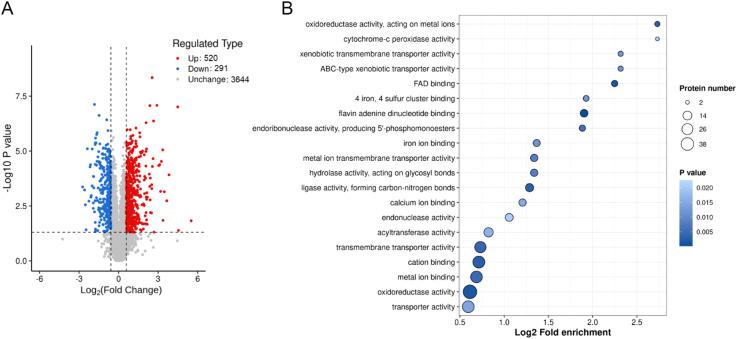
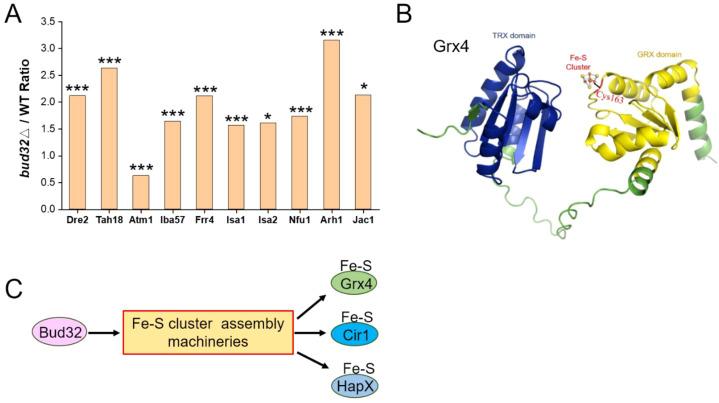
Our findings revealed that deletion of gene significantly impaired growth in iron-limiting environments, leading to notable alterations in the expression of iron transport and iron-sulfur cluster (ISC)-containing proteins. Specifically, Bud32 was shown to modulate ISC assembly and influence the activity of key iron-sulfur binding proteins, including Grx4, Cir1, and HapX. Metabolic profiling indicated changes in 696 metabolites, with reductions in biliverdin levels. Additionally, gene deletion resulted in widespread changes in the phosphorylation status of numerous proteins, including the iron regulators Cir1 and Rim101.
CONCLUSION
These findings provide evidence for the involvement of the kinase Bud32 in regulating iron homeostasis in , thereby contributing to our understanding of its virulence mechanisms.
引言
获取铁并维持铁稳态的能力对于人类致病真菌的毒力至关重要。本研究调查了核心毒力激酶及KEOPS复合体组成部分Bud32在铁调节网络中的作用。
方法
我们使用基因缺失技术研究基因敲除的表型效应,并进行蛋白质组学和代谢组学分析以评估突变体中蛋白质表达和代谢物水平的变化。此外,我们进行磷酸化蛋白质组学分析以评估Bud32对铁调节蛋白的影响。
结果
我们的研究结果表明,基因缺失显著损害了在铁限制环境中的生长,导致铁转运和含铁硫簇(ISC)蛋白的表达发生显著变化。具体而言,Bud32被证明可调节ISC组装并影响关键铁硫结合蛋白的活性,包括Grx4、Cir1和HapX。代谢谱分析表明696种代谢物发生变化,胆绿素水平降低。此外,基因缺失导致众多蛋白质的磷酸化状态发生广泛变化,包括铁调节因子Cir1和Rim101。
结论
这些发现为激酶Bud32参与调节铁稳态提供了证据,从而有助于我们理解其毒力机制。



 Zotero 插件