
1型糖尿病患者技术使用情况与血糖控制的趋势及差异
Trends and Disparities in Technology Use and Glycemic Control in Type 1 Diabetes.
作者信息
Fang Michael, Xu Yunwen, Ballew Shoshana H, Coresh Josef, Echouffo-Tcheugui Justin B, Selvin Elizabeth, Shin Jung-Im
机构信息
Department of Epidemiology, Johns Hopkins Bloomberg School of Public Health, Baltimore, Maryland.
Department of Population Health, Optimal Aging Institute and Division of Epidemiology, New York University Grossman School of Medicine, New York, New York.
出版信息
JAMA Netw Open. 2025 Aug 1;8(8):e2526353. doi: 10.1001/jamanetworkopen.2025.26353.
IMPORTANCE
Characterizing population-level changes in type 1 diabetes (T1D) management can inform public health policies and interventions.
OBJECTIVE
To characterize trends and disparities in glycemic control and use of diabetes technology among US youths and adults with T1D.
DESIGN, SETTING, AND PARTICIPANTS: This serial, cross-sectional analysis used the Optum Labs Data Warehouse, a national, deidentified database of electronic health records, to identify US youths (aged <18 years) and adults (aged ≥18 years) with T1D. Data were obtained from records from January 1, 2009, to December 31, 2023.
EXPOSURES
Calendar years divided into 3-year study periods from 2009 to 2011 to 2021 to 2023.
MAIN OUTCOMES AND MEASURES
Glycemic control (mean hemoglobin A1c level, <7%) and use of diabetes technology (continuous glucose monitoring systems and/or insulin pumps) were defined using laboratory data and prescriptions, procedures, and diagnoses codes from electronic health records.
RESULTS
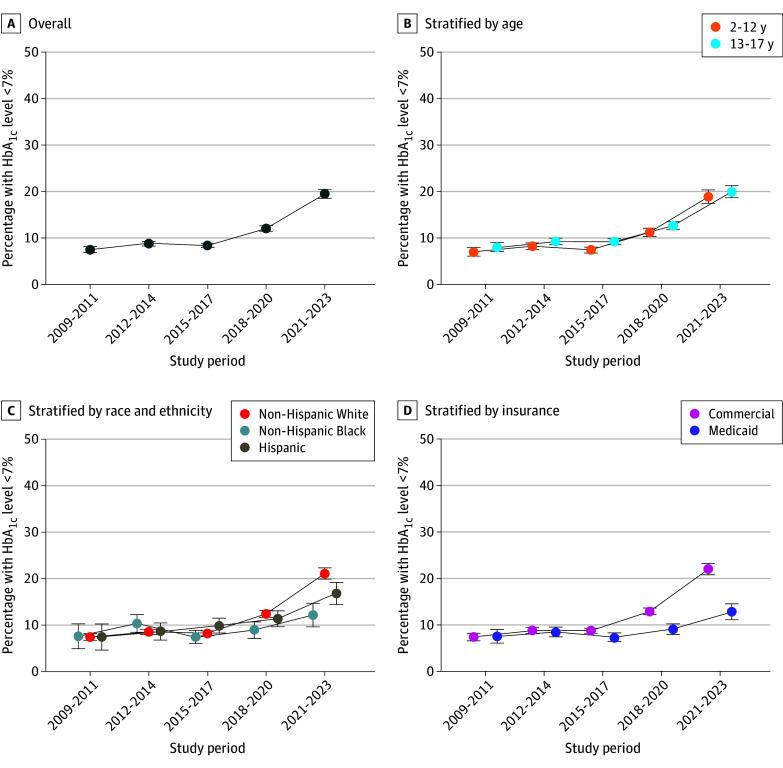
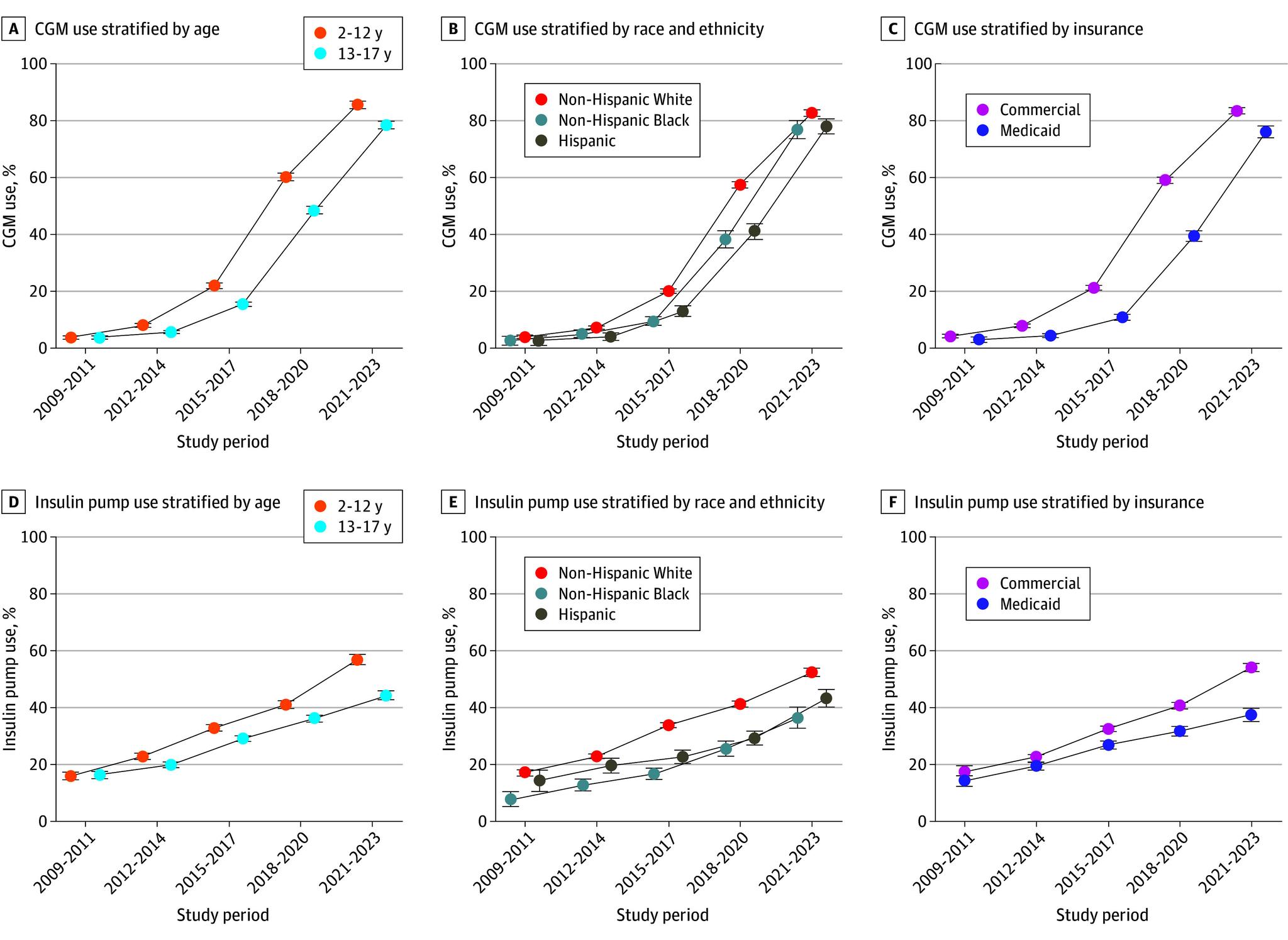
A total of 186 590 participants with T1D was identified (mean [SD] age, 40 [19] years; 96 766 [52%] male; 12 493 [7%] Hispanic, 2819 [2%] non-Hispanic Asian, 21 459 [12%] non-Hispanic Black, and 141 847 [76%] non-Hispanic White). Of these, 26 853 participants were youths (mean [SD] age, 12 [4] years; 14 060 [52%] male; 19 822 [74%] non-Hispanic White) and 159 737 were adults (mean [SD] age, 45 [16] years; 82 706 [52%] male; 122 025 [76%] non-Hispanic White). From the 2009-2011 to 2021-2023 study periods, the prevalence of glycemic control (mean hemoglobin A1c level <7%) increased from 7% (95% CI, 7%-8%) to 19% (95% CI, 19%-20%) in youths (P < .001 for trend) and 21% (95% CI, 21%-22%) to 28% (95% CI, 28%-29%) in adults (P < .001 for trend). During this same period, there was a substantial increase in the percentage of patients using continuous glucose monitoring (4% to 82% for youths; 5% to 57% for adults), insulin pumps (16% to 50% for youths; 11% to 29% for adults), and both devices concurrently (1% to 47% for youths; 1% to 22% for adults) (P < .001 for trend for all). The prevalence of glycemic control and use of diabetes technology were lowest in Hispanic, non-Hispanic Black, and Medicaid-insured youths and adults, and differences persisted or increased over time.
CONCLUSIONS AND RELEVANCE
In this cross-sectional study, there was a rapid increase in the use of diabetes technology and notable improvements in glycemic control among youths and adults with T1D during the past 15 years. Nonetheless, the prevalence of glycemic control remained low, and racial, ethnic, and socioeconomic differences grew over time.
重要性
描述1型糖尿病(T1D)管理在人群层面的变化可为公共卫生政策和干预措施提供参考。
目的
描述美国患有T1D的青少年和成年人在血糖控制及糖尿病技术使用方面的趋势和差异。
设计、背景和参与者:这项系列横断面分析使用了Optum Labs数据仓库,这是一个全国性的、经过去识别处理的电子健康记录数据库,以识别美国患有T1D的青少年(年龄<18岁)和成年人(年龄≥18岁)。数据来自2009年1月1日至2023年12月31日的记录。
暴露因素
将日历年份分为从2009年到2011年、2021年到2023年的3年研究期。
主要结局和测量指标
血糖控制(平均糖化血红蛋白A1c水平,<7%)和糖尿病技术的使用(连续血糖监测系统和/或胰岛素泵)通过实验室数据以及电子健康记录中的处方、程序和诊断代码来定义。
结果
共识别出186590名患有T1D的参与者(平均[标准差]年龄为40[19]岁;96766名[52%]为男性;12493名[7%]为西班牙裔,2819名[2%]为非西班牙裔亚裔,21459名[12%]为非西班牙裔黑人,141847名[76%]为非西班牙裔白人)。其中,26853名参与者为青少年(平均[标准差]年龄为12[4]岁;14060名[52%]为男性;19822名[74%]为非西班牙裔白人),159737名参与者为成年人(平均[标准差]年龄为45[16]岁;82706名[52%]为男性;122025名[76%]为非西班牙裔白人)。从2009 - 2011年到2021 - 2023年研究期,青少年中血糖控制(平均糖化血红蛋白A1c水平<7%)的患病率从7%(95%置信区间,7% - 8%)增至19%(95%置信区间,19% - 20%)(趋势P <.001),成年人中从21%(95%置信区间,21% - 22%)增至28%(95%置信区间,28% - 29%)(趋势P <.001)。在同一时期,使用连续血糖监测的患者百分比大幅增加(青少年从4%增至82%;成年人从5%增至57%),使用胰岛素泵的患者百分比大幅增加(青少年从16%增至50%;成年人从11%增至29%),同时使用两种设备的患者百分比大幅增加(青少年从1%增至47%;成年人从1%增至22%)(所有趋势P <.001)。西班牙裔、非西班牙裔黑人和参加医疗补助的青少年及成年人的血糖控制患病率和糖尿病技术使用情况最低,且随着时间推移差异持续存在或扩大。
结论与意义
在这项横断面研究中,过去15年里患有T1D的青少年和成年人在糖尿病技术使用方面迅速增加,血糖控制也有显著改善。尽管如此,血糖控制的患病率仍然较低,且种族、民族和社会经济差异随着时间推移不断扩大。



 Zotero 插件