
成人肥胖管理的药物治疗:2025年临床实践指南更新
Pharmacotherapy for obesity management in adults: 2025 clinical practice guideline update.
作者信息
Pedersen Sue D, Manjoo Priya, Dash Satya, Jain Akshay, Pearce Nicole, Poddar Megha
机构信息
C-ENDO Diabetes and Endocrinology Clinic, and University of Calgary (Pedersen), Calgary, Alta.; Department of Endocrinology (Manjoo, Jain), University of British Columbia, Vancouver, BC; University of Victoria (Manjoo), Victoria, BC; Department of Medicine (Dash), University of Toronto; University Health Network (Dash), Toronto, Ont.; TLC Diabetes and Endocrinology Clinic (Jain), Surrey, BC; Obesity Canada (Pearce), St. Albert, Alta.; Department of Internal Medicine (Poddar), McMaster University, Hamilton, Ont.
出版信息
CMAJ. 2025 Aug 10;197(27):E797-E809. doi: 10.1503/cmaj.250502.
BACKGROUND
Pharmacotherapy is a key component of comprehensive obesity management, alongside behavioural therapy and metabolic and bariatric surgery. In this guideline, we update the pharmacotherapy recommendations in the 2020 Canadian clinical practice guideline on obesity in adults and in the 2022 pharmacotherapy for obesity management revision to provide current recommendations for clinicians on the efficacy, safety, and appropriate use of pharmacotherapy in the management of obesity in adults.
METHODS
This guideline update follows the same methodology as the 2020 Canadian guideline on obesity in adults, adhering to the Appraisal of Guidelines for Research and Evaluation instrument and using the Shekelle framework to assess and grade evidence and to formulate recommendations. Building on the search conducted for the 2022 pharmacotherapy revision, we conducted a systematic literature review (search dates January 2022 to July 2024), supplemented by relevant trials published through May 2025, to identify studies assessing the efficacy of pharmacotherapy for weight management. We also conducted 13 targeted searches on the management of weight-related complications in 13 subpopulations with important adiposity-related health issues. We engaged primary care physicians, obesity medicine specialists, and people with lived experience of obesity to provide feedback on the recommendations.
RECOMMENDATIONS
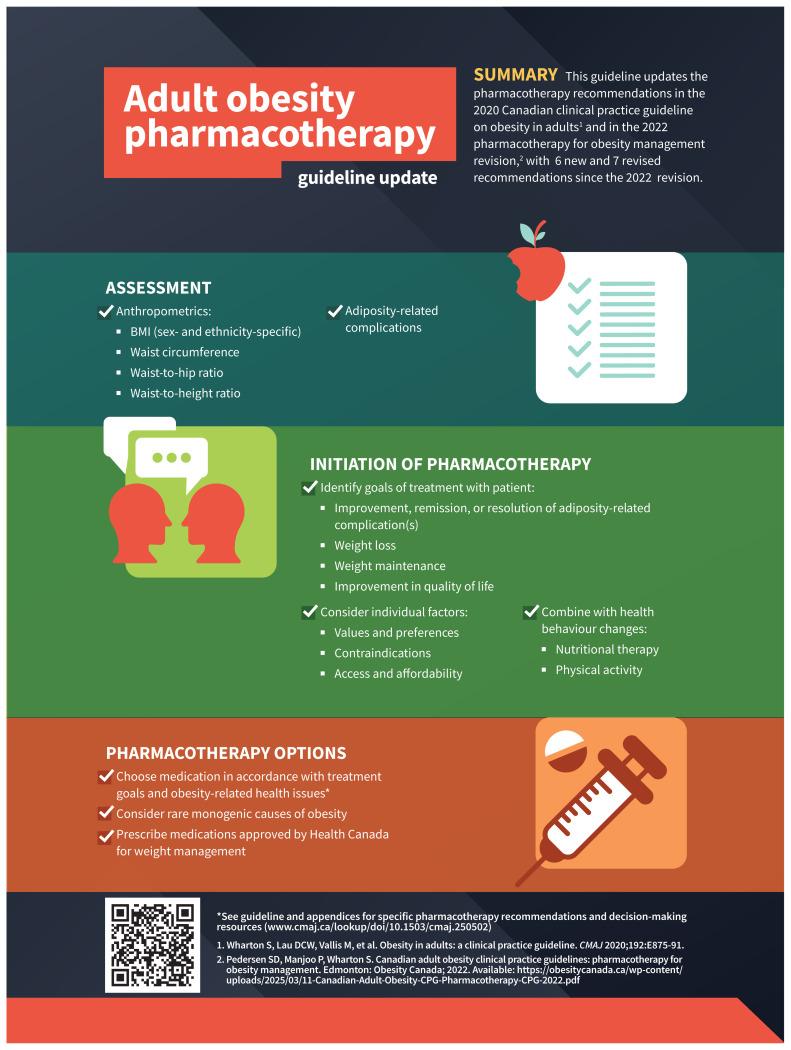
This update includes 6 new and 7 revised recommendations since the 2022 pharmacotherapy guideline revision (all 2020 pharmacotherapy recommendations are updated). Measures of central adiposity, in addition to ethnicity-specific body mass index and adiposity-related complications, should be used to guide the decision to initiate pharmacotherapy. Obesity pharmacotherapy should be used in conjunction with health behaviour changes and individualized based on a person's specific health needs and in keeping with their values and preferences. Recommendations support long-term use of obesity pharmacotherapy for sustained weight loss and maintenance of weight loss. We provide recommendations for use of specific obesity pharmacotherapies with proven benefit in specific subpopulations - atherosclerotic cardiovascular disease, heart failure with preserved ejection fraction, metabolic dysfunction-associated steatohepatitis, prediabetes, type 2 diabetes, obstructive sleep apnea, osteoarthritis - and for those with certain specific monogenic causes of obesity. We recommend against the use of compounded medications or medications other than those approved for weight loss in people with excess adiposity.
INTERPRETATION
Pharmacotherapy in obesity facilitates clinically meaningful weight loss and important improvements in obesity-related health complications. Clinicians who treat people with obesity with or without obesity-related health complications should appropriately use pharmacotherapy as an integral part of their treatment paradigm.
背景
药物治疗是成人肥胖综合管理的关键组成部分,与行为疗法、代谢及减重手术相辅相成。在本指南中,我们更新了2020年加拿大成人肥胖临床实践指南及2022年肥胖管理药物治疗修订版中的药物治疗建议,为临床医生提供有关药物治疗在成人肥胖管理中的疗效、安全性及合理使用的最新建议。
方法
本指南更新遵循与2020年加拿大成人肥胖指南相同的方法,遵循研究与评价指南评估工具,并使用谢克尔框架来评估和分级证据并制定建议。在为2022年药物治疗修订版所做检索的基础上,我们进行了一项系统文献综述(检索日期为2022年1月至2024年7月),并补充了截至2025年5月发表的相关试验,以识别评估药物治疗体重管理疗效的研究。我们还针对13个患有重要肥胖相关健康问题的亚人群中与体重相关并发症的管理进行了13项针对性检索。我们邀请了初级保健医生、肥胖医学专家以及有肥胖生活经历的人对这些建议提供反馈。
建议
自2022年药物治疗指南修订以来,本次更新包括6项新建议和7项修订建议(所有2020年药物治疗建议均已更新)。除特定种族的体重指数和肥胖相关并发症外,应使用中心性肥胖指标来指导启动药物治疗的决策。肥胖药物治疗应与健康行为改变相结合,并根据个人的特定健康需求、价值观和偏好进行个体化治疗。建议支持长期使用肥胖药物治疗以实现持续减重和维持体重减轻。我们针对在特定亚人群——动脉粥样硬化性心血管疾病、射血分数保留的心力衰竭、代谢功能障碍相关脂肪性肝炎、糖尿病前期、2型糖尿病、阻塞性睡眠呼吸暂停、骨关节炎——以及某些特定单基因肥胖病因患者中已证实有获益的特定肥胖药物治疗的使用提供了建议。我们不建议肥胖人群使用复方药物或未经批准用于减肥的药物。
解读
肥胖的药物治疗有助于实现具有临床意义的体重减轻,并显著改善肥胖相关的健康并发症。治疗肥胖患者(无论有无肥胖相关健康并发症)的临床医生应适当使用药物治疗,将其作为治疗模式的一个组成部分。
 Zotero 插件