
估计受饮食偏好和生活方式影响的代谢物网络。
Estimating metabolite networks subject to dietary preferences and lifestyle.
作者信息
Bartzis Georgios, Peeters Carel F W, Uh Hae-Won, Houwing-Duistermaat Jeanine J, van Eeuwijk Fred A
机构信息
Mathematical and Statistical Methods group (Biometris), Wageningen University and Research, Wageningen, The Netherlands.
Department of Data Science and Biostatistics, Julius Centre, UMC Utrecht, Utrecht, The Netherlands.
出版信息
Metabolomics. 2025 Aug 11;21(5):105. doi: 10.1007/s11306-025-02296-2.
INTRODUCTION
The metabolome is an intermediate between DNA variation and clinical phenotypes. Metabolomics have been widely used in biomedical studies for reflecting physiological changes in response to variation coming from various sources, such as diet, environment, time, and lifestyle. While lifestyle factors contribute a considerable part of the metabolic variation, current human studies lack information estimating lifestyle, mainly because it is not strictly defined.
OBJECTIVE
In this work, metabolite concentrations are measured at two time points (2007 and 2014). Additionally, SNP data together with self-reports on dietary behavior. By having measurements over time, as well as all main sources of metabolic variation (diet, genetics), both time-effects and lifestyle-effects can be estimated. Since lifestyle and time effects can be estimated under this setting, we are interested in identifying metabolites sharing similar relationships to diet and lifestyle, using network analysis.
METHODS
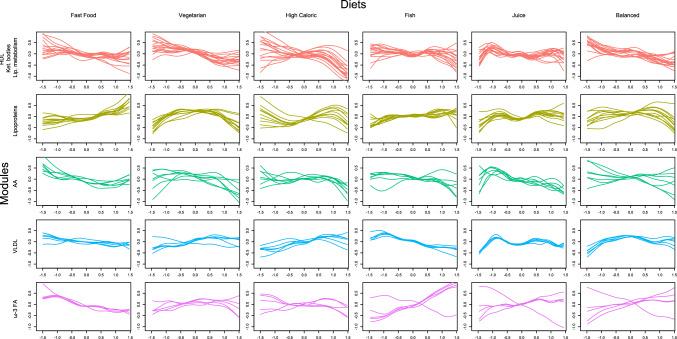
The correlation between repeated measurements is modeled using a random intercepts linear mixed model, with dietary preferences, genetics, and time as fixed effects. The random intercepts can be defined as the lifestyle, and represent the part of the metabolic variation which is not due to diet, genetics, and time and is subject-specific. The part of every metabolite relevant to diet and lifestyle instead of the original values is used as input values to network estimation methods.
CONCLUSIONS
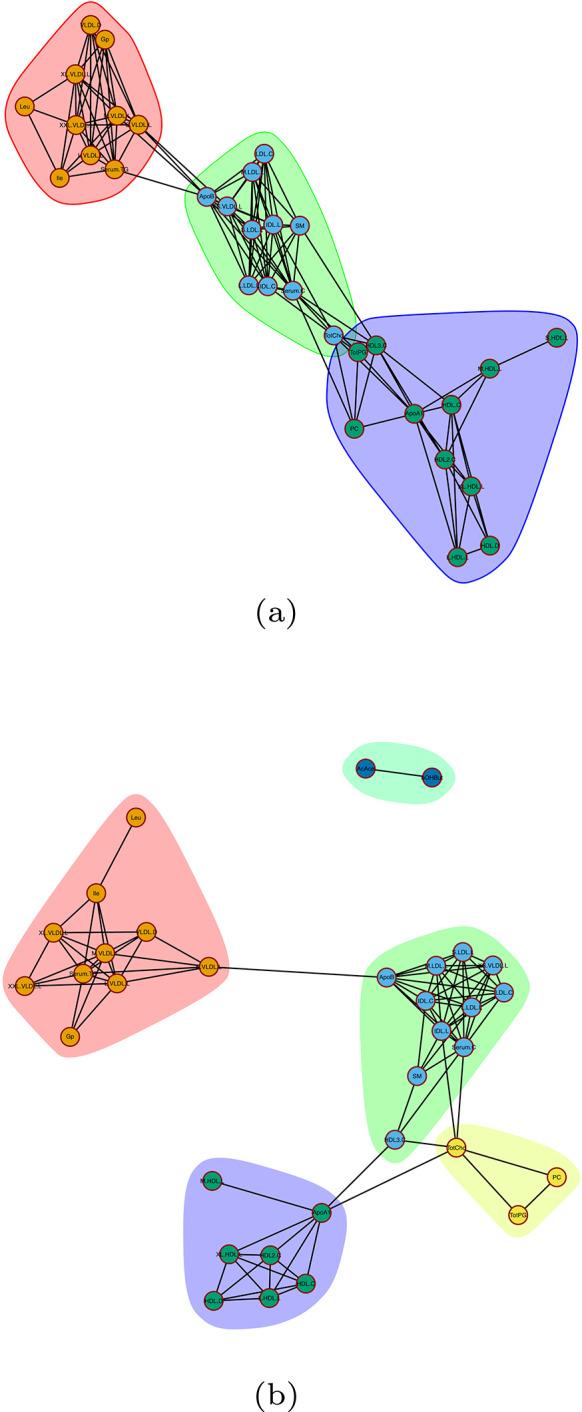
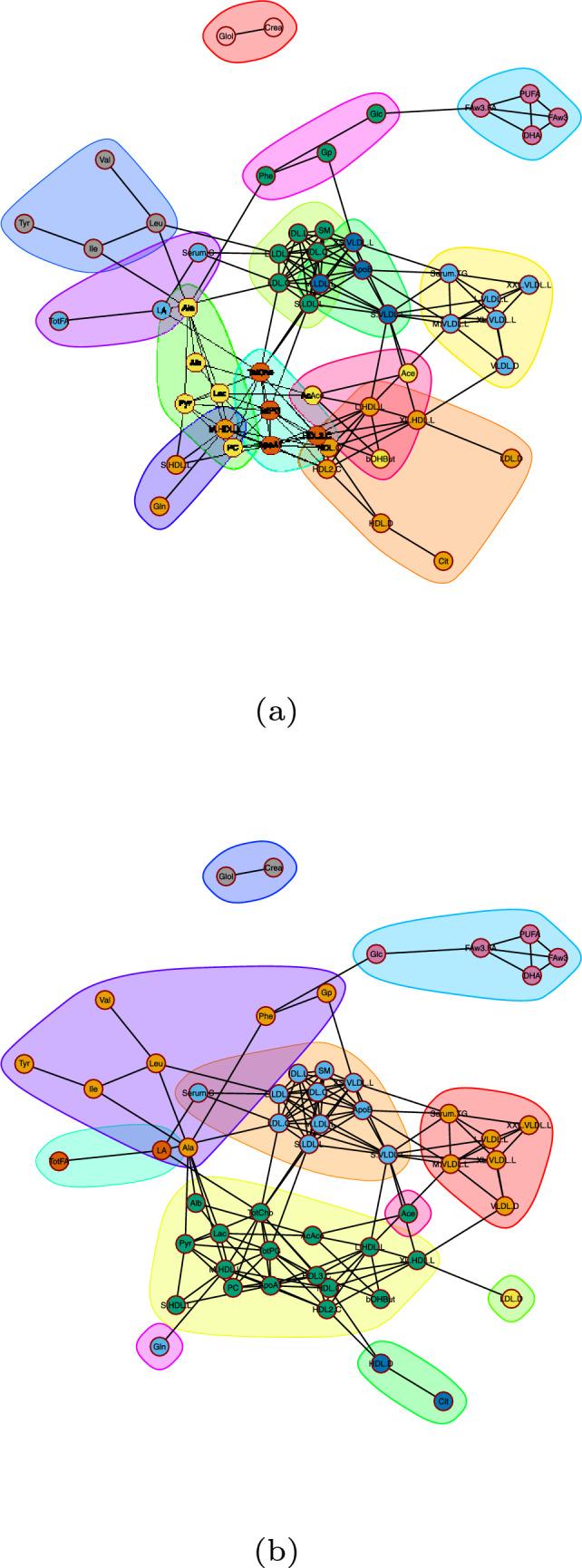
This work demonstrates how correcting for several sources of metabolic variation, allows us to look for residual variation and build networks with meaningful metabolite groups sharing similar association to diet and lifestyle.
引言
代谢组是DNA变异与临床表型之间的中间环节。代谢组学已广泛应用于生物医学研究,以反映因饮食、环境、时间和生活方式等各种来源的变异而产生的生理变化。虽然生活方式因素在代谢变异中占相当大的比例,但目前的人体研究缺乏对生活方式的评估信息,主要原因是其定义不严格。
目的
在这项研究中,在两个时间点(2007年和2014年)测量代谢物浓度。此外,还收集了单核苷酸多态性(SNP)数据以及饮食行为的自我报告。通过对时间的测量以及代谢变异的所有主要来源(饮食、遗传学),可以估计时间效应和生活方式效应。由于在这种情况下可以估计生活方式和时间效应,我们有兴趣使用网络分析来识别与饮食和生活方式具有相似关系的代谢物。
方法
使用随机截距线性混合模型对重复测量之间的相关性进行建模,将饮食偏好、遗传学和时间作为固定效应。随机截距可定义为生活方式,代表代谢变异中不归因于饮食、遗传学和时间且因个体而异的部分。将每个代谢物与饮食和生活方式相关的部分而非原始值用作网络估计方法的输入值。
结论
这项研究表明,校正代谢变异的多种来源如何使我们能够寻找残余变异,并构建与饮食和生活方式具有相似关联的有意义的代谢物组网络。
 Zotero 插件