
新型冠状病毒肺炎患者疾病进展和治疗结果异质性的数学建模
Mathematical modelling of the heterogeneity of disease progression and treatment outcomes in patients with COVID-19.
作者信息
Yu Guozhi, Huang Houhui
机构信息
Department of Bioengineering and Applied Biology, College of Life Sciences, Sichuan Agricultural University, Ya'an, China.
Department of Mathematics, College of Sciences, Sichuan Agricultural University, Ya'an, China.
出版信息
Front Microbiol. 2025 Jul 28;16:1551320. doi: 10.3389/fmicb.2025.1551320. eCollection 2025.
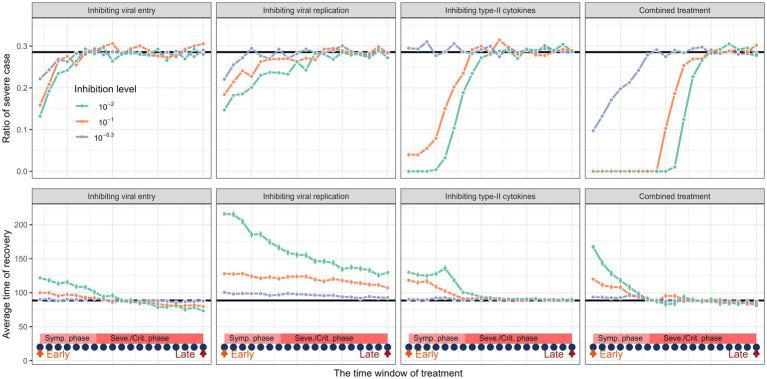
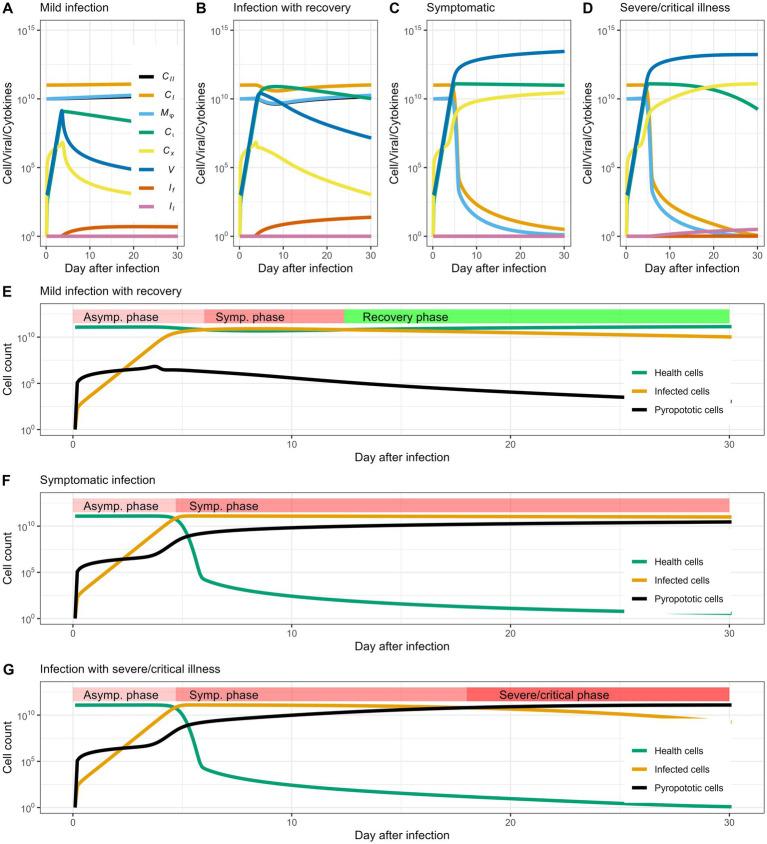
Pneumonia caused by SARS-CoV-2 infection is a self-limiting disease. Its progression and prognosis are highly heterogeneous among people of different ages, genders, and living with different life styles. Such heterogeneity also exists in treatment outcomes of different patients. Various physiological and pathological factors, such as renewal of pulmonary cell, number of entry receptor and viral replication, have been identified linking to the development of the disease. However, it is still unclear how these factors collectively establish a causal relationship in the course of disease progression. In this study, we built a mechanistic model to explain the dynamics of infection and progression of COVID-19. We modeled how the interaction of pulmonary cells determine the dynamics of disease progression by characterizing the temporal dynamics of viral load, infected and health alveolar cells, and dysfunctional alveolar cells. The viral and cellular dynamics captured different stages of clinical manifestations in individual patient during disease progression: the incubation period, mild symptom period, and severe period. We further simulated clinical interference at different stages of disease progression. The results showed that some medical interventions show no improvement either in reducing the recovery rate or shortening the recovery time. Our theoretical framework may provide a mechanistic explanation at the systems level for the progression and prognosis of COVID-19 as well as other similar respiratory tract diseases.
由严重急性呼吸综合征冠状病毒2(SARS-CoV-2)感染引起的肺炎是一种自限性疾病。其进展和预后在不同年龄、性别以及生活方式各异的人群中存在高度异质性。不同患者的治疗结果也存在这种异质性。各种生理和病理因素,如肺细胞更新、进入受体数量和病毒复制等,已被确定与该疾病的发展有关。然而,这些因素在疾病进展过程中如何共同建立因果关系仍不清楚。在本研究中,我们构建了一个机理模型来解释2019冠状病毒病(COVID-19)的感染和进展动态。我们通过表征病毒载量、感染和健康肺泡细胞以及功能失调肺泡细胞的时间动态,对肺细胞的相互作用如何决定疾病进展动态进行了建模。病毒和细胞动态捕捉了个体患者在疾病进展过程中临床表现的不同阶段:潜伏期、轻症期和重症期。我们进一步模拟了疾病进展不同阶段的临床干预。结果表明,一些医学干预在降低恢复率或缩短恢复时间方面均无改善。我们的理论框架可能为COVID-19以及其他类似呼吸道疾病的进展和预后提供系统层面的机理解释。


 Zotero 插件