
使用时间分辨过渡金属离子荧光共振能量转移测量的SthK变构调节中的结构域偶联。
Domain coupling in allosteric regulation of SthK measured using time-resolved transition metal ion FRET.
作者信息
Eggan Pierce, Gordon Sharona E, Zagotta William N
机构信息
Department of Neurobiology and Biophysics, University of Washington, Seattle, United States.
出版信息
Elife. 2025 Aug 12;14:RP106892. doi: 10.7554/eLife.106892.
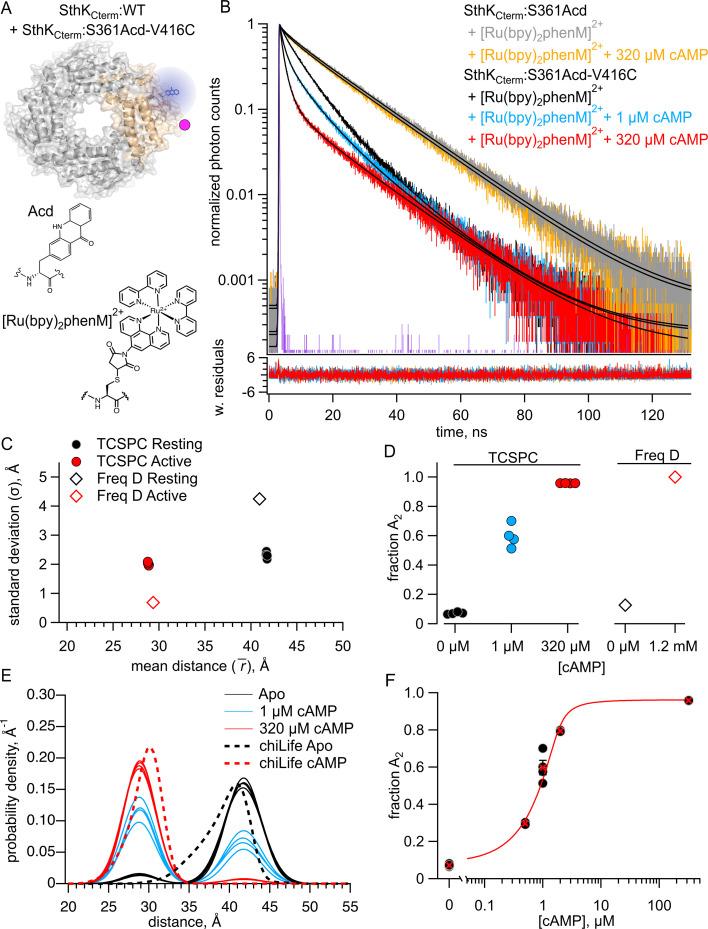
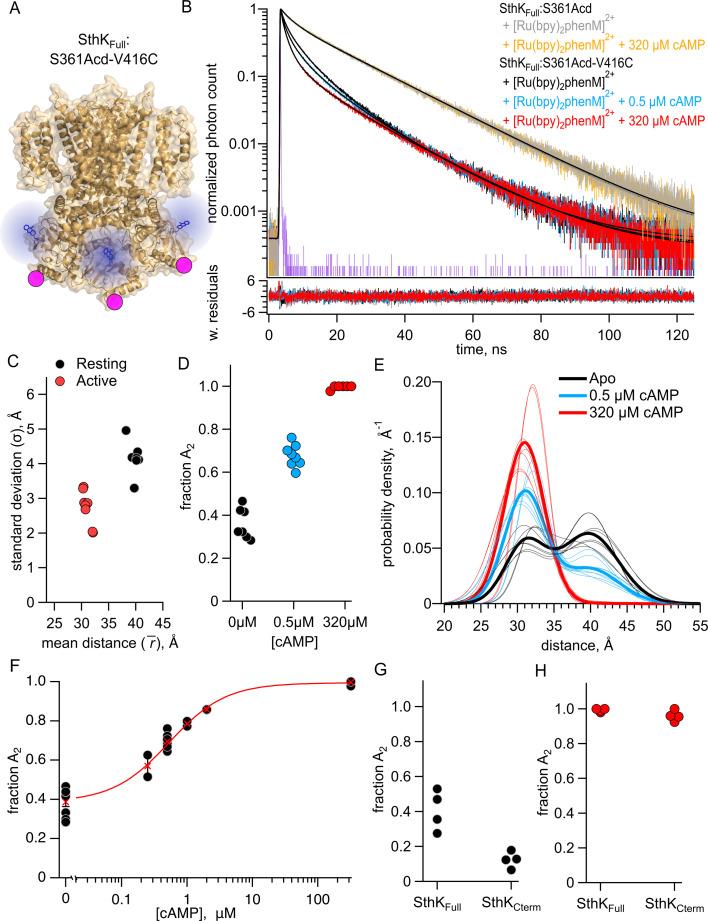
Cyclic nucleotide-binding domain (CNBD) ion channels are vital for cellular signaling and excitability, with activation regulated by cyclic adenosine- or guanosine-monophosphate (cAMP, cGMP) binding. However, the allosteric mechanisms underlying this activation, particularly the energetics that describe conformational changes within individual domains and between domains, remain unclear. The prokaryotic CNBD channel SthK has been a useful model for better understanding these allosteric mechanisms. Previously, we applied time-resolved transition metal ion Förster resonance energy transfer (tmFRET) to investigate the conformational dynamics and energetics in the CNBD of a soluble C-terminal fragment of the SthK protein, SthK (Eggan et al., 2024). Here, we used a similar strategy to measure the conformational energetics of the CNBD in the full-length channel, SthK, and compared them to measurements from SthK. We incorporated the noncanonical amino acid Acd as a FRET donor and a metal bound to a chelator conjugated to a cysteine as an acceptor. We used time-correlated single-photon counting (TCSPC) to measure time-resolved FRET and fit the TCSPC data to obtain donor-acceptor distance distributions in the absence and presence of cAMP. The distance distributions allowed us to quantify the energetics of coupling between the C-terminal domains and the transmembrane domains by comparing the donor-acceptor distance distributions for SthK and SthK. Our data indicate that the presence of the SthK transmembrane domains makes the activating conformational change in the CNBD more favorable. These findings highlight the power of time-resolved tmFRET to uncover the structural and energetic landscapes of allosteric proteins and of the ligand-mediated mechanism in CNBD channels specifically.
环核苷酸结合域(CNBD)离子通道对细胞信号传导和兴奋性至关重要,其激活由环磷酸腺苷或环磷酸鸟苷(cAMP、cGMP)结合调节。然而,这种激活背后的变构机制,特别是描述单个结构域内和结构域之间构象变化的能量学,仍不清楚。原核CNBD通道SthK一直是更好理解这些变构机制的有用模型。此前,我们应用时间分辨过渡金属离子荧光共振能量转移(tmFRET)来研究SthK蛋白可溶性C端片段SthK(Eggan等人,2024年)的CNBD中的构象动力学和能量学。在这里,我们使用类似策略测量全长通道SthK中CNBD的构象能量学,并将其与SthK的测量结果进行比较。我们引入非天然氨基酸Acd作为FRET供体,将与半胱氨酸偶联的螯合剂结合的金属作为受体。我们使用时间相关单光子计数(TCSPC)来测量时间分辨FRET,并对TCSPC数据进行拟合,以获得在有无cAMP情况下的供体-受体距离分布。通过比较SthK和SthK的供体-受体距离分布,这些距离分布使我们能够量化C端结构域与跨膜结构域之间的耦合能量学。我们的数据表明,SthK跨膜结构域的存在使CNBD中的激活构象变化更有利。这些发现突出了时间分辨tmFRET在揭示变构蛋白的结构和能量景观以及特别是CNBD通道中配体介导机制方面的强大作用。





 Zotero 插件