
1990年至2021年全球、区域和国家儿童及青少年甲状腺癌负担:患病率、发病率和伤残调整生命年的统计分析
Global, regional, and national burden of Pediatric and adolescent thyroid cancer from 1990 to 2021: a statistical analysis of prevalence, incidence, and DALYs.
作者信息
Zhang Rui, Mei Zhenxin, Feng Shan, Chen Zongcun
机构信息
Department of Endocrinology, The Second Affiliated Hospital of Hainan Medical University, Haikou, China.
Department of Oncology, The Second Affiliated Hospital of Hainan Medical University, Haikou, China.
出版信息
Front Oncol. 2025 Jul 29;15:1630648. doi: 10.3389/fonc.2025.1630648. eCollection 2025.
BACKGROUND
Thyroid cancer is the most common malignant tumor of the endocrine system. Among children and adolescents, cancer ranks as the fourth leading cause of cancer-related deaths. Pediatric and adolescent thyroid cancer is a rare disease characterized by high metastatic and invasive properties. Currently, there remains a notable absence of comprehensive analyses addressing the global disease burden and evolving trends of Pediatric and adolescent thyroid cancer.
METHODS
This study used the Global Burden of Disease (GBD) database (1990-2021) to extract three key metrics: prevalence, incidence, and disability adjusted life years, for Pediatric and adolescent thyroid cancer cases. The data were shown as numerical counts and age-standardized counts per 100,000 within a population with 95% uncertainty intervals (UI). It assessed the evolving trends in the burden of thyroid cancer among children and adolescents by employing the EAPC (Estimated Annual Percentage Change) and percentage change metric.
RESULTS
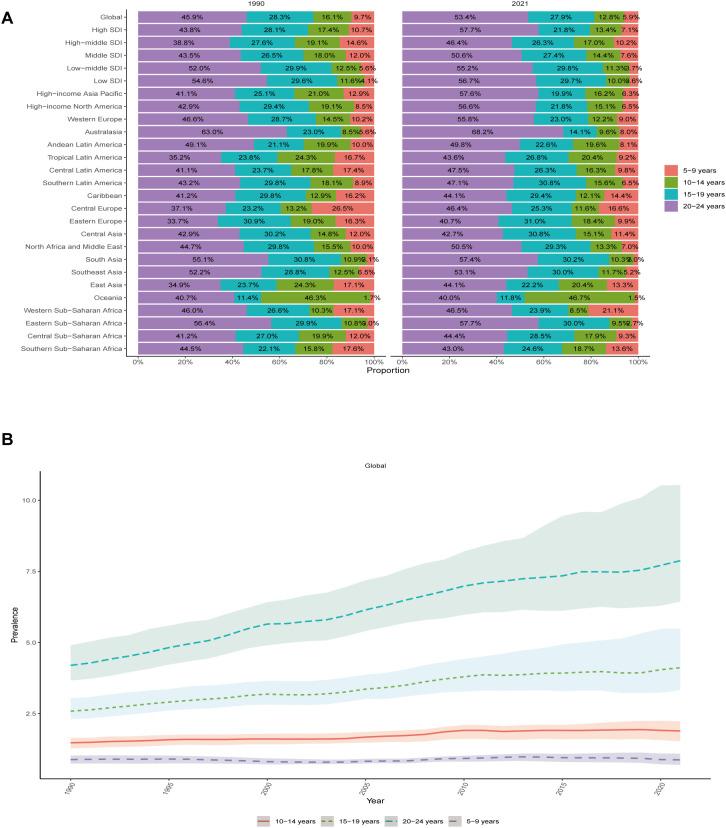
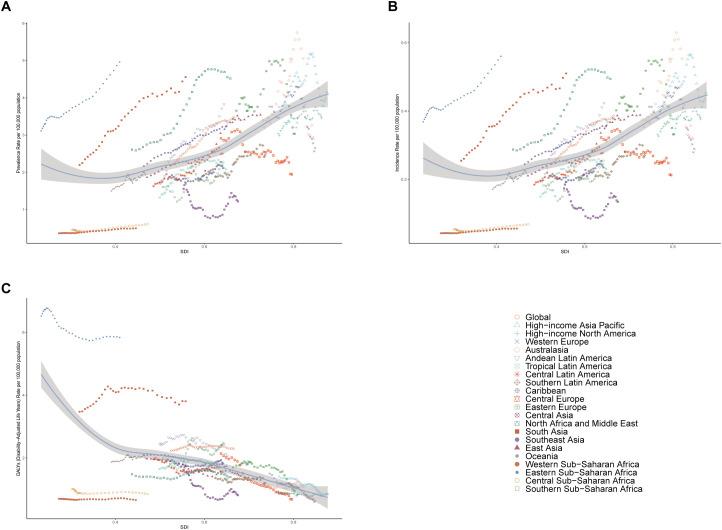
In 2021, the global prevalence, incidence, and disability-adjusted life-years of pediatric and adolescent thyroid cancer reached 91,313 cases, 10,137 cases, and 60,185 years respectively. These figures show 94%, 91%, and 25.2% increases over 1990 figures. Over the 32-year observation period, all three metrics demonstrated sustained upward trajectories, with EAPC of 1.58 (95% UI: 1.48-1.68) for prevalence, 1.52 (95% UI: 1.42-1.62) for incidence, and 0.08 (95% UI: 0.00-0.15) for DALYs. In the 5 SDI regions, the prevalence and incidence are showing an upward trend, while DALYs rates showed divergent patterns: a marginal increase in low-middle SDI regions (EAPC=0.13, 95% UI: -0.07-0.32) contrasted with declining trends in other regions. A notable shift in disease burden has been observed across different regions, with high prevalence, incidence, and DALY rates moving from high-income to low-income countries. Age and sex-stratified analysis demonstrated that in 2021, the 20-24-year age group accounted for over 50% of global prevalence, incidence, and DALY rates, with females bearing a significantly higher disease burden than males. As for the global trend, there was a positive correlation between SDI and prevalence, but an inverse association between SDI and incidence, and an inverse relation between SDI and DALY rate. Decomposition analysis attributed 70.61% of prevalence changes and 69.9% of incidence variations to epidemiological factors, while population growth accounted for 71.83% of DALY rate alterations.
CONCLUSION
Despite the declining prevalence, incidence, and DALY rates in high-income regions, the global disease burden of pediatric and adolescent thyroid cancer continues to rise, particularly among females and within the 20-24 age group. Therefore, implementing targeted interventions in countries or regions with a higher disease burden could contribute to reducing the global disease burden, optimizing resource allocation, and exploring diverse treatment modalities may be pivotal to addressing the issue.
背景
甲状腺癌是内分泌系统最常见的恶性肿瘤。在儿童和青少年中,癌症是癌症相关死亡的第四大主要原因。儿童和青少年甲状腺癌是一种罕见疾病,具有高转移性和侵袭性。目前,针对儿童和青少年甲状腺癌的全球疾病负担及演变趋势,仍缺乏全面分析。
方法
本研究使用全球疾病负担(GBD)数据库(1990 - 2021年)提取儿童和青少年甲状腺癌病例的三个关键指标:患病率、发病率和伤残调整生命年。数据以数值计数和每10万人中的年龄标准化计数表示,并带有95%的不确定性区间(UI)。通过采用估计年度百分比变化(EAPC)和百分比变化指标,评估儿童和青少年甲状腺癌负担的演变趋势。
结果
2021年,全球儿童和青少年甲状腺癌的患病率、发病率和伤残调整生命年分别达到91313例、10137例和60185年。这些数字相较于1990年的数据分别增长了94%、91%和25.2%。在32年的观察期内,所有这三个指标均呈现持续上升趋势,患病率的EAPC为1.58(95% UI:1.48 - 1.68),发病率的EAPC为1.52(95% UI:1.42 - 1.62),伤残调整生命年的EAPC为0.08(95% UI:0.00 - 0.15)。在5个社会人口指数(SDI)区域中,患病率和发病率呈上升趋势,而伤残调整生命年率呈现不同模式:中低SDI区域略有增加(EAPC = 0.13,95% UI: - 0.07 - 0.32),而其他区域呈下降趋势。不同区域的疾病负担出现了显著变化,高患病率、发病率和伤残调整生命年率从高收入国家转移到了低收入国家。年龄和性别分层分析表明,2021年,20 - 24岁年龄组占全球患病率、发病率和伤残调整生命年率的50%以上,女性的疾病负担明显高于男性。就全球趋势而言,SDI与患病率呈正相关,但与发病率呈负相关,与伤残调整生命年率呈负相关。分解分析表明,患病率变化的70.61%和发病率变化的69.9%归因于流行病学因素,而人口增长占伤残调整生命年率变化的71.83%。
结论
尽管高收入地区的患病率、发病率和伤残调整生命年率有所下降,但全球儿童和青少年甲状腺癌的疾病负担仍在上升,尤其是在女性和20 - 24岁年龄组中。因此,在疾病负担较高的国家或地区实施有针对性的干预措施,可能有助于减轻全球疾病负担,优化资源分配,探索多样化的治疗方式对于解决这一问题可能至关重要。



 Zotero 插件