
影响SARS-CoV-2变体适应禽血管紧张素转换酶2的关键刺突受体结合结构域残基的特征分析。
Characterization of key spike RBD residues influencing SARS-CoV-2 variant adaptation to avian ACE2.
作者信息
Yao Weitong, Li Yujun, Sun Huize, Ma Danting, Tang Xiaojuan, Zeng Aiping, Huang Fang
机构信息
Hubei JiangXia Laboratory, Wuhan, Hubei, China.
Biosafety Level 3 Laboratory of Shenzhen University, Shenzhen, Guangdong, China.
出版信息
Front Cell Infect Microbiol. 2025 Jul 29;15:1631926. doi: 10.3389/fcimb.2025.1631926. eCollection 2025.
INTRODUCTION
The beta-coronavirus SARS-CoV-2 has been revealed to infect mammals and other species, which potentially promotes the virus adaptation to broader species and the emergence of new variants. The host range of different SARS-CoV-2 variants are mainly determined by the affinity of the receptor-binding domain (RBD) of the spike protein to the host receptor angiotensin-converting enzyme 2 (ACE2). Thus, this study aims to elucidate the detailed mechanisms of such dynamic adaptation of indicated SARS-CoV-2 variants.
METHODS
In this study, flow cytometry and surface plasmon resonance (SPR) assays were used to assess the binding affinity between RBDs and avian ACE2. Then, infection assays with MLV-based SARS-CoV-2 spike pseudovirus or authentic viruses were performed to verify the avian ACE2 mediated viral entry. Finally, mutagenesis studies were conducted to identify key amino acids of avian ACE2 orthologs and RBDs.
RESULTS
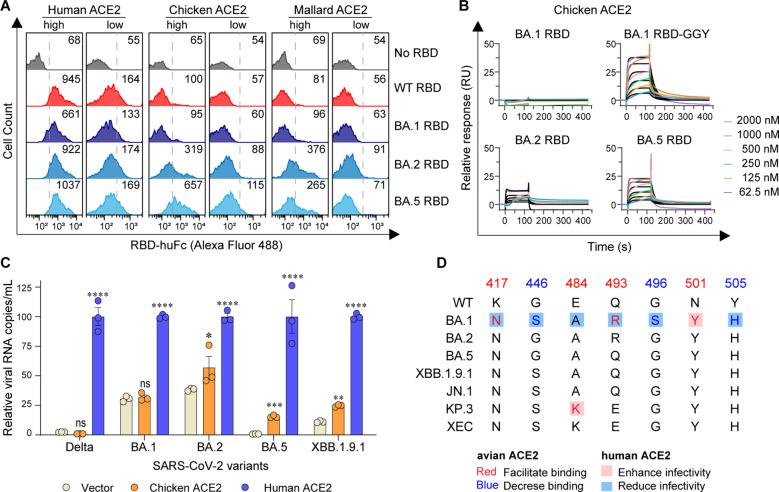
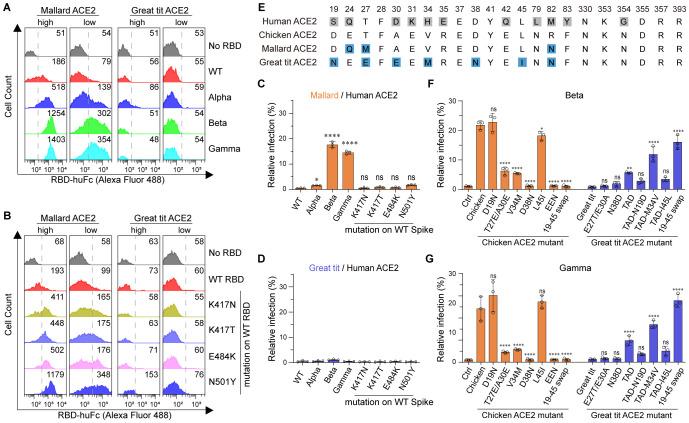
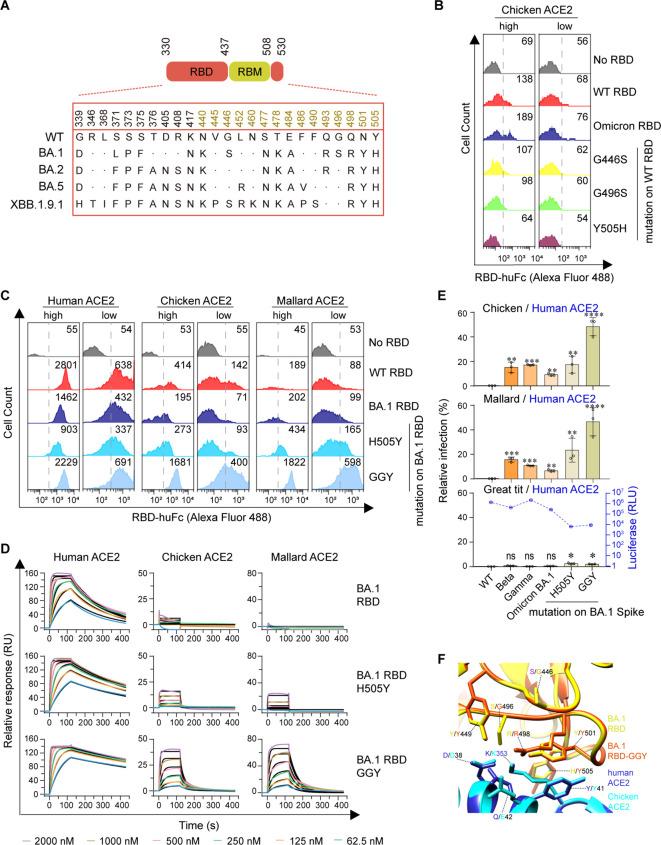
Our previous findings revealed that wild-type SARS-CoV-2 RBD does not bind chicken ACE2. Here, we found that ACE2 orthologs from chicken and mallard were capable to support binding to RBDs of the Alpha, Beta, and Gamma variants, which further enabled the viral entry. On the contrary, the RBD of BA.1 failed to bind avian ACE2. Whereas, a triple-residue reversal mutant (S446G, S496G, H505Y) restored ACE2 binding and enabled efficient viral entry. Additionally, several key residues within RBD were characterized as the determinant of its affinity to avian ACE2.
DISCUSSION
Our findings reveal that higher mutation rates in emerging variants might lead to future cross-species receptor usage or even spillover. Understanding such cross-species transmission mechanisms provides new insights to the virological features and potential host range of emerging SARS-CoV-2 variants.
引言
β冠状病毒严重急性呼吸综合征冠状病毒2(SARS-CoV-2)已被证实可感染哺乳动物和其他物种,这可能促使该病毒适应更广泛的物种并出现新变种。不同SARS-CoV-2变种的宿主范围主要由刺突蛋白的受体结合域(RBD)与宿主受体血管紧张素转换酶2(ACE2)的亲和力决定。因此,本研究旨在阐明上述SARS-CoV-2变种这种动态适应的详细机制。
方法
在本研究中,使用流式细胞术和表面等离子体共振(SPR)分析来评估RBD与禽类ACE2之间的结合亲和力。然后,进行基于莫洛尼鼠白血病病毒(MLV)的SARS-CoV-2刺突假病毒或真实病毒的感染试验,以验证禽类ACE2介导的病毒进入。最后,进行诱变研究以确定禽类ACE2直系同源物和RBD的关键氨基酸。
结果
我们之前的研究结果表明,野生型SARS-CoV-2 RBD不与鸡ACE2结合。在此,我们发现来自鸡和绿头鸭的ACE2直系同源物能够支持与α、β和γ变种的RBD结合,这进一步促成了病毒进入。相反,BA.1的RBD未能与禽类ACE2结合。然而,一个三残基反向突变体(S446G、S496G、H505Y)恢复了ACE2结合并实现了高效的病毒进入。此外,RBD内的几个关键残基被确定为其与禽类ACE2亲和力的决定因素。
讨论
我们的研究结果表明,新出现变种中较高的突变率可能导致未来跨物种受体使用甚至溢出。了解这种跨物种传播机制为新出现的SARS-CoV-2变种的病毒学特征和潜在宿主范围提供了新的见解。

 Zotero 插件