
非阻塞性冠状动脉疾病中终止高血压膳食方法(DASH)干预的长期结果:DISCO-CT研究的随访
Long-Term Outcomes of the Dietary Approaches to Stop Hypertension (DASH) Intervention in Nonobstructive Coronary Artery Disease: Follow-Up of the DISCO-CT Study.
作者信息
Makarewicz-Wujec Magdalena, Henzel Jan, Kępka Cezary, Kruk Mariusz, Jakubczak Barbara, Wróbel Aleksandra, Dąbrowski Rafał, Dzielińska Zofia, Demkow Marcin, Czepielewska Edyta, Filipek Agnieszka
机构信息
Institute of Pharmaceutical Care, VIZJA University, Okopowa Street 59, 01-043 Warsaw, Poland.
Department of Coronary and Structural Heart Diseases, National Institute of Cardiology, 42 Alpejska Street, 04-628 Warsaw, Poland.
出版信息
Nutrients. 2025 Aug 6;17(15):2565. doi: 10.3390/nu17152565.
UNLABELLED
In the original randomised Dietary Intervention to Stop Coronary Atherosclerosis (DISCO-CT) trial, a 12-month Dietary Approaches to Stop Hypertension (DASH) project led by dietitians improved cardiovascular and metabolic risk factors and reduced platelet chemokine levels in patients with coronary artery disease (CAD). It is unclear whether these benefits are sustained.
OBJECTIVE
To determine whether the metabolic, inflammatory, and clinical benefits achieved during the DISCO-CT trial are sustained six years after the structured intervention ended.
METHODS
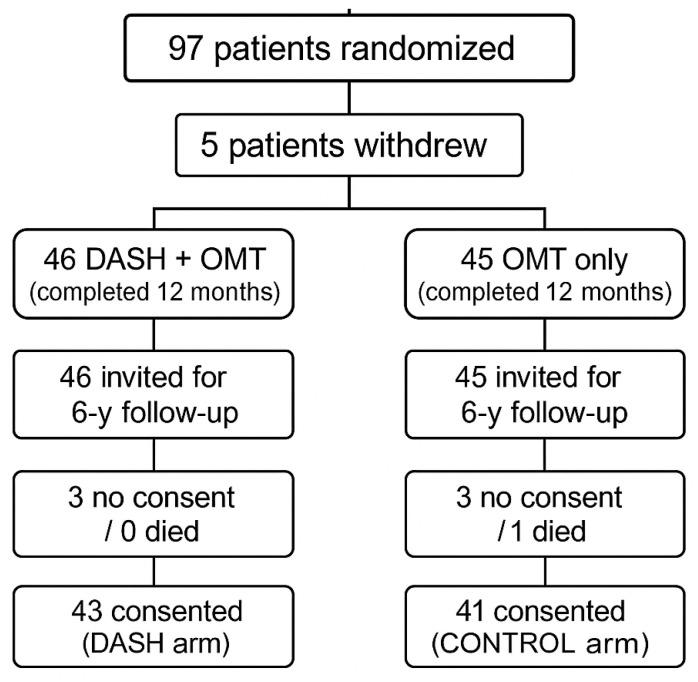
Ninety-seven adults with non-obstructive CAD confirmed in coronary computed tomography angiography were randomly assigned to receive optimal medical therapy (control group, = 41) or the same therapy combined with intensive DASH counselling (DASH group, = 43). After 301 ± 22 weeks, 84 individuals (87%) who had given consent underwent reassessment of body composition, meal frequency assessment, and biochemical testing (lipids, hs-CRP, CXCL4, RANTES and homocysteine). Major adverse cardiovascular events (MACE) were assessed.
RESULTS
During the intervention, the DASH group lost an average of 3.6 ± 4.2 kg and reduced their total body fat by an average of 4.2 ± 4.8 kg, compared to an average loss of 1.1 ± 2.9 kg and a reduction in total body fat of 0.3 ± 4.1 kg in the control group (both < 0.01). Six years later, most of the lost body weight and fat tissue had been regained, and there was a sharp increase in visceral fat area in both groups ( < 0.0001). CXCL4 decreased by 4.3 ± 3.0 ng/mL during the intervention and remained lower than baseline values; in contrast, in the control group, it initially increased and then decreased ( < 0.001 between groups). LDL cholesterol and hs-CRP levels returned to baseline in both groups but remained below baseline in the DASH group. There was one case of MACE in the DASH group, compared with four cases (including one fatal myocardial infarction) in the control group ( = 0.575). Overall adherence to the DASH project increased by 26 points during counselling and then decreased by only four points, remaining higher than in the control group.
CONCLUSIONS
A one-year DASH project supported by a physician and dietitian resulted in long-term suppression of the proatherogenic chemokine CXCL4 and fewer MACE over six years, despite a decline in adherence and loss of most anthropometric and lipid benefits. It appears that sustained systemic reinforcement of behaviours is necessary to maintain the benefits of lifestyle intervention in CAD.
未标注
在最初的随机化饮食干预以阻止冠状动脉粥样硬化(DISCO - CT)试验中,由营养师主导的为期12个月的终止高血压饮食方法(DASH)项目改善了冠状动脉疾病(CAD)患者的心血管和代谢危险因素,并降低了血小板趋化因子水平。尚不清楚这些益处是否能持续。
目的
确定在DISCO - CT试验期间所获得的代谢、炎症和临床益处,在结构化干预结束六年后是否仍然存在。
方法
97名在冠状动脉计算机断层扫描血管造影中确诊为非阻塞性CAD的成年人被随机分配接受最佳药物治疗(对照组,n = 41)或相同治疗并联合强化DASH咨询(DASH组,n = 43)。在301±22周后,84名(87%)已给予同意的个体接受了身体成分重新评估、进餐频率评估以及生化检测(血脂、高敏C反应蛋白、CXCL4、调节活化正常T细胞表达和分泌因子及同型半胱氨酸)。评估主要不良心血管事件(MACE)。
结果
在干预期间,DASH组平均体重减轻3.6±4.2 kg,全身脂肪平均减少4.2±4.8 kg,而对照组平均体重减轻1.1±2.9 kg,全身脂肪减少0.3±4.1 kg(均P<0.01)。六年后,大部分减轻的体重和脂肪组织又重新恢复,两组内脏脂肪面积均急剧增加(P<0.0001)。干预期间CXCL4降低了4.3±3.0 ng/mL,且仍低于基线值;相比之下,对照组其最初升高然后降低(组间P<0.001)。两组的低密度脂蛋白胆固醇和高敏C反应蛋白水平均恢复到基线,但DASH组仍低于基线。DASH组有1例MACE,而对照组有4例(包括1例致命性心肌梗死)(P = 0.575)。在咨询期间,对DASH项目的总体依从性提高了26分,然后仅下降了4分,仍高于对照组。
结论
由医生和营养师支持的为期一年的DASH项目导致促动脉粥样硬化趋化因子CXCL4长期受到抑制,且六年间MACE较少,尽管依从性下降,且大多数人体测量和血脂方面的益处消失。看来,持续的系统性行为强化对于维持CAD生活方式干预的益处是必要的。
 Zotero 插件