
通过混合生成模型进行潜在多功能抗菌肽候选物的计算设计
Computational Design of Potentially Multifunctional Antimicrobial Peptide Candidates via a Hybrid Generative Model.
作者信息
Ying Fangli, Go Wilten, Li Zilong, Ouyang Chaoqian, Phaphuangwittayakul Aniwat, Dhuny Riyad
机构信息
Department of Computer Science and Engineering, State Key Laboratory of Bioreactor Engineering, East China University of Science and Technology, Shanghai 200237, China.
International College of Digital Innovation, Chiang Mai University, Chiang Mai 50200, Thailand.
出版信息
Int J Mol Sci. 2025 Jul 30;26(15):7387. doi: 10.3390/ijms26157387.
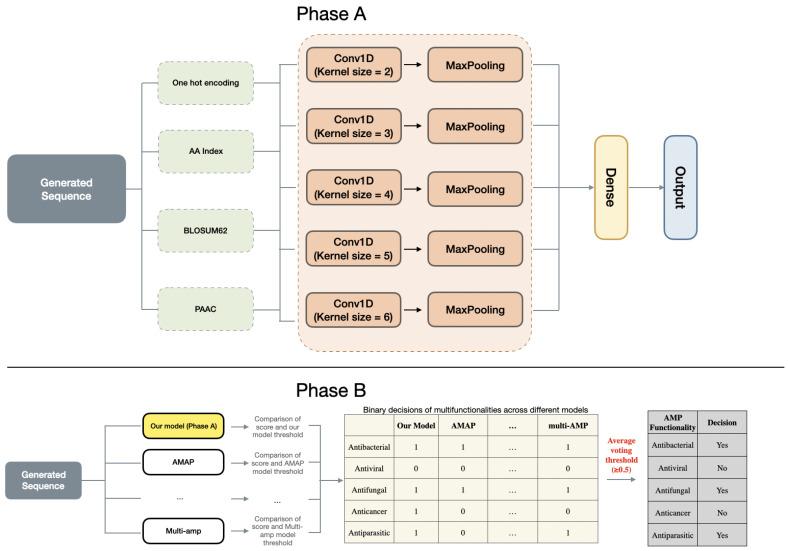
Antimicrobial peptides (AMPs) provide a robust alternative to conventional antibiotics, combating escalating microbial resistance through their diverse functions and broad pathogen-targeting abilities. While current deep learning technologies enhance AMP generation, they face challenges in developing multifunctional AMPs due to intricate amino acid interdependencies and limited consideration of diverse functional activities. To overcome this challenge, we introduce a novel de novo multifunctional AMP design framework that enhances a Feedback Generative Adversarial Network (FBGAN) by integrating a global quantitative AMP activity regression module and a multifunctional-attribute integrated prediction module. This integrated approach not only facilitates the automated generation of potential AMP candidates, but also optimizes the network's ability to assess their multifunctionality. Initially, by integrating an effective pre-trained regression and classification model with feedback-loop mechanisms, our model can not only identify potential valid AMP candidates, but also optimizes computational predictions of Minimum Inhibitory Concentration (MIC) values. Subsequently, we employ a combinatorial predictor to simultaneously identify and predict five multifunctional AMP bioactivities, enabling the generation of multifunctional AMPs. The experimental results demonstrate the efficiency of generating AMPs with multiple enhanced antimicrobial properties, indicating that our work can provide a valuable reference for combating multi-drug-resistant infections.
抗菌肽(AMPs)为传统抗生素提供了一种强大的替代方案,通过其多样的功能和广泛的病原体靶向能力来对抗不断升级的微生物耐药性。虽然当前的深度学习技术增强了抗菌肽的生成,但由于复杂的氨基酸相互依赖性以及对多样功能活性的考虑有限,它们在开发多功能抗菌肽方面面临挑战。为了克服这一挑战,我们引入了一种新颖的从头多功能抗菌肽设计框架,通过整合全局定量抗菌肽活性回归模块和多功能属性综合预测模块来增强反馈生成对抗网络(FBGAN)。这种整合方法不仅有助于自动生成潜在的抗菌肽候选物,还优化了网络评估其多功能性的能力。首先,通过将有效的预训练回归和分类模型与反馈回路机制相结合,我们的模型不仅可以识别潜在的有效抗菌肽候选物,还能优化最小抑菌浓度(MIC)值的计算预测。随后,我们采用组合预测器同时识别和预测五种多功能抗菌肽生物活性,从而实现多功能抗菌肽的生成。实验结果证明了生成具有多种增强抗菌特性的抗菌肽的效率,表明我们的工作可为对抗多重耐药感染提供有价值的参考。




 Zotero 插件