
帕金森病中的左旋多巴与植物源生物活性化合物:作用机制、疗效及未来展望
Levodopa and Plant-Derived Bioactive Compounds in Parkinson's Disease: Mechanisms, Efficacy, and Future Perspectives.
作者信息
Aktaş Emre, Hanağası Haşmet Ayhan, Özgentürk Nehir Özdemir
机构信息
Faculty of Art and Science, Molecular Biology and Genetics, Yıldız Technical University, Istanbul, Turkey.
Behavioral Neurology and Movement Disorders Unit, Department of Neurology, Istanbul Faculty of Medicine, Istanbul University, Istanbul, Turkey.
出版信息
CNS Neurosci Ther. 2025 Aug;31(8):e70540. doi: 10.1111/cns.70540.
BACKGROUND
Parkinson's disease (PD) is a progressive neurodegenerative disorder characterized by the degeneration of dopaminergic neurons in the substantia nigra, resulting in dopamine deficiency and motor dysfunction. While levodopa (L-DOPA) remains the gold standard for symptomatic treatment, its long-term administration is associated with complications such as motor fluctuations, dyskinesia, and oxidative stress. Given these limitations, interest has grown in plant-derived bioactive compounds for their potential neuroprotective and disease-modifying effects.
METHODS
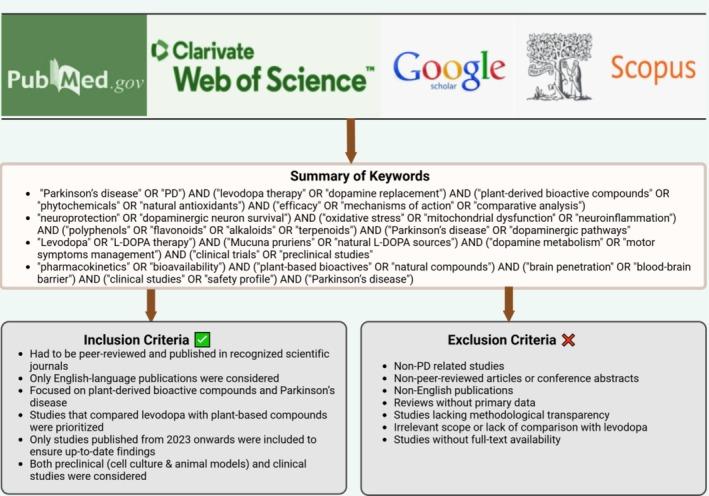
A systematic literature review was conducted across PubMed, Scopus, Google Scholar, and Web of Science, focusing on peer-reviewed studies published between 2023 and March 2025. The inclusion criteria targeted in vitro and in vivo preclinical studies as well as clinical trials that directly compared levodopa with plant-derived compounds in the context of PD. Key search terms included "Parkinson's disease," "levodopa," "phytochemicals," and "plant-based neuroprotection".
RESULTS
Recent studies have highlighted several classes of plant-based compounds-including polyphenols (resveratrol, curcumin, EGCG), flavonoids (quercetin, apigenin, naringenin), alkaloids (berberine, caffeine, L-DOPA derived from Mucuna pruriens), and terpenoids (ginkgolide B, celastrol)-as potential neuroprotective agents. These compounds exert multiple actions, such as reducing oxidative stress, blocking neuroinflammation, preventing α-synuclein aggregation, and protecting mitochondria. Although levodopa effectively addresses motor symptoms, these phytochemicals may complement conventional therapy by targeting underlying disease processes.
CONCLUSIONS
Although levodopa is indispensable for the symptomatic management of PD, emerging evidence supports the integration of plant-derived bioactive compounds as adjunct therapies with disease-modifying potential. Future research should prioritize improving bioavailability, developing standardized formulations, and conducting long-term clinical trials to evaluate the translational applicability of these natural agents in Parkinson's disease therapy.
背景
帕金森病(PD)是一种进行性神经退行性疾病,其特征是黑质中多巴胺能神经元变性,导致多巴胺缺乏和运动功能障碍。虽然左旋多巴(L-DOPA)仍然是症状性治疗的金标准,但其长期使用会带来运动波动、异动症和氧化应激等并发症。鉴于这些局限性,人们对植物源生物活性化合物因其潜在的神经保护和疾病修饰作用越来越感兴趣。
方法
在PubMed、Scopus、谷歌学术和科学网进行了系统的文献综述,重点关注2023年至2025年3月发表的同行评审研究。纳入标准针对体外和体内临床前研究以及在帕金森病背景下直接将左旋多巴与植物源化合物进行比较的临床试验。关键搜索词包括“帕金森病”、“左旋多巴”、“植物化学物质”和“基于植物的神经保护”。
结果
最近的研究强调了几类植物源化合物,包括多酚(白藜芦醇、姜黄素、表没食子儿茶素没食子酸酯)、黄酮类化合物(槲皮素、芹菜素、柚皮素)、生物碱(小檗碱、咖啡因、源自刺蒺藜的L-多巴)和萜类化合物(银杏内酯B、雷公藤红素)作为潜在的神经保护剂。这些化合物发挥多种作用,如减少氧化应激、阻断神经炎症、防止α-突触核蛋白聚集和保护线粒体。虽然左旋多巴有效地解决了运动症状,但这些植物化学物质可能通过针对潜在的疾病过程来补充传统疗法。
结论
虽然左旋多巴对于帕金森病的症状管理不可或缺,但新出现的证据支持将植物源生物活性化合物作为具有疾病修饰潜力的辅助疗法。未来的研究应优先提高生物利用度、开发标准化制剂,并进行长期临床试验,以评估这些天然药物在帕金森病治疗中的转化适用性。



 Zotero 插件