
导航支气管镜检查对肺结节诊断率的叙述性综述——呼吁标准化
Narrative review of diagnostic yield of navigational bronchoscopy for pulmonary nodules-a call for standardization.
作者信息
Funes-Ferrada Rodrigo, Barrios-Ruiz Alanna, Yu Lee-Mateus Alejandra, Valdes-Camacho Sofia, Vaca-Cartagena Bryan F, Robertson Kelly S, Fernandez-Bussy Sebastian, Abia-Trujillo David
机构信息
Division of Pulmonary, Allergy, and Sleep Medicine, Mayo Clinic Florida, Jacksonville, FL, USA.
出版信息
J Thorac Dis. 2025 Jul 31;17(7):5361-5370. doi: 10.21037/jtd-24-1469. Epub 2025 Jul 28.
BACKGROUND AND OBJECTIVE
Lung cancer remains the leading cause of cancer-related mortality worldwide, with peripheral pulmonary lesions (PPLs) being increasingly identified through screening programs. Navigational bronchoscopy, including electromagnetic and robotic-assisted bronchoscopy, is pivotal for biopsying these lesions. However, inconsistent definitions of diagnostic yield (DY) across studies hinder accurate assessment of bronchoscopy performance. This narrative review aims to clarify current DY definitions and advocate for a standardized approach.
METHODS
A narrative review of articles from January 2019 to July 2024 was conducted using PubMed, focusing on DY and its calculation in bronchoscopic procedures.
KEY CONTENT AND FINDINGS
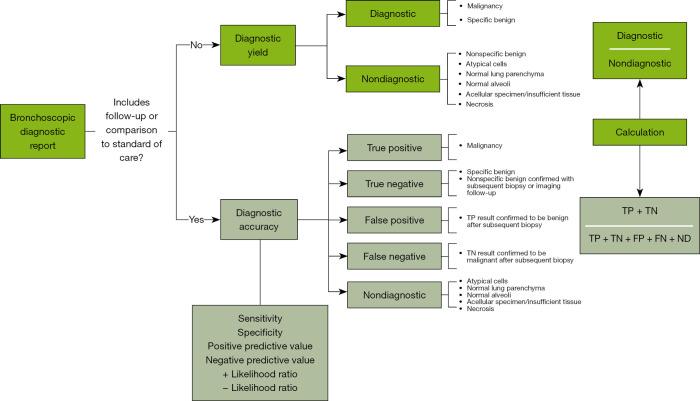
This review highlights significant inconsistencies in DY definitions, with some studies including follow-up assessments and nonspecific benign (NSB) findings, while others only consider immediate specific benign (SB) and malignant results. These discrepancies result in wide-ranging reported DY values, from 26.7% to 97%. Additionally, the review underscores the importance of distinguishing between DY and diagnostic accuracy (DA), as they assess different aspects of procedural performance and should not be used interchangeably. Simulation studies also demonstrate that cancer prevalence and methodological differences in DY calculation substantially affect study outcomes. Standardizing DY as a measure based solely on immediate SB and malignant findings-without follow-up-would allow faster study times and for easier comparison across different studies. Reporting disease prevalence within the study population is highly relevant as higher prevalence may inflate reported DY values.
CONCLUSIONS
A standardized, strict definition of DY is crucial for accurately evaluating the diagnostic capacity of bronchoscopy. DY should not be confused with DA, as they measure distinct elements of performance. Adopting a strict definition of DY will enhance the comparability of study results, promote evidence-based decision-making, and help reduce unnecessary procedures while improving the reliability of diagnostic assessments in clinical practice.
背景与目的
肺癌仍然是全球癌症相关死亡的主要原因,通过筛查计划越来越多地发现外周肺病变(PPL)。导航支气管镜检查,包括电磁导航和机器人辅助支气管镜检查,对于这些病变的活检至关重要。然而,各研究中诊断率(DY)的定义不一致,阻碍了对支气管镜检查性能的准确评估。本叙述性综述旨在阐明当前的DY定义,并倡导采用标准化方法。
方法
使用PubMed对2019年1月至2024年7月的文章进行叙述性综述,重点关注支气管镜检查程序中的DY及其计算。
关键内容与发现
本综述强调了DY定义中的显著不一致,一些研究包括随访评估和非特异性良性(NSB)结果,而另一些研究仅考虑即时特异性良性(SB)和恶性结果。这些差异导致报告的DY值范围广泛,从26.7%到97%。此外,综述强调了区分DY和诊断准确性(DA)的重要性,因为它们评估程序性能的不同方面,不应互换使用。模拟研究还表明,癌症患病率和DY计算方法的差异会显著影响研究结果。将DY标准化为仅基于即时SB和恶性结果(无随访)的指标,将缩短研究时间,并便于不同研究之间的比较。报告研究人群中的疾病患病率非常重要,因为较高的患病率可能会夸大报告的DY值。
结论
对DY进行标准化、严格的定义对于准确评估支气管镜检查的诊断能力至关重要。DY不应与DA混淆,因为它们衡量的是性能的不同要素。采用严格的DY定义将提高研究结果的可比性,促进循证决策,并有助于减少不必要的程序,同时提高临床实践中诊断评估的可靠性。
 Zotero 插件