
放射治疗及放射治疗联合热疗延缓转移性黑色素瘤患者全身治疗方案改变的疗效
Efficacy of radiotherapy and radiotherapy with hyperthermia to delay change of systemic therapy in patients with metastatic melanoma.
作者信息
Chmiel Paulina, Spałek Mateusz Jacek, Koseła-Paterczyk Hanna, Rutkowski Piotr Łukasz, Jagodzińska-Mucha Paulina, Rogala Paweł, Kozak Katarzyna, Telejko Maria, Borkowska Aneta Maria
机构信息
Department of Soft Tissue/Bone Sarcoma and Melanoma, Maria Sklodowska-Curie National Research Institute of Oncology, Warsaw, Poland.
Department of Radiotherapy I, Maria Sklodowska-Curie National Research Institute of Oncology, Warsaw, Poland.
出版信息
Clin Transl Radiat Oncol. 2025 Aug 5;55:101024. doi: 10.1016/j.ctro.2025.101024. eCollection 2025 Nov.
BACKGROUND
The use of radiotherapy (RT) and RT with hyperthermia (HT) as a local treatment for oligoprogression in many tumors is becoming increasingly prevalent. However, there is currently limited data regarding RT efficacy in prolonging systemic therapy in melanoma. To address this lack of evidence, we conducted a single-institution study to establish the role of RT and RT + HT in delaying the time to systemic treatment switch in metastatic melanoma (MM).
METHODS
Patients with MM who received RT or RT + HT for oligoprogressive lesions at the referral center between 2018 and 2023 were identified. Oligoprogression was defined as up to five progressive metastases. Systemic treatment included immunotherapy and BRAF/MEK inhibitors. All patients who received radiotherapy to the brain and lungs were excluded. The primary endpoint was time to the next systemic therapy (TTNST) after RT/RT + HT. The secondary endpoints included overall survival (OS) and progression-free survival (PFS). Factors influencing TTNST were analyzed.
RESULTS
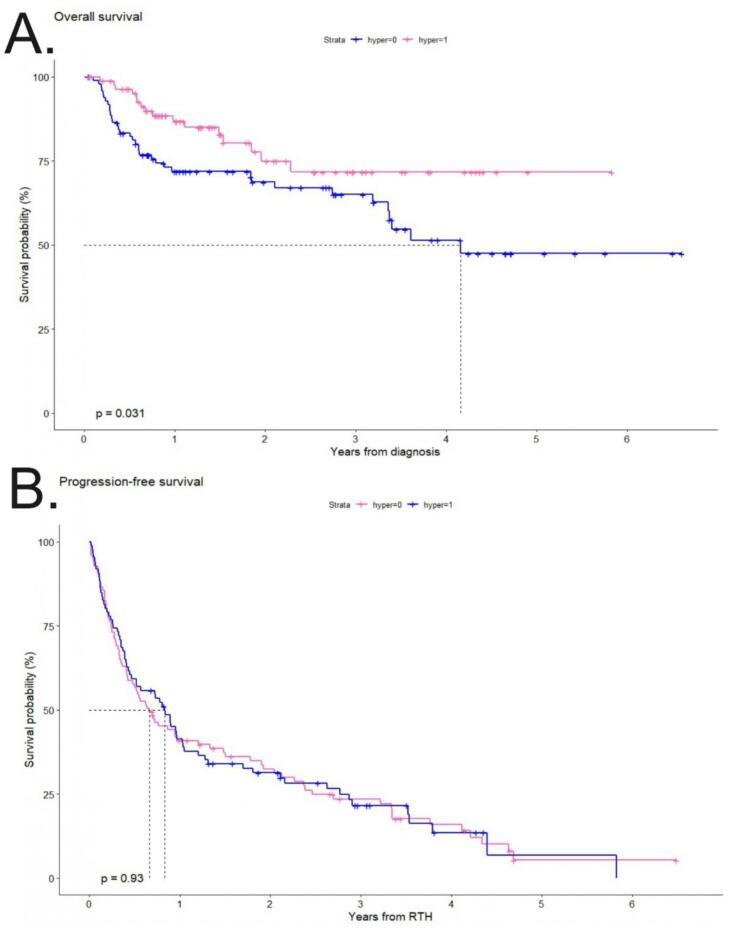
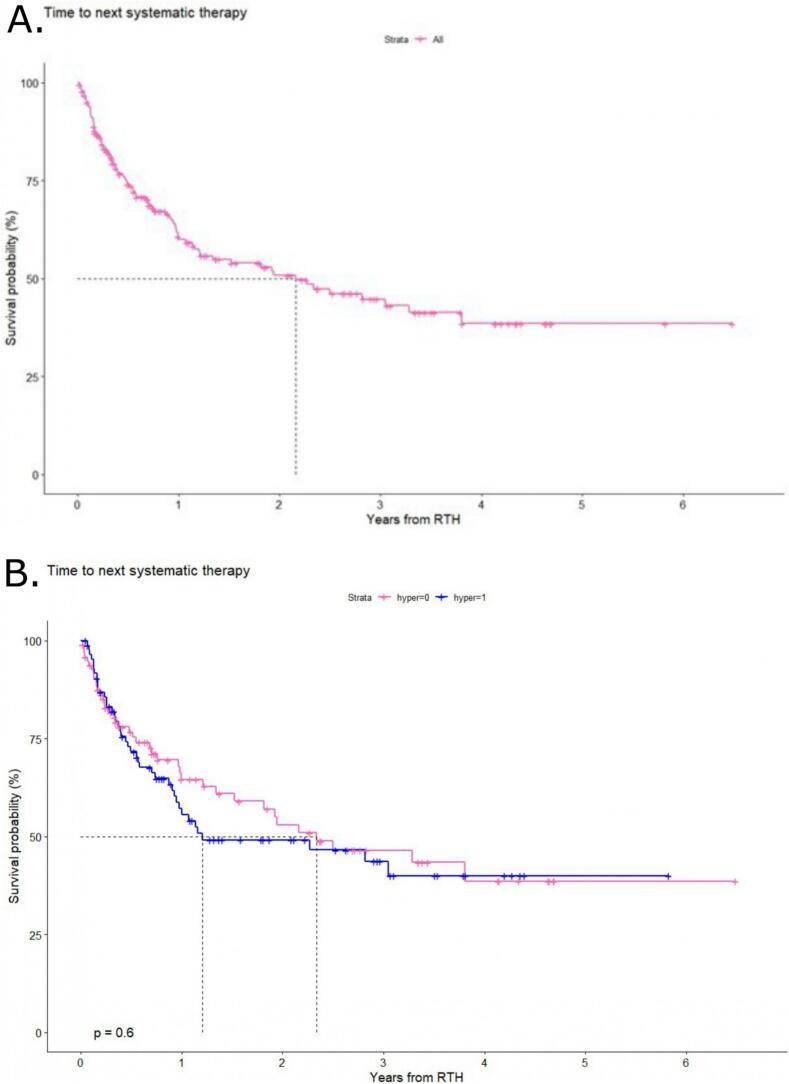
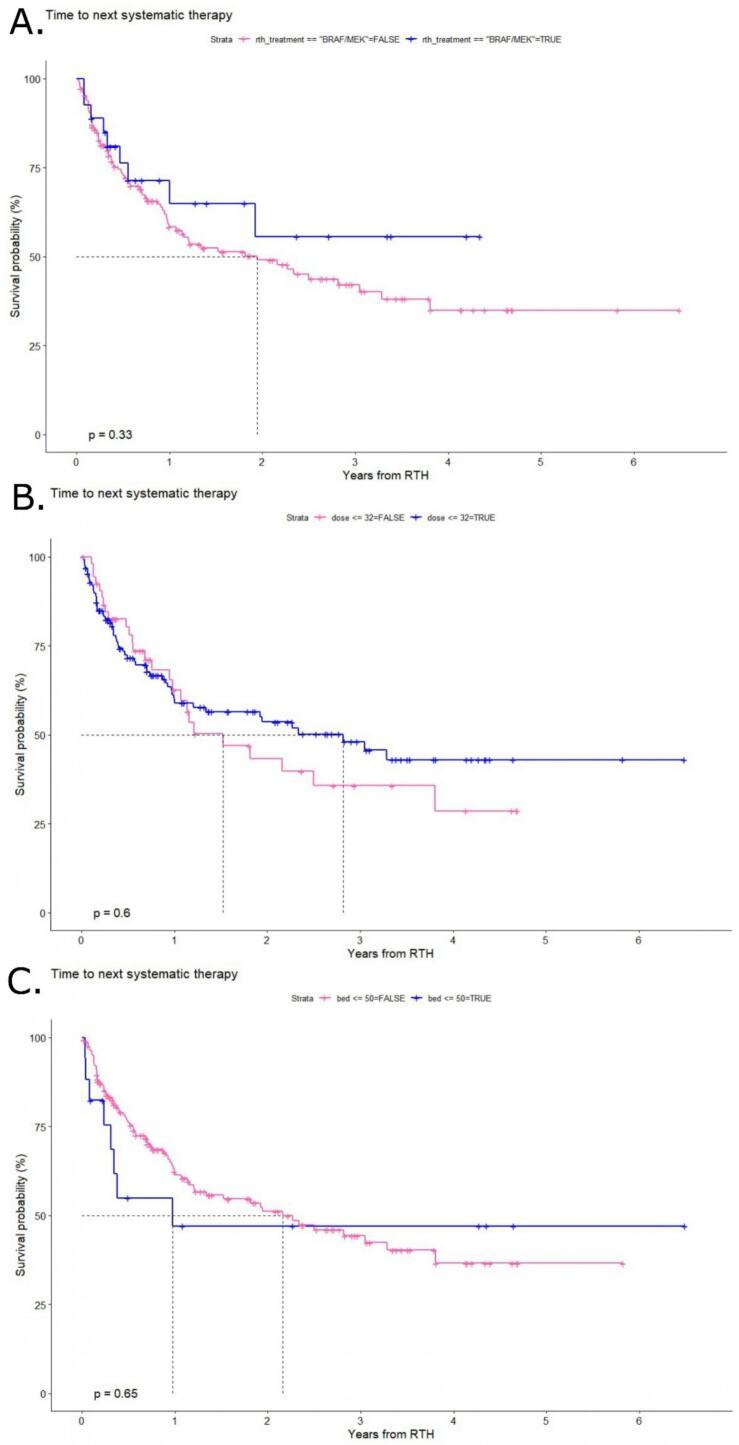
156 patients were included, 82 patients had RT + HT while 74 had RT only. The median follow-up was 23 months (15.2-34). Immunotherapy was used in 82.7 % and BRAF/MEK inhibitors in 17.3 % of patients. The median TTNST for the overall cohort was 26 months (95 % CI: 14.5- NA), the mTTNST for patients treated with RT + HT was 14 months (95 % CI: 11.4-NA), and for patients treated with RT as sole treatment, it was 28 months (95 % CI: 18.3-NA) (p = 0.6). The median PFS from local treatment was 8 months (95 % CI: 5.1-16) for patients who received RT and 10 months (95 % CI: 5.6-12.6) for patients who received RT + HT (p = 0.9). The median OS from RT was 50 months (95 % CI: 40- NA) for patients who received RT and was not reached for patients who received RT + HT (p = 0.031). None of the analyzed factors influenced median TTNST.
CONCLUSION
Both RT and RT + HT have been demonstrated to extend the duration of systemic treatment in patients with metastatic melanoma. The combination of RT + HT is suggested to be more efficacious than RT alone in the therapy of oligoprogressive disease during systemic treatment of patients, especially for OS.
背景
放射治疗(RT)以及放射治疗联合热疗(HT)作为多种肿瘤寡进展的局部治疗方法,其应用越来越普遍。然而,目前关于RT在延长黑色素瘤全身治疗方面疗效的数据有限。为了填补这一证据空白,我们开展了一项单机构研究,以确定RT和RT + HT在延迟转移性黑色素瘤(MM)全身治疗转换时间方面的作用。
方法
确定2018年至2023年在转诊中心因寡进展性病变接受RT或RT + HT治疗的MM患者。寡进展定义为最多五个进展性转移灶。全身治疗包括免疫治疗和BRAF/MEK抑制剂。所有接受脑部和肺部放疗的患者均被排除。主要终点是RT/RT + HT后至下一次全身治疗的时间(TTNST)。次要终点包括总生存期(OS)和无进展生存期(PFS)。分析影响TTNST的因素。
结果
纳入156例患者,82例接受RT + HT,74例仅接受RT。中位随访时间为23个月(15.2 - 34个月)。82.7%的患者使用免疫治疗,17.3%的患者使用BRAF/MEK抑制剂。整个队列的中位TTNST为26个月(95%CI:14.5 - 无上限),接受RT + HT治疗的患者mTTNST为14个月(95%CI:11.4 - 无上限),仅接受RT治疗的患者为28个月(95%CI:18.3 - 无上限)(p = 0.6)。接受RT的患者局部治疗后的中位PFS为8个月(95%CI:5.1 - 16个月),接受RT + HT的患者为10个月(95%CI:5.6 - 12.6个月)(p = 0.9)。接受RT的患者从RT开始的中位OS为50个月(95%CI:40 - 无上限),接受RT + HT的患者未达到(p = 0.031)。分析的因素均未影响中位TTNST。
结论
RT和RT + HT均已证明可延长转移性黑色素瘤患者的全身治疗持续时间。在患者全身治疗期间,对于寡进展性疾病的治疗,建议RT + HT联合治疗比单独RT更有效,尤其是在OS方面。

 Zotero 插件