
循环肿瘤DNA(ctDNA)检测在精准肿瘤学中的应用:来自印度一家三级癌症中心的四年经验。
Implementation of circulating tumor DNA (ctDNA) testing in precision oncology: A four-year experience from a tertiary cancer center in India.
作者信息
Joshi Pradnya, Gogte Prachi, Pawar Prachi, Gurav Mamta, Iyer Ramya, Singh Shambhavi, Hatkar Sonam, Shetty Ujwal, Nair Aruna, Mulay Mansi, Jaiswar Snehal, Pai Trupti, Deshpande Gauri, Karnik Nupur, Shah Prarthna, Arora Aditi, Juneja Archita, Desai Sangeeta, Shetty Omshree, Shet Tanuja
机构信息
Molecular Pathology Laboratory, Department of Pathology, Homi Bhabha National Institute, Tata Memorial Hospital, Mumbai, India.
Department of Medical and Precision Oncology, Sir HN Reliance Foundation Hospital and Research Centre, Mumbai, 400004, Maharashtra, India.
出版信息
J Liq Biopsy. 2025 Jul 26;9:100319. doi: 10.1016/j.jlb.2025.100319. eCollection 2025 Sep.
INTRODUCTION
Liquid biopsy testing has emerged as a pivotal tool in molecular characterization of solid malignancies. Circulating tumor DNA (ctDNA) analysis is quintessential in precision oncology for early detection, disease monitoring, prognosis, and theranostic purposes. This study summarizes ctDNA analysis performed on patients with advanced or metastatic solid tumors at tertiary cancer centers in India (2021-2024).
METHODS
ctDNA was isolated following standard pre-analytical protocols and quality control measures. Sequencing was performed using the Oncomine Precision Assay on Thermo Fisher platform and Custom Solid Tumor Panel (SOPHiA Genetics) on Illumina platforms. Variant annotation and clinical interpretation were performed as per ACMG and AMP Guidelines.
RESULTS
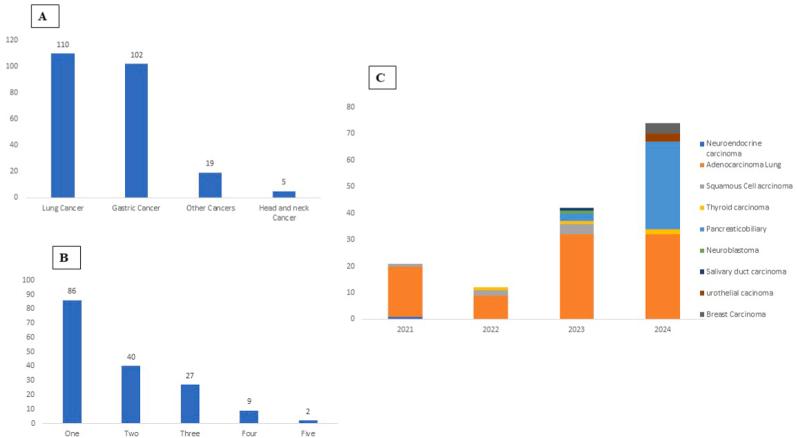
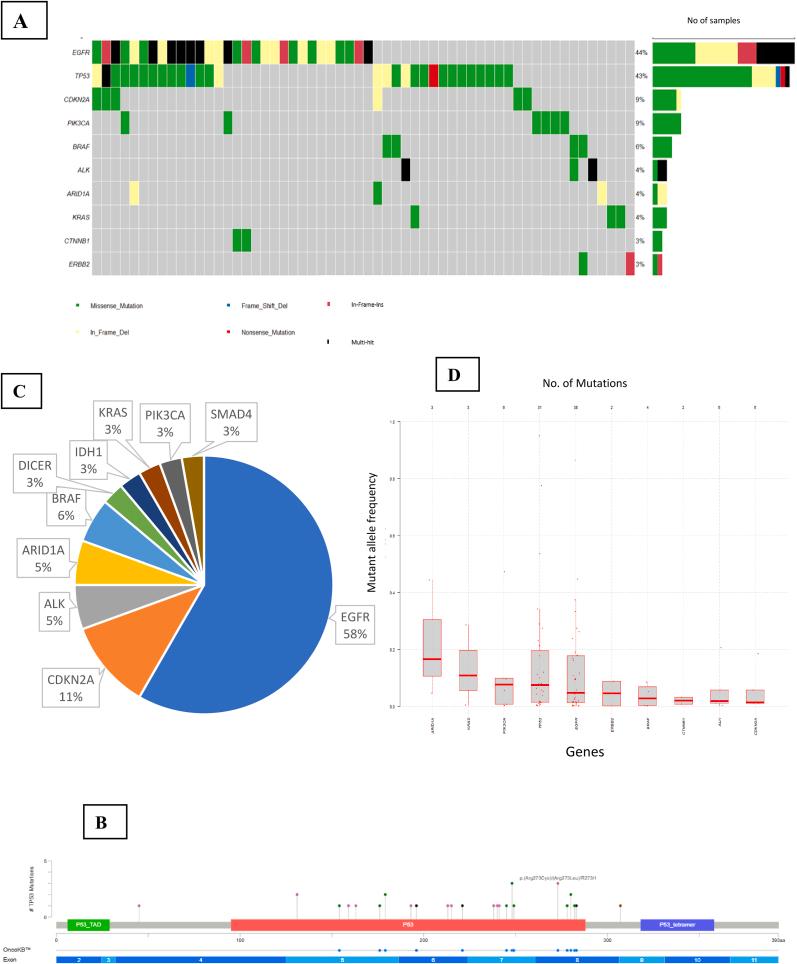
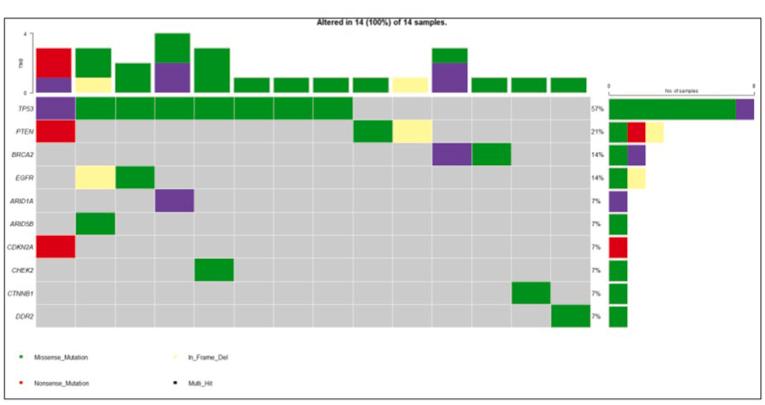
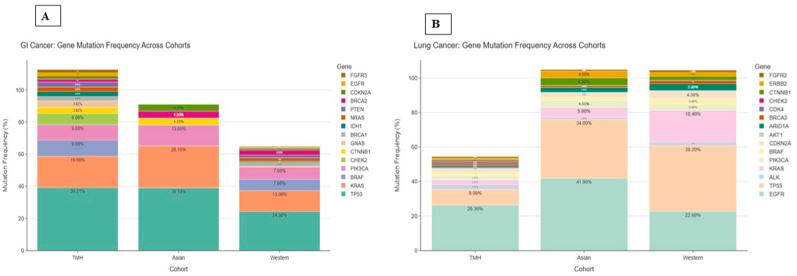
Out of 236 ctDNA samples, majority were lung malignancies (47 %), gastric cancers (43 %), head & neck cancers (2 %), other malignancies (8 %). A total of 250 clinically relevant genomic alterations were reported. On Illumina, 19.8 % of variants were classified as Tier I, 18.3 % Tier II, and 11.7 % as Tier III. Thermofisher platform identified Tier I alterations in 33 %, Tier II in 54 %, and Tier III in 11 % cases. In the GI cohort, was most frequently mutated (51 %), followed by (25 %), (13 %), (13 %), and (9 %). Among lung cancer patients, mutations (44 %), followed by (43 %), (9 %), (9 %), and (6 %).Tissue-liquid biopsy concordance was observed in 36 of 96 cases for which baseline tissue NGS data was available. The mutational landscape derived from this cohort was compared with the MSKCC dataset for Asian and Western populations. The comparison revealed high concordance, clinical relevance, and reliability of liquid biopsy-based genomic profiling in diverse oncologic settings.
CONCLUSION
Study underscores substantial increase in the adoption of liquid biopsy and the real-world utility of ctDNA-based NGS testing in solid tumors contributing to improved patient care management.
引言
液体活检检测已成为实体恶性肿瘤分子特征分析的关键工具。循环肿瘤DNA(ctDNA)分析在精准肿瘤学中对于早期检测、疾病监测、预后评估及治疗诊断目的而言至关重要。本研究总结了在印度三级癌症中心对晚期或转移性实体瘤患者进行的ctDNA分析(2021 - 2024年)。
方法
按照标准的分析前方案和质量控制措施分离ctDNA。使用赛默飞平台上的Oncomine Precision Assay以及Illumina平台上的定制实体瘤检测板(SOPHiA Genetics)进行测序。根据美国医学遗传学与基因组学学会(ACMG)和美国分子病理学会(AMP)指南进行变异注释和临床解读。
结果
在236份ctDNA样本中,大多数为肺癌(47%)、胃癌(43%)、头颈癌(2%)、其他恶性肿瘤(8%)。共报告了250种临床相关的基因组改变。在Illumina平台上,19.8%的变异被归类为I级,18.3%为II级,11.7%为III级。赛默飞平台在33%的病例中鉴定出I级改变,54%为II级,11%为III级。在胃肠道队列中, 最常发生突变(51%),其次是 (2�%)、 (13%)、 (13%)和(9%)。在肺癌患者中, 突变(44%),其次是 (43%)、 (9%)、 (9%)和 (6%)。在96例有基线组织NGS数据的病例中,36例观察到组织 - 液体活检一致性。将该队列得出的突变图谱与亚洲和西方人群的MSKCC数据集进行比较。比较结果显示,在不同肿瘤学环境中,基于液体活检的基因组分析具有高度一致性、临床相关性和可靠性。
结论
研究强调了液体活检应用的显著增加以及基于ctDNA的NGS检测在实体瘤中的实际应用价值,有助于改善患者护理管理。



 Zotero 插件