
人脐带血单个核细胞组分的免疫组成
Immune composition of the mononuclear cell fraction of human umbilical cord blood.
作者信息
Kikuta Karen, Lee Esmond, Menezes Talia, Fung Hannah, Amorin Alvaro, Agrawal Aditi, Roth Theodore L, Porteus Matthew
机构信息
Center for Definitive and Curative Medicine, Stanford University School of Medicine, Stanford, CA, United States.
Institute for Stem Cell Biology and Regenerative Medicine, Stanford University School of Medicine, Stanford, CA, United States.
出版信息
Front Immunol. 2025 Aug 1;16:1614230. doi: 10.3389/fimmu.2025.1614230. eCollection 2025.
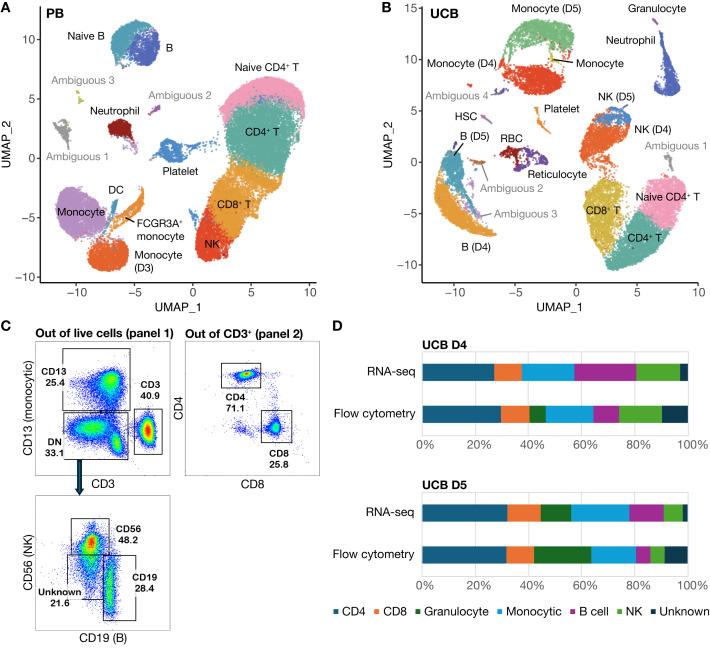
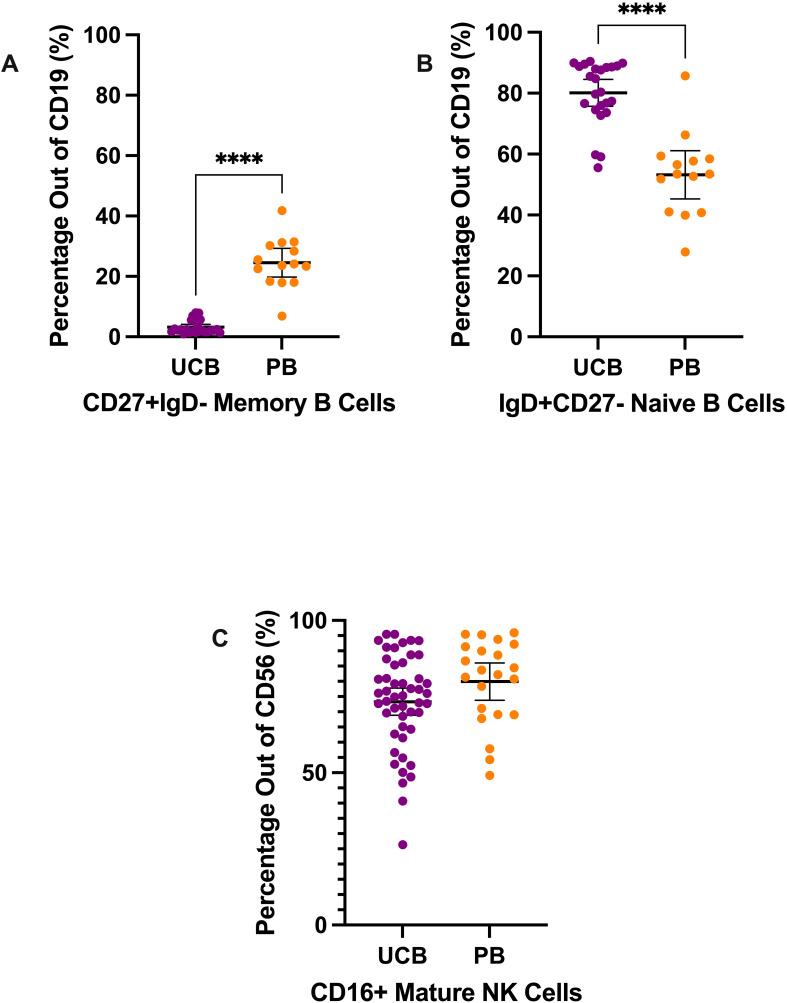
Despite its therapeutic potential and unique immunological properties, the immune composition of umbilical cord blood lacks consistent and comprehensive characterizations. Human umbilical cord blood (UCB) is often discarded after delivery and is difficult to obtain for research purposes. Furthermore, most research on UCB is focused on properties of CD34+ hematopoietic stem cells for transplantation. The Binns Program for Cord Blood Research at Stanford University has the unique advantage of regular collection and isolation of mononuclear cells (MNC) from UCB donors. This study provides a robust characterization of the immune subset compositions of the CD34-negative MNC fraction of UCB (n=50). The study also compares the UCB data to adult peripheral blood (PB) mononuclear cells to identify differences in immune maturity. Using flow cytometry and single-cell RNA sequencing (scRNA-Seq), we analyzed UCB and adult PB MNC samples to characterize the cell surface protein and transcriptomic profiles of different immune subsets. Our study findings bring a higher-definition understanding of the unique immunological properties of umbilical cord blood. Study findings reveal a distinct immune profile in UCB, such as a higher average percentage of CD19 B Lymphocytes, CD4 T Cells, CD4 Naive T Cells, CD4 Recent Thymic Emigrants, CD8 Naive T Cells, CD8 Recent Thymic Emigrants, and CD19 Naive B Cells compared to adult PB. Additionally, there were fewer CD19 Memory B Cells in UCB compared to PB. The scRNA-Seq showed concordance in the proportion of immune cell types but captured more differentiated subtypes of cells. Additionally, scRNA-Seq showed unique clustering patterns in UCB, which reflect cell types that converge in adulthood as the immune system matures. These analyses yield the intriguing possibility that the immune heterogeneity of individuals at birth gives way to more stereotyped immune subsets as the immune system is exposed to the external environment and undergoes maturation. Overall, our findings provide a robust characterization of MNC UCB immune subsets and insights into how immune function develops from birth to adulthood.
尽管脐带血具有治疗潜力和独特的免疫特性,但其免疫组成缺乏一致且全面的表征。人类脐带血(UCB)通常在分娩后被丢弃,并且出于研究目的很难获取。此外,大多数关于脐带血的研究都集中在用于移植的CD34+造血干细胞的特性上。斯坦福大学的宾斯脐带血研究项目具有从脐带血捐献者定期采集和分离单核细胞(MNC)的独特优势。本研究对脐带血CD34阴性MNC部分(n = 50)的免疫亚群组成进行了全面表征。该研究还将脐带血数据与成人外周血(PB)单核细胞进行比较,以确定免疫成熟度的差异。我们使用流式细胞术和单细胞RNA测序(scRNA-Seq)分析了脐带血和成人外周血MNC样本,以表征不同免疫亚群的细胞表面蛋白和转录组图谱。我们的研究结果使人们对脐带血独特的免疫特性有了更清晰的了解。研究结果揭示了脐带血中独特的免疫特征,例如与成人外周血相比,CD19 B淋巴细胞、CD4 T细胞、CD4幼稚T细胞、CD4近期胸腺迁出细胞、CD8幼稚T细胞、CD8近期胸腺迁出细胞和CD19幼稚B细胞的平均百分比更高。此外,与外周血相比,脐带血中的CD19记忆B细胞更少。scRNA-Seq显示免疫细胞类型的比例一致,但捕获到了更多分化的细胞亚型。此外,scRNA-Seq在脐带血中显示出独特的聚类模式,这反映了随着免疫系统成熟在成年期趋同的细胞类型。这些分析产生了一种有趣的可能性,即个体出生时的免疫异质性随着免疫系统暴露于外部环境并经历成熟而让位于更具模式化的免疫亚群。总体而言,我们的研究结果对MNC脐带血免疫亚群进行了全面表征,并深入了解了免疫功能从出生到成年的发展过程。




 Zotero 插件