
1990—2021年全球、区域和国家肌肉骨骼疾病负担:全球疾病负担研究2021分析及至2035年的预测
Global, regional, and national burden of musculoskeletal disorders, 1990-2021: an analysis of the global burden of disease study 2021 and forecast to 2035.
作者信息
Liu Meizhi, Rong Jian, An Xiangzhen, Li Yulei, Min Yan, Yuan Guomeng, Yang Yan, Li Mengjie
机构信息
Department of Rheumatology, Hebei Provincial People's Hospital, Shijiazhuang, China.
Department of Scientific Research, The Second Affiliated Hospital of Anhui Medical University, Hefei, China.
出版信息
Front Public Health. 2025 Aug 1;13:1562701. doi: 10.3389/fpubh.2025.1562701. eCollection 2025.
OBJECTIVES
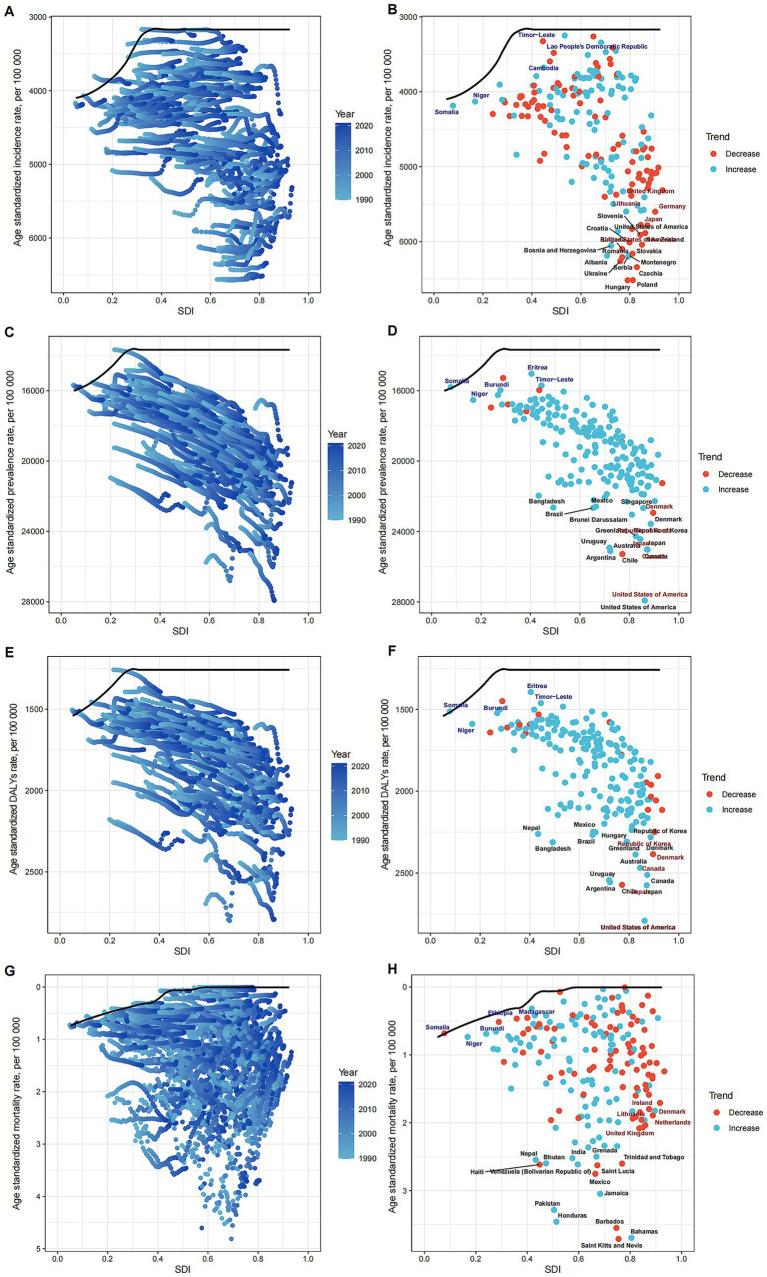
This study aimed to assess the global, regional, and national burdens of musculoskeletal disorders (MSDs) since 1990. It also projected trends up to 2035 and explored potential improvements through frontier analysis.
METHODS
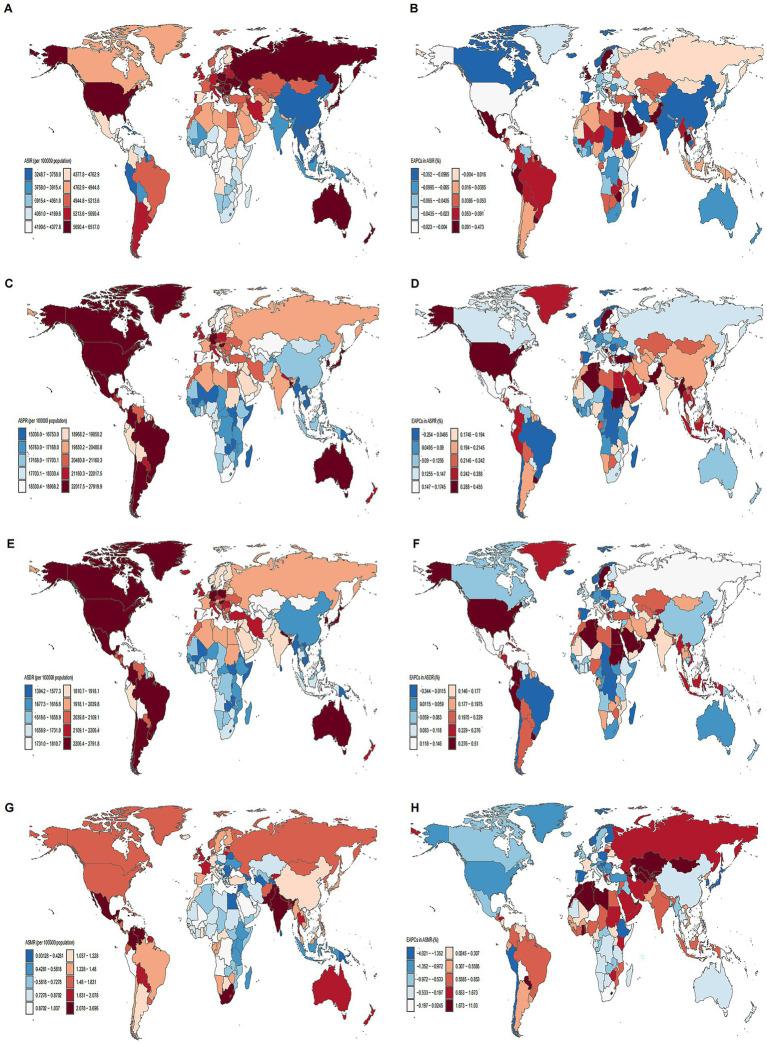
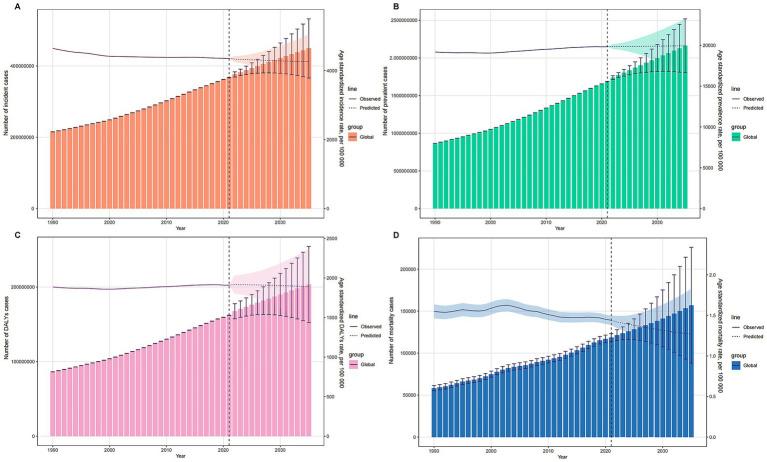
Using data from the Global Burden of Disease 2021 study, MSDs in 204 countries and territories were analyzed. Age-standardized rates (ASRs) for prevalence (ASPR), incidence (ASIR), DALYs (ASDR), and mortality (ASMR) were calculated. Trends were evaluated through estimated annual percentage changes (EAPC). The Bayesian age-period-cohort (BAPC) model was employed for projections to 2035, and frontier analysis was used to assess the potential for reducing MSD burdens.
RESULTS
In 2021, 1.686 billion MSDs prevalent cases were recorded globally, representing a 95% increase since 1990. Although total cases and DALYs have increased, ASIR and ASMR showed declining trends, with global MSD-related mortality decreasing by 0.265% annually. By 2035, the number of MSD cases is projected to rise to 2.161 billion, along with corresponding increases in DALYs and mortality, although ASRs are expected to continue declining. Frontier analysis revealed significant gaps between current burdens and achievable benchmarks, particularly in high-SDI regions, while some low-SDI regions demonstrated effective management despite limited resources. A U-shaped relationship between SDI and MSDs burdens was observed, with middle-SDI regions generally performing better.
CONCLUSION
The global burden of MSDs is projected to rise in absolute case numbers, underscoring the necessity for strategically targeted interventions to manage their impact effectively. Frontier analysis illuminates potential improvements, particularly in high-SDI countries, while projections indicate that enhanced access to healthcare and better resource distribution could alleviate the global MSDs burden. Addressing disparities and implementing tailored interventions are crucial for reducing MSDs-related disability and mortality.
目的
本研究旨在评估自1990年以来肌肉骨骼疾病(MSD)的全球、区域和国家负担。它还预测了到2035年的趋势,并通过前沿分析探索了潜在的改善措施。
方法
利用全球疾病负担2021研究的数据,对204个国家和地区的肌肉骨骼疾病进行了分析。计算了患病率(ASPR)、发病率(ASIR)、伤残调整生命年(ASDR)和死亡率(ASMR)的年龄标准化率。通过估计的年度百分比变化(EAPC)评估趋势。采用贝叶斯年龄-时期-队列(BAPC)模型预测到2035年的情况,并使用前沿分析评估减轻MSD负担的潜力。
结果
2021年,全球记录了16.86亿例MSD流行病例,自1990年以来增加了95%。尽管病例总数和伤残调整生命年有所增加,但ASIR和ASMR呈下降趋势,全球与MSD相关的死亡率每年下降0.265%。到2035年,预计MSD病例数将增至21.61亿,伤残调整生命年和死亡率也将相应增加,尽管年龄标准化率预计将继续下降。前沿分析揭示了当前负担与可实现基准之间的显著差距,特别是在高社会人口指数(SDI)地区,而一些低SDI地区尽管资源有限,但仍表现出有效的管理。观察到SDI与MSD负担之间呈U形关系,中等SDI地区通常表现较好。
结论
预计MSD的全球负担在绝对病例数上将会增加,这凸显了采取战略针对性干预措施以有效管理其影响的必要性。前沿分析阐明了潜在的改善措施,特别是在高SDI国家,而预测表明,增加医疗保健可及性和更好地分配资源可减轻全球MSD负担。解决差异并实施针对性干预措施对于降低与MSD相关的残疾和死亡率至关重要。



 Zotero 插件