
真核生物起始因子:在神经性疼痛进展过程中与mRNA翻译可塑性相关的核心因子。
Eukaryotic initiation factors: central factor associating mRNA translational plasticity during neuropathic pain progression.
作者信息
Li Xinshuo, Zhan Haibo, Zhang Xindan, Li Jiayi, Li Xiangrui, Lu Xihua, Miao Changhong, Zhou Chunli, Zhang Zhen
机构信息
Department of Anesthesiology, The Affiliated Cancer Hospital of Zhengzhou University & Henan Cancer Hospital, Zhengzhou, Henan, China.
Department of Anesthesiology, Huadu District People's Hospital of Guangzhou, Huadu Institute of Medical Sciences, Guangzhou, Guangdong, China.
出版信息
Front Neurol. 2025 Jul 30;16:1566205. doi: 10.3389/fneur.2025.1566205. eCollection 2025.
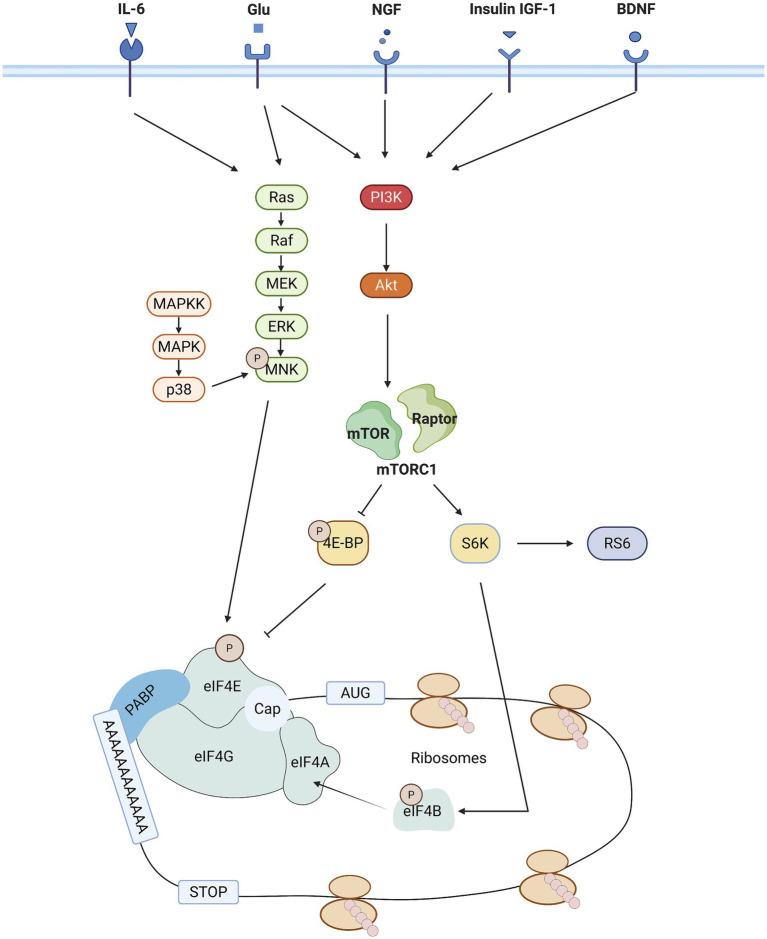
Neuropathic pain causes plasticity in the nervous system, which is often associated with altered protein synthesis. Proteins are the key executors of cellular functions, and their alteration is closely related to the occurrence of neuropathic pain. Protein synthesis is a finely regulated process involving the interaction of multiple biomolecules. Among them, the eukaryotic translation initiation factors (eIFs) are a group of key regulatory proteins that control the initiation phase of protein translation and thus influence the rate and type of protein synthesis. Recent studies have shown that the eIFs are involved in the regulation of neuropathic pain regulating translation through phosphorylation and affecting the transmission and processing of neuropathic pain signals. Among them, eIF4E and eIF2α, as core initiation factors, changes in their expression and activity are closely associated with various neuropathic pain. This review aims to summarize the evidence for the involvement of the eIFs, especially eIF4E and eIF2α, in pain-associated mRNA translational plasticity, and to propose relevant therapeutic approaches. We hope that this review will provide important ideas for future research on the mechanisms of neuropathic pain and new targets for the treatment of neuropathic pain.
神经性疼痛会导致神经系统可塑性,这通常与蛋白质合成改变有关。蛋白质是细胞功能的关键执行者,其改变与神经性疼痛的发生密切相关。蛋白质合成是一个受到精细调控的过程,涉及多种生物分子的相互作用。其中,真核生物翻译起始因子(eIFs)是一组关键的调节蛋白,它们控制蛋白质翻译的起始阶段,从而影响蛋白质合成的速率和类型。最近的研究表明,eIFs通过磷酸化参与神经性疼痛调节翻译的过程,并影响神经性疼痛信号的传递和处理。其中,eIF4E和eIF2α作为核心起始因子,它们的表达和活性变化与各种神经性疼痛密切相关。本综述旨在总结eIFs,特别是eIF4E和eIF2α参与疼痛相关mRNA翻译可塑性的证据,并提出相关治疗方法。我们希望本综述将为未来神经性疼痛机制的研究提供重要思路,并为神经性疼痛的治疗提供新靶点。

 Zotero 插件