
对照试验中乳腺癌患者高血糖与化疗诱导的周围神经病变发生之间的关联
Association between hyperglycemia and the development of chemotherapy induced peripheral neuropathy among patients with breast cancer in the control trial.
作者信息
Klahr Miriam Pearl, Faheem Khadija, Raghunathan Rohit R, Wooster Margaux, Hershman Dawn L, Accordino Melissa K
机构信息
Department of Medicine, Columbia University Medical Center, New York, NY, USA.
Columbia University Irving Medical Center, 630 W. 168th St, New York, NY, 10032, USA.
出版信息
Breast Cancer Res. 2025 Aug 18;27(1):150. doi: 10.1186/s13058-025-01984-0.
BACKGROUND
Poorly controlled diabetes is a predictor of chemotherapy induced peripheral neuropathy (CIPN) and hyperglycemia may mediate CIPN risk. We evaluated the association between hyperglycemia and CIPN development.
FINDINGS
Methods: This was a secondary analysis of the CONTRoL trial, which randomized patients with Stage I-III breast cancer receiving taxane chemotherapy to cryotherapy, compression therapy, or placebo. CIPN data was obtained from the FACT-NTX survey which patients completed at baseline, week-12, and week-24. Hyperglycemia (glucose ≥ 140 mmol/L) was assessed using random glucose values obtained throughout trial duration. We included patients who completed FACT-NTX at baseline and week-12. Patients were divided into two groups based on CIPN development. For each group we calculated the proportion of patients with hyperglycemia and mean glucose values; 95% confidence intervals were constructed.
RESULTS
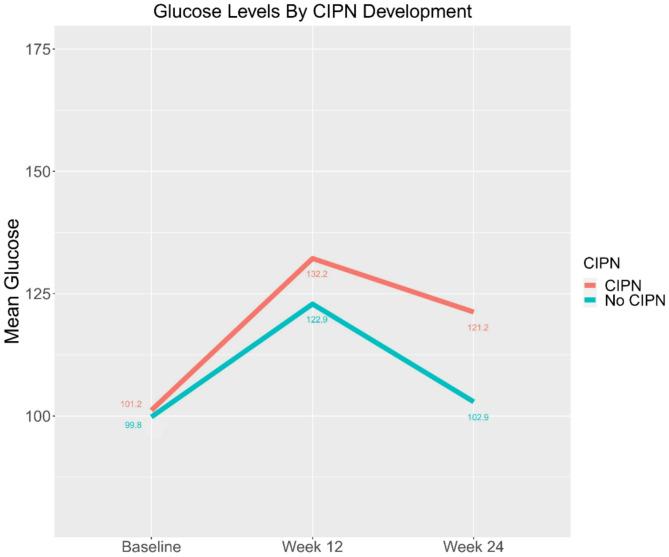
Fifty-nine patients met inclusion criteria; 34 patients developed CIPN and 25 did not. Hyperglycemia occurred in 47.1% vs. 36.0% of patients who developed CIPN vs. those who did not (p = 0.56). Mean glucose was numerically but not significantly higher in patients with CIPN compared to those without at all timepoints, most notably at week-12 (132.2 mg/dL vs. 122.9 mg/dL p = 0.47).
CONCLUSIONS
In this analysis, hyperglycemia affected almost half of patients with CIPN versus about a third of patients without CIPN. Patients with CIPN also had higher mean glucose levels compared to those without CIPN, though the differences were not significant. No conclusions can be drawn from these results and further research is needed to assess these trends in a larger prospective patient population.
背景
糖尿病控制不佳是化疗引起的周围神经病变(CIPN)的一个预测指标,并且高血糖可能介导CIPN风险。我们评估了高血糖与CIPN发生之间的关联。
研究结果
方法:这是对CONTRoL试验的二次分析,该试验将接受紫杉烷化疗的I - III期乳腺癌患者随机分为冷冻疗法组、压迫疗法组或安慰剂组。CIPN数据来自患者在基线、第12周和第24周完成的FACT - NTX调查。使用整个试验期间获得的随机血糖值评估高血糖(血糖≥140 mmol/L)。我们纳入了在基线和第12周完成FACT - NTX的患者。根据CIPN的发生情况将患者分为两组。对于每组,我们计算了高血糖患者的比例和平均血糖值;构建了95%置信区间。
结果
59名患者符合纳入标准;34名患者发生了CIPN,25名未发生。发生CIPN的患者中高血糖发生率为47.1%,未发生CIPN的患者中为36.0%(p = 0.56)。在所有时间点,CIPN患者的平均血糖数值上更高,但无显著差异,最明显的是在第12周(132.2 mg/dL对122.9 mg/dL,p = 0.47)。
结论
在本分析中,高血糖影响了近一半发生CIPN的患者,而未发生CIPN的患者约为三分之一。与未发生CIPN的患者相比,发生CIPN的患者平均血糖水平也更高,尽管差异不显著。这些结果无法得出结论,需要进一步研究以在更大的前瞻性患者群体中评估这些趋势。
 Zotero 插件