
RGS1通过调节NF-κB/AQP5轴诱导变应性鼻炎鼻上皮屏障功能障碍。
RGS1 induces nasal epithelial barrier dysfunction in allergic rhinitis by modulating NF-κB/AQP5 axis.
作者信息
Chang Wenchuan, He Yan, Liu Liang
机构信息
Department of Otolaryngology, Children's Hospital of Soochow University, No.92, Zhongnan Street, Wuzhong Industrial Park, Wuzhong District, Suzhou, 215025 China.
Department of Otolaryngology, The Affiliated Suzhou Hospital of Nanjing Medical University, Suzhou, 215008 China.
出版信息
Cytotechnology. 2025 Oct;77(5):164. doi: 10.1007/s10616-025-00825-4. Epub 2025 Aug 17.
UNLABELLED
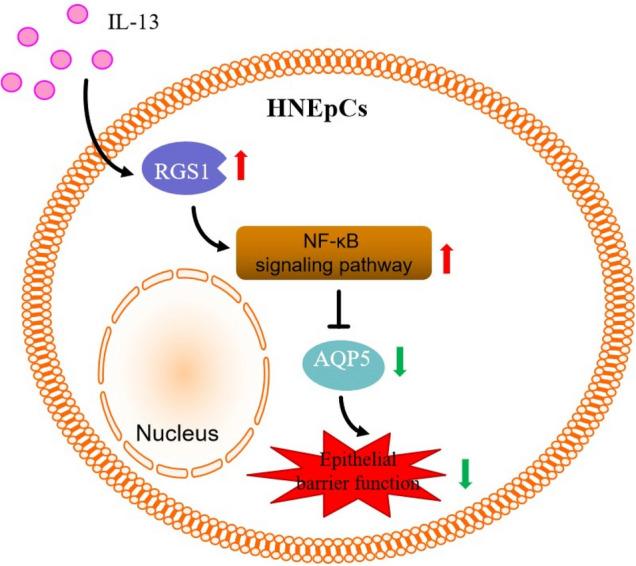
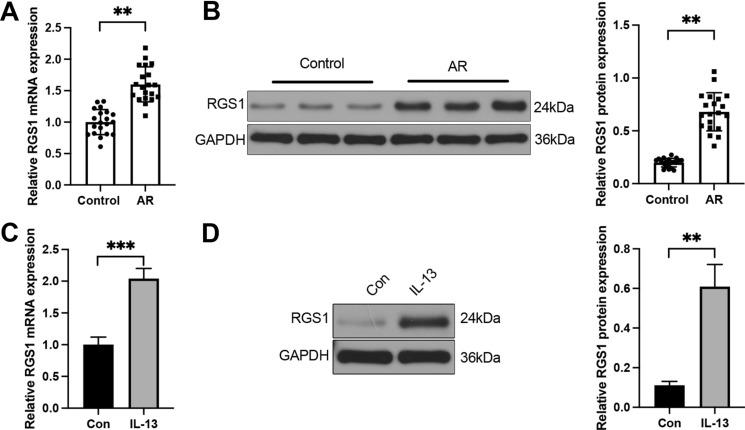
The tight junctions (TJs) between nasal mucosal epithelial cells are a crucial component of the nasal barrier function. Incomplete formation or reduced expression of TJs is a primary contributor to the onset and progression of allergic rhinitis (AR). Therefore, an in-depth investigation into the mechanisms affecting the barrier function of human nasal mucosal epithelial cells (HNEpCs) may facilitate the identification of new therapeutic approaches for AR treatment. Bioinformatics analysis found RGS1 is upregulated in AR, but its impact on the nasal mucosal epithelial barrier function remains unclear. This study aims to explore the mechanism of RGS1 regulating epithelial barrier function in AR. Differentially expressed genes in AR were analyzed using GSE43523 from GEO database. RGS1 expression level was validated in AR clinical samples and IL-13-induced HNEpCs. Loss and function of RGS1 or/and AQP5 was performed in IL-13-induced HNEpCs to detect the activation of NF-κB signal pathway. The epithelial barrier function of HNEpCs was measured by trans-epithelial electrical resistance (TER) and FITC-Dextran 4(FD4) assay. TJs, such as ZO-1, Occludin and Claudin-1 were also detected by western blot and Immunofluorescence. Bioinformatics analysis, AR clinical samples and IL-13-induced HNEpCs consistently found up-regulated RGS1 expression in AR. RGS1 silencing can protect HNEpCs against IL-13-induced epithelial barrier dysfunction, evidence by increased TER value, decreased FD4 and elevated expression of ZO-1, Occludin and Claudin-1. RGS1 silencing can also suppress the activation of NF-κB signal pathway and increase AQP5 expression, which such expression pattern can be nullified in response to AQP5 silencing. RGS1 was found to be elevated in AR. Silencing of RGS1 can suppress NF-κB signal pathway to increase AQP5 expression, thereby attenuating epithelial barrier dysfunction in HNEpCs.
SUPPLEMENTARY INFORMATION
The online version contains supplementary material available at 10.1007/s10616-025-00825-4.
未标记
鼻黏膜上皮细胞之间的紧密连接(TJs)是鼻屏障功能的关键组成部分。紧密连接形成不完全或表达减少是变应性鼻炎(AR)发病和进展的主要原因。因此,深入研究影响人鼻黏膜上皮细胞(HNEpCs)屏障功能的机制可能有助于确定AR治疗的新方法。生物信息学分析发现RGS1在AR中上调,但其对鼻黏膜上皮屏障功能的影响尚不清楚。本研究旨在探讨RGS1在AR中调节上皮屏障功能的机制。使用来自GEO数据库的GSE43523分析AR中的差异表达基因。在AR临床样本和IL-13诱导的HNEpCs中验证RGS1表达水平。在IL-13诱导的HNEpCs中进行RGS1或/和AQP5的缺失和功能实验,以检测NF-κB信号通路的激活。通过跨上皮电阻(TER)和异硫氰酸荧光素标记葡聚糖4(FD4)测定法测量HNEpCs的上皮屏障功能。还通过蛋白质免疫印迹和免疫荧光检测紧密连接蛋白,如闭合蛋白1(ZO-1)、闭合蛋白(Occludin)和紧密连接蛋白1(Claudin-1)。生物信息学分析、AR临床样本和IL-13诱导的HNEpCs一致发现AR中RGS1表达上调。RGS1沉默可保护HNEpCs免受IL-13诱导的上皮屏障功能障碍,表现为TER值增加、FD4降低以及ZO-1、Occludin和Claudin-1表达升高。RGS1沉默还可抑制NF-κB信号通路的激活并增加AQP5表达,而这种表达模式在AQP5沉默后可被消除。研究发现RGS1在AR中升高。沉默RGS1可抑制NF-κB信号通路以增加AQP5表达,从而减轻HNEpCs中的上皮屏障功能障碍。
补充信息
在线版本包含可在10.1007/s10616-025-00825-4获取的补充材料。



 Zotero 插件