
比较常用外科冲洗液治疗植入物相关感染的体外疗效。
Comparing the in Vitro Efficacy of Commonly Used Surgical Irrigants for the Treatment of Implant-Associated Infections.
作者信息
Hamad Christopher D, Sheppard William L, Chun Rene F, Mamouei Zara, Lloyd Trevor S, Li Alan K, Sobti Rahul, Pearce Jack W, Hernandez Adolfo, Dipane Matthew V, Hu Serena S, Bernthal Nicholas M, McPherson Edward J
机构信息
Department of Orthopaedic Surgery, David Geffen School of Medicine at UCLA, Santa Monica, California.
Department of Orthopaedic Surgery, Stanford Medicine, Redwood City, California.
出版信息
J Bone Joint Surg Am. 2025 Jun 19;107(16):1818-1824. doi: 10.2106/JBJS.24.01225.
BACKGROUND
Implant-associated infections (IAIs) require aggressive debridement to eliminate microbial bioburden. The use of irrigants may improve microbial killing during debridement. This study compared the efficacy of surgical irrigants in vitro against Staphylococcus aureus alone and in combination with Candida albicans, in both planktonic and biofilm states.
METHODS
Full-strength Dakin's solution, 0.35% povidone-iodine (PI), 10% PI, 3% hydrogen peroxide (HP), a 1:1 combination of 10% PI and 3% HP (PI + HP), Irrisept, XPERIENCE, Bactisure, and normal saline solution were tested. For planktonic testing, 1 × 10⁶ colony-forming units (CFUs) of S. aureus and C. albicans were utilized, and biofilms were grown in these conditions on 0.8 × 10-mm titanium alloy Kirschner wires for 48 hours. Killing assays were performed using 5-minute dwell times. Success was defined by complete eradication of planktonic or biofilm CFUs.
RESULTS
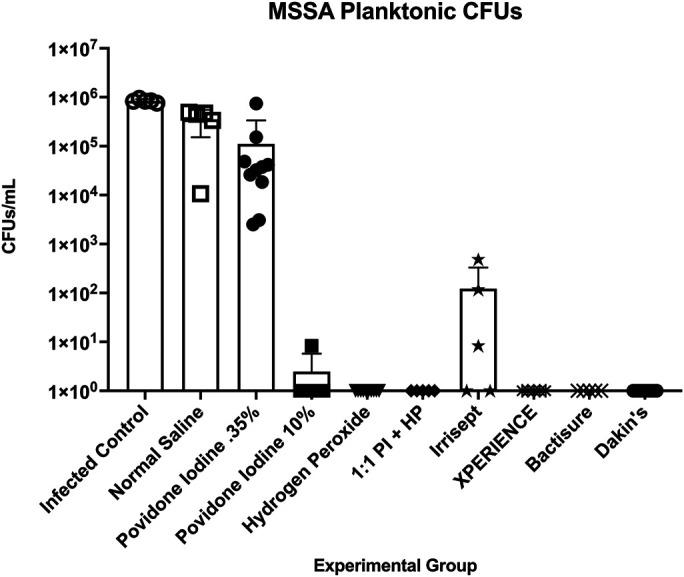
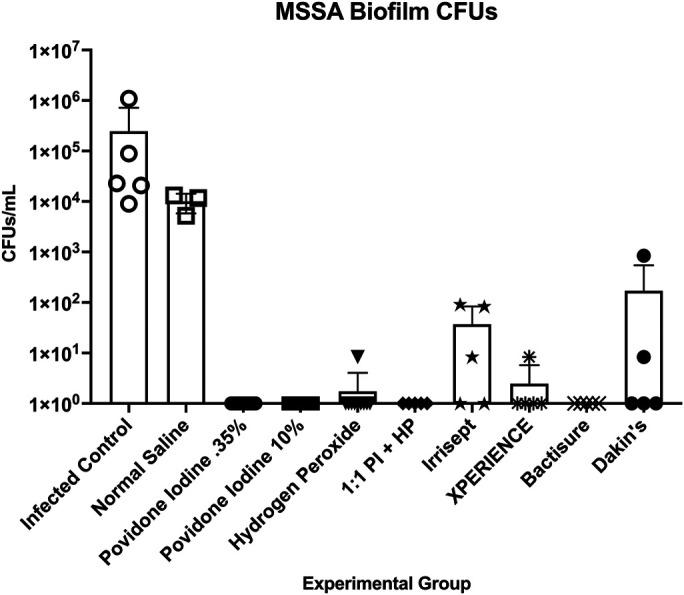
PI + HP and Bactisure were the only irrigants to eradicate S. aureus in both planktonic and biofilm states. PI + HP was the only irrigant to eradicate polymicrobial S. aureus + C. albicans bioburden in both states.
CONCLUSIONS
PI + HP and Bactisure were superior irrigants against S. aureus, eliminating it in planktonic and biofilm states. PI + HP was the only irrigant to eradicate polymicrobial S. aureus + C. albicans bioburden in both states. In vivo studies are needed to evaluate the clinical effectiveness.
CLINICAL RELEVANCE
Surgical irrigants have variable efficacy in eradicating microbes depending on their state of existence (planktonic versus biofilm). In this study, the most effective eradication of polymicrobial S. aureus + C. albicans bioburden was a 1:1 combination of 10% PI and 3% HP, which is of nominal cost.
背景
植入物相关感染(IAIs)需要积极清创以消除微生物负荷。使用冲洗液可能会提高清创过程中的杀菌效果。本研究比较了手术冲洗液在体外对单独的金黄色葡萄球菌以及与白色念珠菌联合存在时,在浮游态和生物膜态下的杀菌效果。
方法
测试了原液达金氏溶液、0.35%聚维酮碘(PI)、10%聚维酮碘、3%过氧化氢(HP)、10%聚维酮碘与3%过氧化氢的1:1混合液(PI + HP)、Irrisept、XPERIENCE、Bactisure以及生理盐水溶液。对于浮游态测试,使用1×10⁶个金黄色葡萄球菌和白色念珠菌的菌落形成单位(CFU),并在这些条件下在0.8×10毫米的钛合金克氏针上培养生物膜48小时。使用5分钟的停留时间进行杀菌试验。成功定义为浮游态或生物膜CFU的完全根除。
结果
PI + HP和Bactisure是仅有的在浮游态和生物膜态下均能根除金黄色葡萄球菌的冲洗液。PI + HP是唯一在两种状态下均能根除多微生物金黄色葡萄球菌+白色念珠菌负荷的冲洗液。
结论
PI + HP和Bactisure是针对金黄色葡萄球菌的 superior冲洗液,能在浮游态和生物膜态下将其消除。PI + HP是唯一在两种状态下均能根除多微生物金黄色葡萄球菌+白色念珠菌负荷的冲洗液。需要进行体内研究以评估临床有效性。
临床意义
手术冲洗液在根除微生物方面的效果因微生物的存在状态(浮游态与生物膜态)而异。在本研究中,最有效地根除多微生物金黄色葡萄球菌+白色念珠菌负荷的是10%聚维酮碘与3%过氧化氢的1:1混合液,其成本低廉。


 Zotero 插件