
利用环境协变量改进植物病害的基因组预测
Improving genomic prediction for plant disease using environmental covariates.
作者信息
Brault Charlotte, Conley Emily J, Read Andrew C, Green Andrew J, Glover Karl D, Cook Jason P, Gill Harsimardeep S, Fiedler Jason D, Anderson James A
机构信息
Department of Agronomy and Plant Genetics, University of Minnesota, St. Paul, MN, 55108, USA.
USDA-ARS, Plant Science Research Unit, St. Paul, MN, USA.
出版信息
Plant Methods. 2025 Aug 20;21(1):114. doi: 10.1186/s13007-025-01418-0.
BACKGROUND
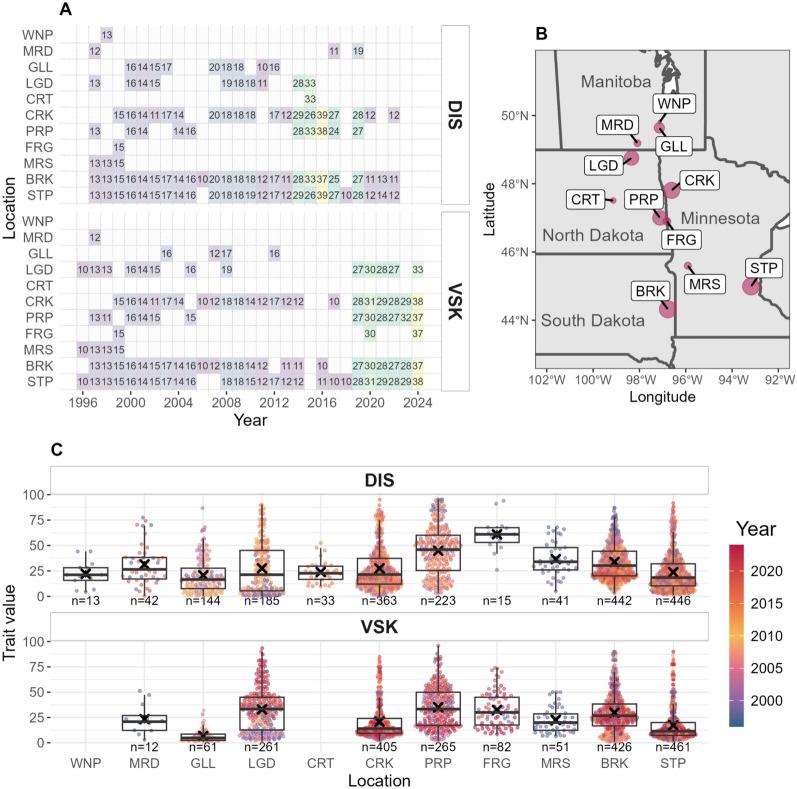
Fusarium Head Blight (FHB) is a destructive fungal disease affecting wheat and barley, leading to significant yield losses and reduced grain quality. Susceptibility to FHB is influenced by genetic factors, environmental conditions, and genotype-by-environment interactions (GxE), making it challenging to predict disease resistance across diverse environments. This study investigates GxE in a long-term spring wheat multi-environment uniform nursery trial focusing on the evaluation of resistant lines in northern US breeding programs.
RESULTS
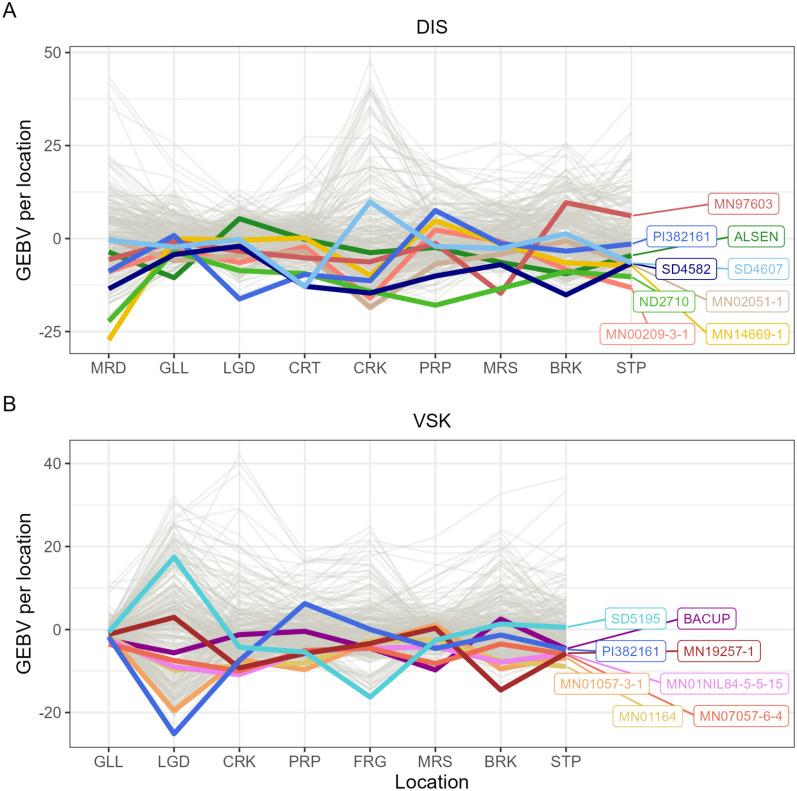
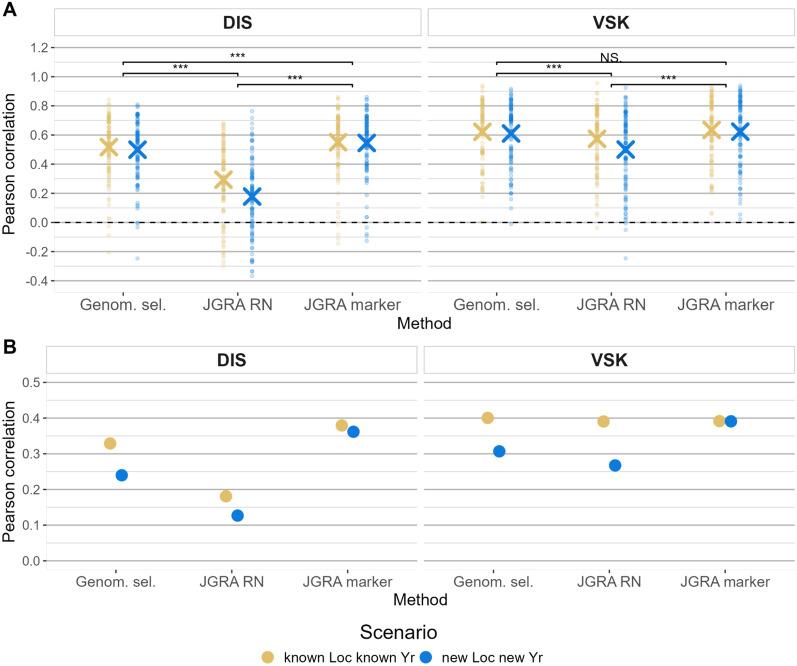
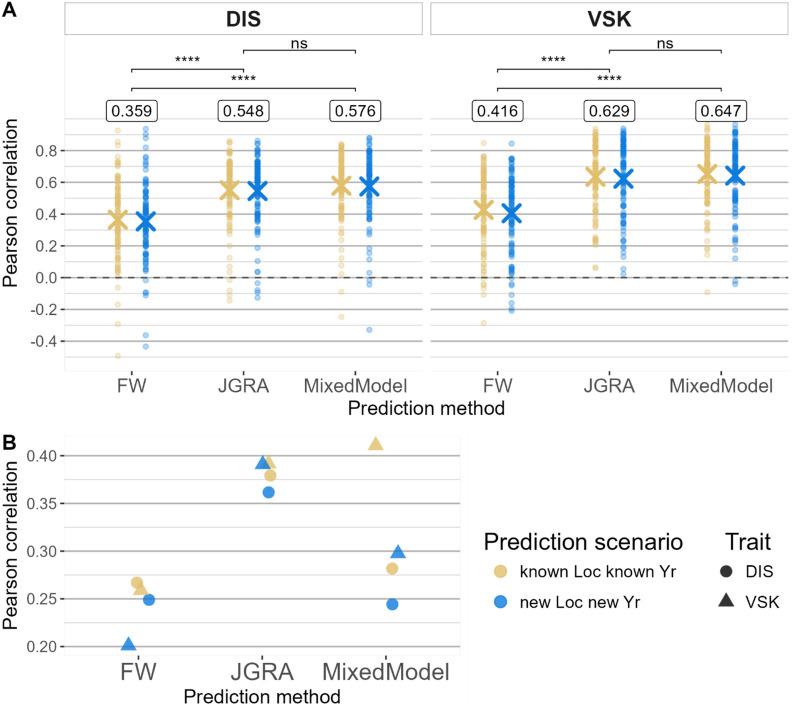
Traditionally, GxE has been analyzed as a reaction norm over an environment index. Here, we computed the environment index as a linear combination of environmental covariables specific to each environment, and we derived an environment relationship matrix. Three methods were compared, all aimed at predicting untested genotypes in untested environments: the widely used Finlay-Wilkinson regression (FW), the joint-genomic regression analysis (JGRA) method, and mixed models incorporating an environmental covariates matrix. These were benchmarked against a baseline genomic selection model (GS) without environmental covariates. Predictive abilities were assessed within and across environments. The results revealed that the JGRA marker effect method was more accurate than GS in within- and across-environment predictions, although the differences were small. The predictive ability slightly decreased when the target environment was less related to the training environments. Mixed models performed similarly to JGRA within-environment, but JGRA outperformed the other methods for across-environment predictions. Additionally, JGRA identified significant genetic markers associated with baseline FHB resistance and environmental sensitivity. Furthermore, location-specific genomic estimated breeding values were predicted, providing insights into genotype stability across varying locations.
CONCLUSION
These findings highlight the value of incorporating environmental covariates to increase predictive ability and improve the selection of resistant genotypes for diverse, untested environments. By leveraging this approach, breeders can effectively exploit GxE interactions to improve disease management at no additional cost.
背景
小麦赤霉病(FHB)是一种影响小麦和大麦的毁灭性真菌病害,会导致显著的产量损失和谷物品质下降。对小麦赤霉病的易感性受遗传因素、环境条件以及基因型与环境互作(GxE)的影响,这使得在不同环境中预测抗病性具有挑战性。本研究在美国北部育种项目的长期春小麦多环境统一试验田中,针对抗性品系评估展开了GxE研究。
结果
传统上,GxE被分析为环境指数上的反应规范。在此,我们将环境指数计算为每个环境特有的环境协变量的线性组合,并推导了环境关系矩阵。比较了三种方法,均旨在预测未测试环境中的未测试基因型:广泛使用的芬利-威尔金森回归(FW)、联合基因组回归分析(JGRA)方法以及纳入环境协变量矩阵的混合模型。将这些方法与无环境协变量的基线基因组选择模型(GS)进行了对比。在环境内和跨环境中评估了预测能力。结果表明,JGRA标记效应方法在环境内和跨环境预测中比GS更准确,尽管差异较小。当目标环境与训练环境的相关性较低时,预测能力略有下降。混合模型在环境内的表现与JGRA相似,但在跨环境预测方面JGRA优于其他方法。此外,JGRA识别出了与基线小麦赤霉病抗性和环境敏感性相关的显著遗传标记。此外,还预测了特定地点的基因组估计育种值,为不同地点的基因型稳定性提供了见解。
结论
这些发现凸显了纳入环境协变量以提高预测能力并改进针对不同未测试环境的抗性基因型选择的价值。通过采用这种方法,育种者可以在不增加额外成本的情况下有效利用GxE互作来改善病害管理。



 Zotero 插件