
在铜和聚碳酸酯表面生长的G20生物膜的比较转录组学分析。
Comparative transcriptomics analysis of the G20 biofilms grown on copper and polycarbonate surfaces.
作者信息
Saxena Priya, Samanta Dipayan, Thakur Payal, Gopalakrishnan Vinoj, Sani Rajesh K
机构信息
Department of Chemical and Biological Engineering, South Dakota School of Mines and Technology, Rapid City, SD, 57701, USA.
Data Driven Material Discovery Center for Bioengineering Innovation, South Dakota School of Mines and Technology, Rapid City, SD, 57701, USA.
出版信息
Biofilm. 2025 Aug 6;10:100309. doi: 10.1016/j.bioflm.2025.100309. eCollection 2025 Dec.
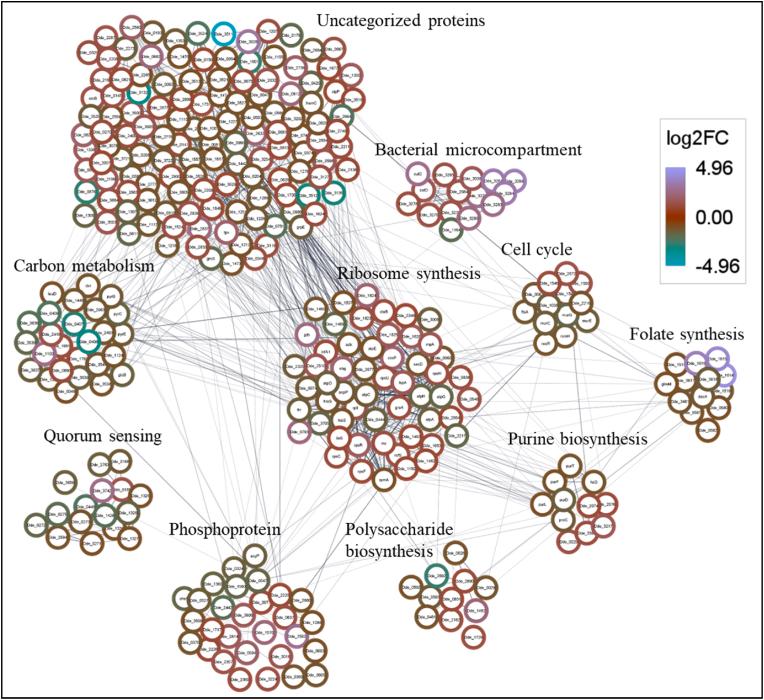
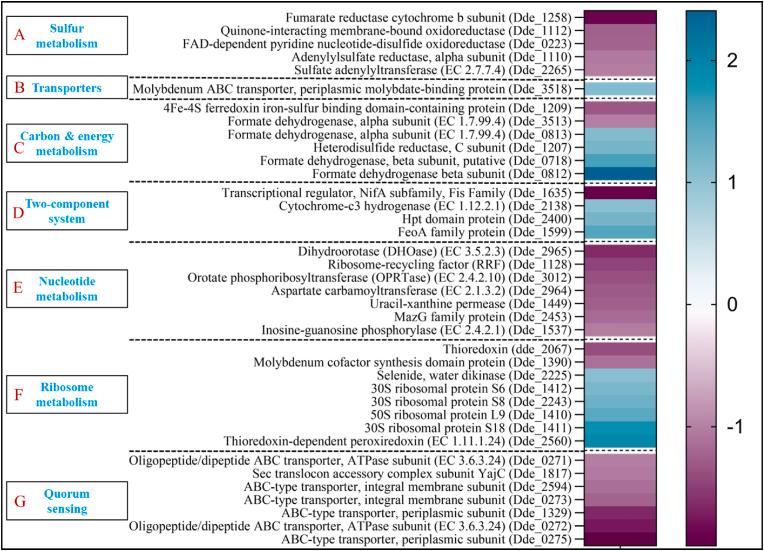
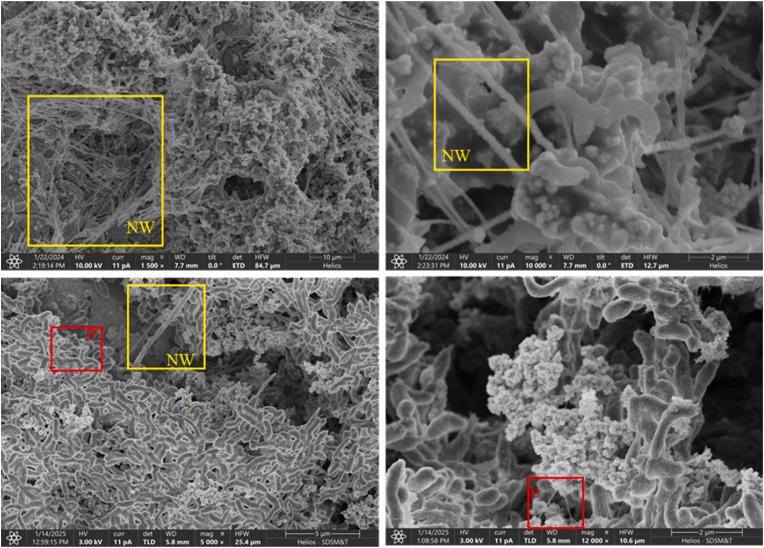
Sulfate-reducing bacterial (SRB) biofilms are prevalent across diverse environments, playing key roles in biogeochemical sulfur cycling while also contributing to industrial challenges such as biofouling and biocorrosion. Understanding the genetic and physiological adaptations of SRB biofilms to different surfaces is crucial for developing mitigation strategies. This study presents a comparative transcriptomic analysis of G20 biofilms grown on copper and polycarbonate surfaces, aimed at elucidating their differential responses at the molecular level. RNA sequencing revealed 1255 differentially expressed genes, with copper-grown biofilms exhibiting upregulation of Dde_1570 (flagellin; log2FC 2.31) and Dde_0831 (polysaccharide chain length determinant; log2FC 1.15), highlighting enhanced motility and extracellular polymeric substance production. Conversely, downregulated genes on copper included Dde_0132 (Cu/Zn efflux transporter; log2FC -3.37) and Dde_0369 (methyl-accepting chemotaxis protein; log2FC -1.19), indicating a metabolic shift and stress adaptation to metal exposure. Morphological analysis via SEM revealed denser biofilm clusters with precipitates on copper, whereas biofilms on polycarbonate were more dispersed. AFM analysis showed a 4.6-fold increase in roughness on copper (44.3 ± 3.1 to 205.89 ± 8.7 nm) and a 3.8-fold increase on polycarbonate (521.12 ± 15.2 to 1975.64 ± 52.6 nm), indicating surface erosion and structural modifications. Protein-protein interaction analysis identified tightly regulated clusters associated with ribosomal synthesis, folate metabolism, and quorum sensing, underscoring their role in biofilm resilience. Additionally, functional annotations of uncharacterized genes revealed potential biofilm regulators, such as Dde_4025 (cytochrome-like protein; log2FC 4.18) and Dde_3288 (DMT superfamily permease; log2FC 3.55). These findings provide mechanistic insights into surface-dependent biofilm formation, with implications for designing antifouling materials and controlling microbial-induced corrosion.
硫酸盐还原细菌(SRB)生物膜在各种环境中普遍存在,在生物地球化学硫循环中发挥关键作用,同时也给生物污垢和生物腐蚀等工业问题带来影响。了解SRB生物膜对不同表面的遗传和生理适应性对于制定缓解策略至关重要。本研究对在铜和聚碳酸酯表面生长的G20生物膜进行了比较转录组分析,旨在阐明它们在分子水平上的差异反应。RNA测序揭示了1255个差异表达基因,在铜表面生长的生物膜中,Dde_1570(鞭毛蛋白;log2FC 2.31)和Dde_0831(多糖链长度决定因素;log2FC 1.15)上调,突出了运动性增强和细胞外聚合物产生增加。相反,铜表面下调的基因包括Dde_0132(铜/锌外流转运蛋白;log2FC -3.37)和Dde_0369(甲基接受趋化蛋白;log2FC -1.19),表明存在代谢转变以及对金属暴露的应激适应。通过扫描电子显微镜(SEM)进行的形态学分析显示,铜表面的生物膜簇更密集且有沉淀物,而聚碳酸酯表面的生物膜更分散。原子力显微镜(AFM)分析表明,铜表面粗糙度增加了4.6倍(从44.3 ± 3.1纳米增加到205.89 ± 8.7纳米),聚碳酸酯表面增加了3.8倍(从521.12 ± 15.2纳米增加到1975.64 ± 52.6纳米),表明存在表面侵蚀和结构改变。蛋白质 - 蛋白质相互作用分析确定了与核糖体合成、叶酸代谢和群体感应相关的紧密调控簇,强调了它们在生物膜恢复力中的作用。此外,对未表征基因的功能注释揭示了潜在的生物膜调节因子,如Dde_4025(细胞色素样蛋白;log2FC 4.18)和Dde_3288(DMT超家族通透酶;log2FC 3.55)。这些发现为表面依赖性生物膜形成提供了机制见解,对设计防污材料和控制微生物诱导的腐蚀具有重要意义。






 Zotero 插件