
全膝关节或髋关节置换术患者术前凝血指标及输血需求的临床预测因素:一项单中心回顾性研究
Preoperative Coagulation Markers and Clinical Predictors of Transfusion Requirement in Patients Undergoing Total Knee or Hip Arthroplasty: A Single-Center Retrospective Study.
作者信息
Konarski Wojciech
机构信息
Medical Rehabilitation Center, Sobieskiego 47D, 05-120 Legionowo, Poland.
出版信息
Med Sci (Basel). 2025 Aug 15;13(3):135. doi: 10.3390/medsci13030135.
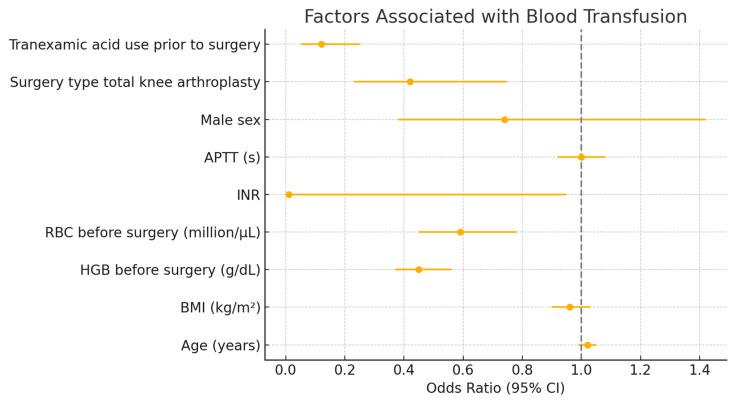
Total knee arthroplasty (TKA) and total hip arthroplasty (THA) are widely performed procedures often associated with significant blood loss, leading to the need for allogeneic blood transfusion. Transfusions carry inherent risks and increase healthcare costs, making the identification of transfusion predictors crucial. This study aimed to assess preoperative predictors associated with transfusion requirement in patients undergoing THA or TKA. This single-center, retrospective analysis included 742 patients who underwent primary TKA or THA between 2016 and 2023. Preoperative variables such as hemoglobin, red blood cell count (RBC), INR, APTT, and use of tranexamic acid (TXA) were collected. Univariable and multivariable logistic regression analyses were conducted to identify independent predictors of transfusion. Transfusions were required in 12.0% of patients. Multivariable analysis revealed that lower preoperative HGB and RBC levels, absence of TXA use, higher INR, and undergoing THA (versus TKA) were independently associated with increased transfusion risk. INR was not significant in univariable analysis but reached significance in the adjusted model. The final multivariable model demonstrated good predictive performance, with an area under the ROC curve (AUC) of 0.79. Lower hemoglobin and RBC levels, elevated INR, absence of TXA use, and THA surgery were independent predictors of transfusion. These findings may guide the use of routine preoperative hematologic and coagulation assessments to guide perioperative management and reduce transfusion rates in joint arthroplasty.
全膝关节置换术(TKA)和全髋关节置换术(THA)是广泛开展的手术,常伴有大量失血,因此需要进行异体输血。输血存在固有风险且会增加医疗成本,所以确定输血预测因素至关重要。本研究旨在评估接受THA或TKA的患者中与输血需求相关的术前预测因素。这项单中心回顾性分析纳入了2016年至2023年间接受初次TKA或THA的742例患者。收集了术前变量,如血红蛋白、红细胞计数(RBC)、国际标准化比值(INR)、活化部分凝血活酶时间(APTT)以及氨甲环酸(TXA)的使用情况。进行单变量和多变量逻辑回归分析以确定输血的独立预测因素。12.0%的患者需要输血。多变量分析显示,术前较低的血红蛋白和红细胞水平、未使用TXA、较高的INR以及接受THA(与TKA相比)与输血风险增加独立相关。INR在单变量分析中不显著,但在调整模型中具有显著性。最终的多变量模型显示出良好的预测性能,ROC曲线下面积(AUC)为0.79。较低的血红蛋白和红细胞水平、升高的INR、未使用TXA以及THA手术是输血的独立预测因素。这些发现可能指导常规术前血液学和凝血评估的使用,以指导围手术期管理并降低关节置换术中的输血率。

 Zotero 插件