
BTK抑制剂TL-895的药物相互作用风险
Drug-Drug Interaction Liabilities with BTK Inhibitor TL-895.
作者信息
Stromatt Jack C, Ahmed Eman A, Drabison Thomas, Nepal Mahesh R, Chowdhury Anika T, Orwick Shelley J, Buelow Daelynn R, Eisenmann Eric D, Huang Kevin M, Sparreboom Alex, Baker Sharyn D
机构信息
Division of Pharmaceutics and Pharmacology, College of Pharmacy, The Ohio State University, Columbus, Ohio.
Division of Pharmaceutics and Pharmacology, Comprehensive Cancer Center, The Ohio State University, Columbus, Ohio.
出版信息
Cancer Res Commun. 2025 Sep 1;5(9):1621-1630. doi: 10.1158/2767-9764.CRC-25-0265.
UNLABELLED
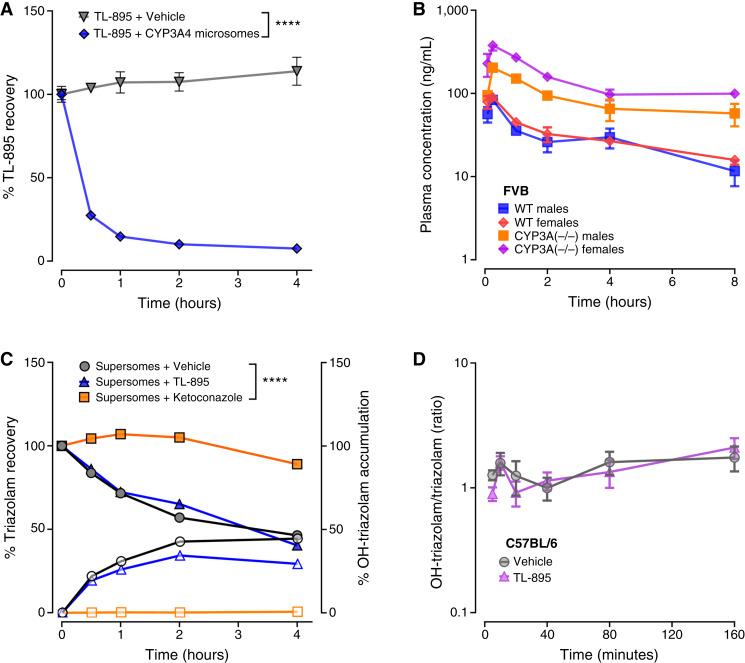
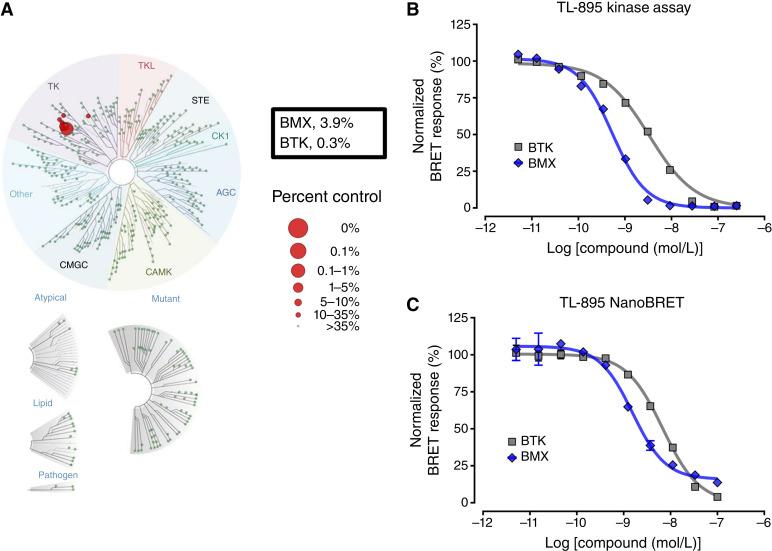
TL-895 is an orally administered protein kinase inhibitor in clinical development for the treatment of B-cell malignancies and various other blood and autoimmune disorders. In the early stages of drug development, limited data are available to assess off-target engagement and drug-drug interaction (DDI) liabilities, which may have profound effects on drug safety and efficacy. In this context, we characterized the kinase interaction profile of TL-895 and determined that the agent inhibits Bruton's tyrosine kinase (BTK) and bone marrow kinase on chromosome X (BMX), with more potent inhibition of BMX than BTK in a kinase assay (IC50: 0.53 vs. 3.02 nmol/L) and a bioluminescence resonance energy transfer (BRET) assay (IC50: 1.6 vs. 6.8 nmol/L). We used in vitro and in vivo models to assess DDI liabilities and identified TL-895 as a substrate of the hepatic uptake transporter OATP1B1 and the enzyme CYP3A4. In vivo, coadministration of TL-895 did not increase plasma concentrations of the endogenous and xenobiotic OATP1B1 substrates chenodeoxycholic acid 24-acyl-β-D-glucuronide, pravastatin, and gilteritinib, which indicates that TL-895 is an unlikely perpetrator of OATP1B1-mediated DDIs. Consistent with hepatic microsomal studies, we found that plasma concentrations of TL-895 were increased by 1.8- and 4.6-fold, respectively, in male and female mice lacking all CYP3A isoforms. The pharmacokinetic profile of TL-895 was not significantly sexually dimorphic or strain-dependent at drug doses producing human-equivalent measures of systemic exposure. These collective findings signify an important contribution of OATP1B1 and CYP3A4 to the in vivo handling of the dual BTK/BMX inhibitor TL-895 and suggest the agent is an unlikely perpetrator of potentially deleterious DDIs in polypharmacy regimens.
SIGNIFICANCE
TL-895 is an investigational second-generation BTK inhibitor for the treatment of B-cell malignancies. We found that TL-895 undergoes hepatocellular uptake by OATP1B-type transporters in advance of extensive CYP3A-mediated metabolism but is unlikely to perpetrate pharmacokinetic DDIs that could compromise drug safety in the context of polypharmacy regimens.
未标记
TL-895是一种口服蛋白激酶抑制剂,正处于临床开发阶段,用于治疗B细胞恶性肿瘤以及各种其他血液和自身免疫性疾病。在药物开发的早期阶段,可用于评估脱靶效应和药物-药物相互作用(DDI)风险的数据有限,而这些可能对药物安全性和疗效产生深远影响。在此背景下,我们对TL-895的激酶相互作用谱进行了表征,确定该药物可抑制布鲁顿酪氨酸激酶(BTK)和X染色体上的骨髓激酶(BMX),在激酶测定(IC50:0.53对3.02 nmol/L)和生物发光共振能量转移(BRET)测定(IC50:1.6对6.8 nmol/L)中,对BMX的抑制作用比对BTK更强。我们使用体外和体内模型评估DDI风险,并确定TL-895是肝脏摄取转运蛋白OATP1B1和细胞色素P450 3A4(CYP3A4)酶的底物。在体内,联合给予TL-895并未增加内源性和外源性OATP1B1底物鹅去氧胆酸24-酰基-β-D-葡萄糖醛酸、普伐他汀和吉列替尼的血浆浓度,这表明TL-895不太可能是OATP1B1介导的DDIs的引发剂。与肝微粒体研究一致,我们发现,在缺乏所有CYP3A亚型的雄性和雌性小鼠中,TL-895的血浆浓度分别增加了1.8倍和4.6倍。在产生人体等效全身暴露量的药物剂量下,TL-895的药代动力学特征没有明显的性别差异或品系依赖性。这些共同发现表明OATP1B1和CYP3A4对双重BTK/BMX抑制剂TL-895的体内处置具有重要作用,并表明该药物在多药联合治疗方案中不太可能引发潜在有害的DDIs。
意义
TL-895是一种用于治疗B细胞恶性肿瘤的第二代研究性BTK抑制剂。我们发现,TL-895在被CYP3A广泛介导代谢之前,先通过OATP1B型转运蛋白进行肝细胞摄取,但不太可能引发可能会在多药联合治疗方案中损害药物安全性的药代动力学DDIs。

 Zotero 插件