
白蛋白校正阴离子间隙(ACAG)与急性胰腺炎患者急性肾损伤风险的关联:基于MIMIC-IV数据库的回顾性分析。
The association between Albumin-Corrected Anion Gap (ACAG) and the risk of acute kidney injury in patients with acute pancreatitis: A retrospective analysis based on the MIMIC-IV database.
作者信息
Bian Jiaxiang, Wang Xiaoyang, Chen Youli, Lu Guiyang, Zhang Luanluan, Tu Xiaoyan, Wang Shuling, Huang Weibin, Chen Cunrong
机构信息
Department of Critical Care Medicine, Fujian Medical University Union Hospital, Fuzhou, Fujian, China.
Department of Critical Care Medicine, Mengchao Hepatobiliary Hospital of Fujian Medical University, Fuzhou Fujian, China.
出版信息
PLoS One. 2025 Aug 22;20(8):e0330458. doi: 10.1371/journal.pone.0330458. eCollection 2025.
PURPOSE
Acute kidney injury (AKI), a common and severe complication of acute pancreatitis (AP), is significantly linked to patient prognosis. Albumin-corrected anion gap (ACAG) is a modified acid-base balance assessment metric with potential clinical significance in various critical illnesses. However, the role of ACAG in forecasting the risk of AKI in AP patients remains unclear. This study sheds light on the relationship between ACAG levels and AKI risk in the AP population.
METHODS
This retrospective study utilized data from the MIMIC-IV database, including 1,552 adult patients diagnosed with AP during their stay in the intensive care unit (ICU). ACAG was calculated using a standard formula, and patients were grouped according to their ACAG levels. Cox proportional hazards and restricted cubic spline (RCS) models were employed to assess the correlation of ACAG levels with AKI risk in AP patients. The incidence of AKI was the primary outcome, and in-hospital mortality was the secondary outcome. Differences in primary and secondary outcomes between ACAG groups were evaluated through Kaplan-Meier (KM) survival analysis. Subgroup analyses were performed for examining the influence of confounding factors.
RESULTS
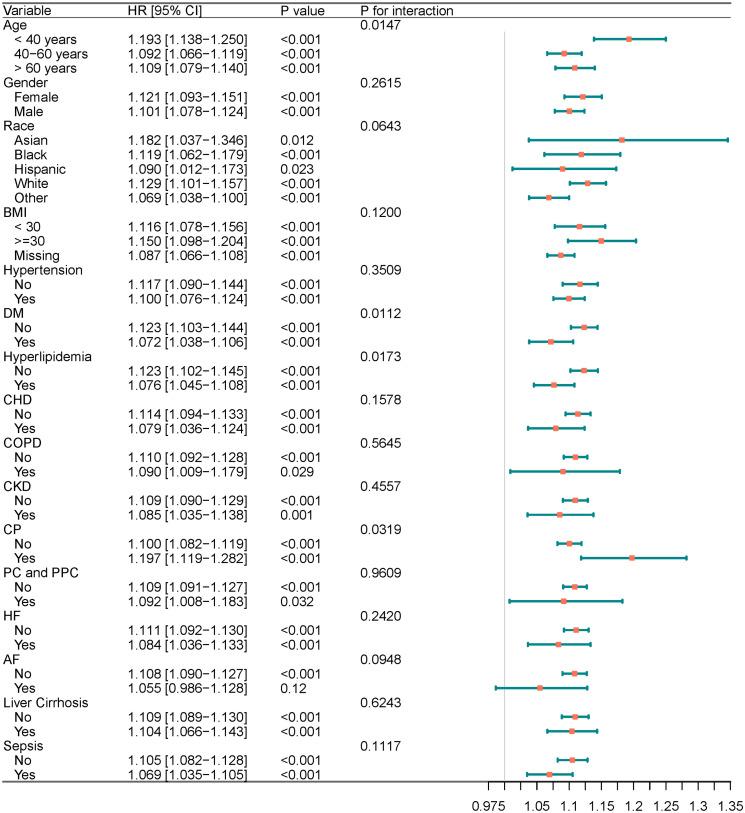
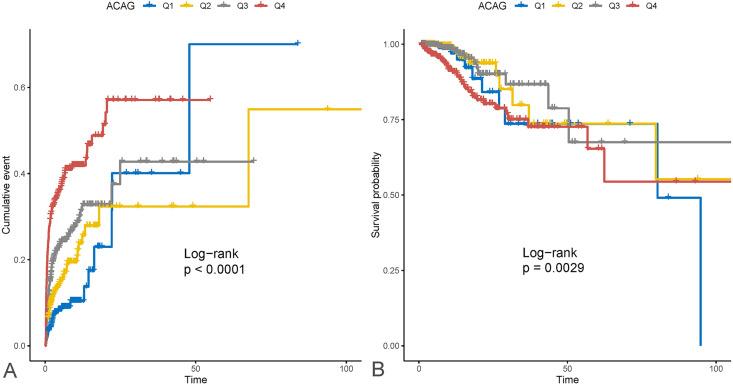
Higher ACAG levels were significantly related to an elevated risk of AKI. The RCS model demonstrated a nonlinear correlation between higher ACAG levels and increased AKI risk in the AP cohort, and a linear association of ACAG with in-hospital death. KM survival analysis showed that patients exhibiting higher ACAG levels had poorer renal function outcomes and higher ICU mortality. Subgroup analyses further proved this correlation across varied patient characteristics.
CONCLUSIONS
Elevated ACAG is an independent predictor of AKI risk in the AP cohort. ACAG may be useful for early AKI risk stratification and clinical decision-making in critically ill AP sufferers.
目的
急性肾损伤(AKI)是急性胰腺炎(AP)常见且严重的并发症,与患者预后密切相关。白蛋白校正阴离子间隙(ACAG)是一种改良的酸碱平衡评估指标,在各种危重病中具有潜在的临床意义。然而,ACAG在预测AP患者发生AKI风险中的作用仍不明确。本研究旨在阐明ACAG水平与AP人群中AKI风险之间的关系。
方法
这项回顾性研究利用了MIMIC-IV数据库中的数据,包括1552名在重症监护病房(ICU)住院期间被诊断为AP的成年患者。使用标准公式计算ACAG,并根据患者的ACAG水平进行分组。采用Cox比例风险模型和受限立方样条(RCS)模型评估ACAG水平与AP患者发生AKI风险的相关性。AKI的发生率是主要结局,院内死亡率是次要结局。通过Kaplan-Meier(KM)生存分析评估ACAG组之间主要和次要结局的差异。进行亚组分析以检验混杂因素的影响。
结果
较高的ACAG水平与AKI风险升高显著相关。RCS模型显示,在AP队列中,较高的ACAG水平与AKI风险增加之间存在非线性相关性,而ACAG与院内死亡之间存在线性关联。KM生存分析表明,ACAG水平较高的患者肾功能结局较差,ICU死亡率较高。亚组分析进一步证实了在不同患者特征中这种相关性。
结论
ACAG升高是AP队列中AKI风险的独立预测因素。ACAG可能有助于对危重症AP患者进行早期AKI风险分层和临床决策。


 Zotero 插件