
超声引导下竖脊肌平面阻滞联合椎旁阻滞对胸腔镜肺叶切除术后疼痛反弹的影响
The impact of ultrasound-guided erector spinae plane block combined with paravertebral block on postoperative rebound pain following thoracoscopic lobectomy.
作者信息
He Yihang, Chen Dongxu, Zuo Youbo, Lin Jing
机构信息
Department of Anesthesiology, Affiliated Hospital of North Sichuan Medical College, Nanchong, Sichuan, China.
Department of Anesthesiology, West China Second University Hospital, Sichuan University, Chengdu, Sichuan, China.
出版信息
Front Med (Lausanne). 2025 Aug 7;12:1651245. doi: 10.3389/fmed.2025.1651245. eCollection 2025.
BACKGROUND
Thoracic paravertebral block (TPVB) is the mainstream analgesic regimen for post-video-assisted thoracoscopic surgery (VATS) pain management. However, rebound pain frequently emerges once the block effect subsides. Given that the erector spinae plane block (ESPB) may modulate the incidence of rebound pain through its mechanism of local anesthetic diffusion into the paravertebral space, this study sought to evaluate whether combining TPVB with ESPB could effectively reduce postoperative rebound pain in VATS patients.
METHODS
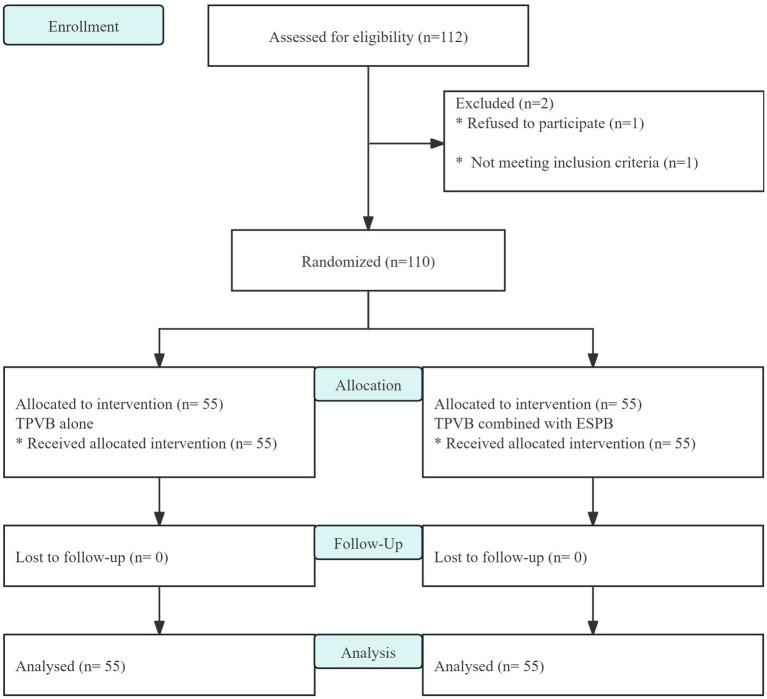
A total of 110 patients scheduled for elective video-assisted thoracoscopic lobectomy were enrolled and randomly allocated via a random number table to either the TPVB group (Group P, = 55) or the TPVB combined with ESPB group (Group PE, = 55). In Group P, TPVB was performed under oblique axial scanning at the T5 level using the in-plane technique, with 20 mL of 0.5% ropivacaine administered. In Group PE, TPVB was first performed with 10 mL of 0.5% ropivacaine; the needle was then withdrawn and repositioned with its tip deep to the erector spinae muscle at the transverse process level, followed by injection of 10 mL of 0.5% ropivacaine for ESPB. The primary outcome was the incidence of rebound pain within 24 h postoperatively. Secondary outcomes included: Numeric Rating Scale (NRS) scores at rest (quiet supine position) and during activity (coughing and expectoration) on postoperative day 1 morning (D1 am), evening (D1 pm), day 2 morning (D2 am), and evening (D2 pm); time to first rebound pain within 24 h; Modified Rebound Pain Scale (MRPS) score; Quality of Recovery-15 (QoR-15) scores on postoperative days 1 and 2; total sufentanil consumption via patient-controlled intravenous analgesia (PCIA) over 48 h; number of rescue analgesia doses administered in the ward; postoperative hospital stay; patient satisfaction score at discharge; and postoperative complication rate.
RESULTS
Compared with Group P, Group PE had a significantly lower incidence of rebound pain within 24 h postoperatively (23.64% vs. 47.27%, = 0.010) and a significantly reduced MRPS score (3.06 ± 1.75 vs. 3.84 ± 2.05; = 0.035). Additionally, Group PE had lower activity-related NRS scores on D1 am ( = 0.010), D1 pm ( < 0.001), and D2 pm ( = 0.031), as well as a lower resting NRS score on D1 am ( = 0.048). Furthermore, Group PE showed higher QoR-15 scores on both postoperative days 1 and 2 ( < 0.05), reduced 48-h PCIA sufentanil consumption ( = 0.002), fewer rescue analgesia requirements ( = 0.048), and a shorter postoperative hospital stay ( < 0.001).
CONCLUSION
Compared with TPVB alone, the combination of TPVB and ESPB significantly reduces the incidence of postoperative rebound pain, prolongs analgesic duration, and improves the quality of postoperative recovery.
背景
胸椎旁神经阻滞(TPVB)是电视辅助胸腔镜手术(VATS)后疼痛管理的主流镇痛方案。然而,一旦阻滞效果消退,反弹痛经常出现。鉴于竖脊肌平面阻滞(ESPB)可能通过其局麻药扩散至椎旁间隙的机制来调节反弹痛的发生率,本研究旨在评估TPVB联合ESPB是否能有效降低VATS患者术后的反弹痛。
方法
总共纳入110例行择期电视辅助胸腔镜肺叶切除术的患者,并通过随机数字表随机分为TPVB组(P组,n = 55)或TPVB联合ESPB组(PE组,n = 55)。在P组中,采用平面内技术在T5水平进行斜轴扫描下的TPVB,注入20 mL 0.5%罗哌卡因。在PE组中,首先用10 mL 0.5%罗哌卡因进行TPVB;然后拔出针头并重新定位,使其尖端位于横突水平的竖脊肌深处,接着注入10 mL 0.5%罗哌卡因进行ESPB。主要结局是术后24小时内反弹痛的发生率。次要结局包括:术后第1天上午(D1 am)、晚上(D1 pm)、第2天上午(D2 am)和晚上(D2 pm)静息(安静仰卧位)和活动(咳嗽和咳痰)时的数字评分量表(NRS)评分;24小时内首次出现反弹痛的时间;改良反弹痛量表(MRPS)评分;术后第1天和第2天的恢复质量-15(QoR-15)评分;48小时内通过患者自控静脉镇痛(PCIA)的舒芬太尼总消耗量;在病房给予的补救镇痛剂量数;术后住院时间;出院时患者满意度评分;以及术后并发症发生率。
结果
与P组相比,PE组术后24小时内反弹痛的发生率显著更低(23.64%对47.27%,P = 0.010),且MRPS评分显著降低(3.06±1.75对3.84±2.05;P = 0.035)。此外,PE组在D1 am(P = 0.010)、D1 pm(P < 0.001)和D2 pm(P = 0.031)时与活动相关的NRS评分更低,以及在D1 am时静息NRS评分更低(P = 0.048)。此外,PE组在术后第1天和第2天的QoR-15评分更高(P < 0.05),48小时PCIA舒芬太尼消耗量减少(P = 0.002),补救镇痛需求更少(P = 0.048),且术后住院时间更短(P < 0.001)。
结论
与单独使用TPVB相比,TPVB联合ESPB显著降低术后反弹痛的发生率,延长镇痛持续时间,并改善术后恢复质量。



 Zotero 插件