
通过使用1纳米厚的碳纳米膜进行生物功能化,利用表面等离子体共振对严重急性呼吸综合征冠状病毒2(SARS-CoV-2)蛋白进行高灵敏度无标记检测。
Highly sensitive and label-free detection of SARS-CoV-2 proteins via surface plasmon resonance using biofunctionalization with 1 nm thick carbon nanomembranes.
作者信息
Eshaghi Ghazaleh, Kaiser David, Rasouli Hamid Reza, Ennaciri Rania, Frey Martha, Neumann Christof, Gary Dominik, Fischer Tobias, Frankenfeld Katrin, Turchanin Andrey
机构信息
Institute of Physical Chemistry, Friedrich Schiller University Jena, 07743, Jena, Germany.
fzmb GmbH, Forschungszentrum für Medizintechnik und Biotechnologie, 99947, Bad Langensalza, Germany.
出版信息
Sci Rep. 2025 Aug 25;15(1):31248. doi: 10.1038/s41598-025-16342-5.
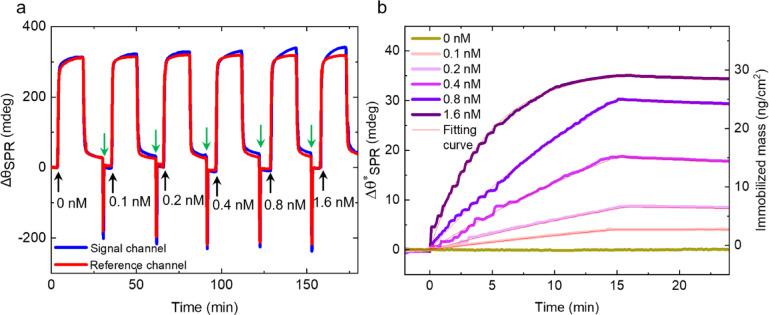
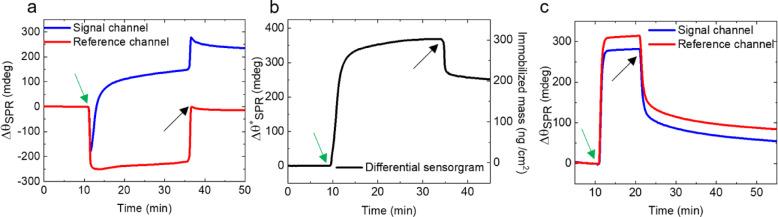
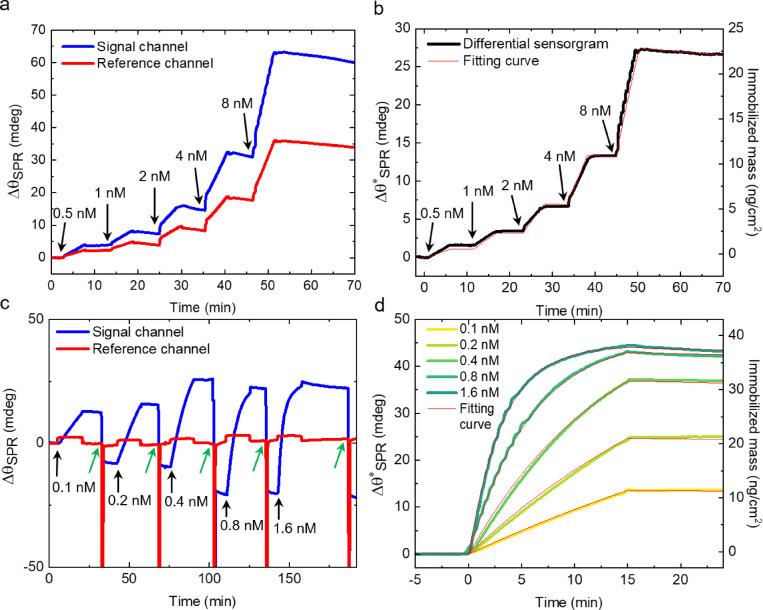
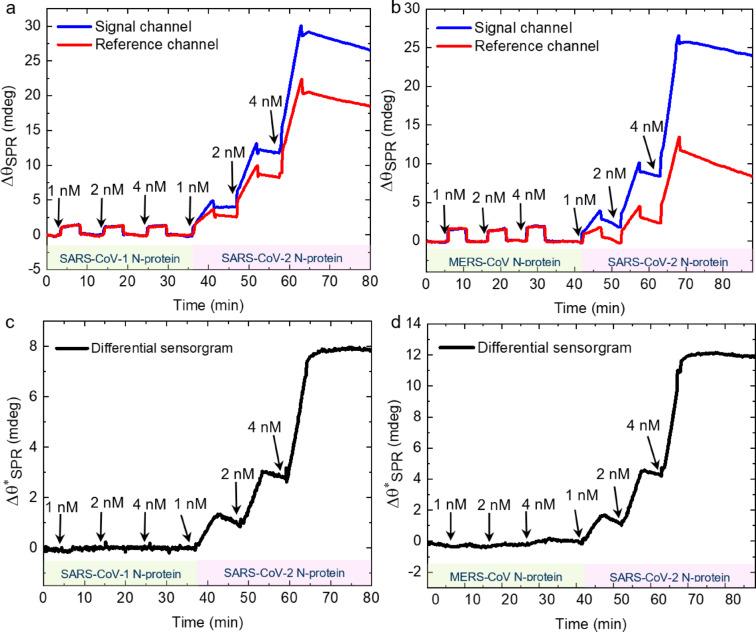
Here we report a novel platform for the detection of nucleocapsid (N) and receptor-binding domain (RBD) of spike (S) proteins of SARS-CoV-2 viruses using the surface plasmon resonance (SPR) technique. We demonstrate that the functionalization of SPR sensors with molecular 2D materials - 1 nm thick carbon nanomembranes (CNMs) significantly enhances sensitivity. CNMs terminated with azide linker (N-CNM) enable covalent bonding of SARS-CoV-2 antibodies for specific immobilization of the N- and S-proteins to the sensor surface. The successful and stable hierarchical functionalization is confirmed by multiparametric SPR measurements complemented with X-ray photoelectron spectroscopy and polarization modulation infrared reflection absorption spectroscopy. The obtained equilibrium dissociation constants (K) for the N-protein and the S-protein in the physiological buffer are 570 ± 50 pM and 22 ± 2 pM and the low detection limits (LODs) are ~ 190 pM and ~ 10 pM, respectively. The high specificity of the developed sensors is shown via their negligible cross-reactivity with SARS-CoV-1 and MERS-CoV proteins. Finally, detection of SARS-CoV-2 proteins in nasopharyngeal swab samples with the LOD of ~ 40 pM is demonstrated. The proposed methodology enables the development of biosensors that cover clinically relevant range for the direct and immediate detection of SARS-CoV-2 without any amplification or labeling.
在此,我们报告了一种利用表面等离子体共振(SPR)技术检测严重急性呼吸综合征冠状病毒2(SARS-CoV-2)病毒核衣壳(N)蛋白和刺突(S)蛋白受体结合域(RBD)的新型平台。我们证明,用分子二维材料——1纳米厚的碳纳米膜(CNM)对SPR传感器进行功能化可显著提高灵敏度。用叠氮连接子终止的CNM(N-CNM)能够使SARS-CoV-2抗体共价结合,从而将N蛋白和S蛋白特异性固定在传感器表面。通过多参数SPR测量,并辅以X射线光电子能谱和偏振调制红外反射吸收光谱,证实了成功且稳定的分级功能化。在生理缓冲液中获得的N蛋白和S蛋白的平衡解离常数(K)分别为570±50 pM和22±2 pM,低检测限(LOD)分别约为190 pM和约10 pM。所开发传感器的高特异性通过其与SARS-CoV-1和中东呼吸综合征冠状病毒(MERS-CoV)蛋白的交叉反应可忽略不计得以体现。最后,展示了在鼻咽拭子样本中检测SARS-CoV-2蛋白,检测限约为40 pM。所提出的方法能够开发出覆盖临床相关范围的生物传感器,用于直接即时检测SARS-CoV-2,无需任何扩增或标记。


 Zotero 插件