
一种“抗大流行”的疫情检测方法,改编自新冠疫情对荷兰传染病通报的影响:监测研究
A "Pandemic-Proof" Methodology for Outbreak Detection Adapted From COVID-19's Impact on Notifications of Infectious Diseases in the Netherlands: Surveillance Study.
作者信息
van Deursen Babette, Raven Stijn, van den Bosch Wolfer, van Jaarsveld Cornelia H M, Timen Aura
机构信息
Department of Primary and Community Care, Research Institute for Medical Innovation, Radboud University Medical Center, Geert Grooteplein 21, Nijmegen, 6500 HB, The Netherlands, +31622989091.
Department of Infectious Disease Control, Public Health Service region Utrecht, Zeist, The Netherlands.
出版信息
JMIR Public Health Surveill. 2025 Aug 26;11:e73953. doi: 10.2196/73953.
BACKGROUND
Reporting of notifiable infectious diseases was overall impacted by the COVID-19 pandemic. This could affect disease surveillance and thus, outbreak detection, as it is based on historical data. For effective outbreak detection, it is crucial that communicable disease control professionals can rely on accurate and valuable alarm thresholds to ensure timely and adequate response to potential outbreaks.
OBJECTIVE
In this study, we take the first steps in the development of a methodology that adjusts for the impact of the COVID-19 pandemic on the number of notifications of notifiable infectious diseases and provides corrected alarm thresholds for outbreak detection. We identify which infectious diseases were affected by the COVID-19 pandemic, assess the duration of these effects, and explore potential correction methods to improve outbreak detection.
METHODS
We analyzed cases of 25 notifiable infectious diseases reported from 2015-2023 in the Netherlands. Negative binomial regression was used to calculate the incidence rate ratios for each period: pre-COVID-19 pandemic, COVID 2020, COVID 2021, COVID 2022, and post-COVID-19 pandemic. To address the decrease in notifications during the COVID-19 pandemic, we tested 3 correction methods: (1) recoding COVID-19 years as missing; (2) imputing with the last pre-COVID-19 pandemic observation; and (3) imputing the historical moving average.
RESULTS
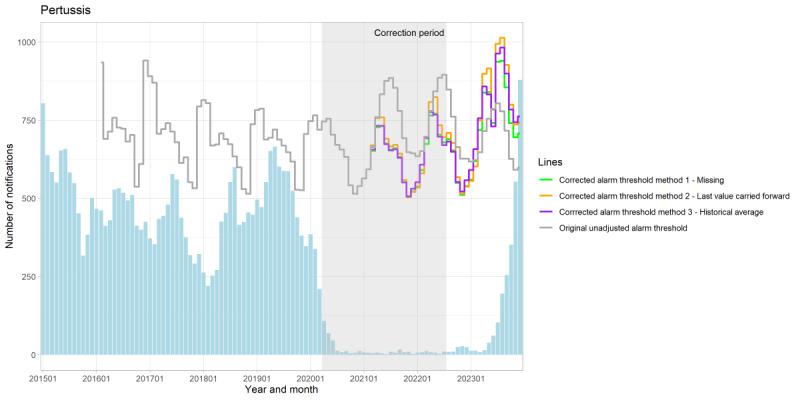
Between 2015-2023, a total of 74,990 notifications were reported in the Netherlands, of which 9,836 notifications (13%) occurred during the COVID-19 pandemic. Malaria, typhoid fever, hepatitis A, meningococcal infection, paratyphoid fever, Q-fever, shigellosis, measles, mumps, and pertussis had significantly lower notifications during the COVID-19 pandemic, but the duration and magnitude of the effect differed among the infections. The effect of the COVID-19 pandemic on the notifications of malaria (incidence rate ratio [IRR] 0.17, 95% CI 0.08-0.36) and typhoid fever (IRR 0.12, 95% CI 0.02-0.55) was only seen in 2020, while the notifications for measles (IRR 0.34, 95% CI 0.15-0.75) and pertussis (IRR 0.34, 95% CI 0.20-0.60) were still significantly lower in the post-COVID-19 pandemic period. In addition, the newly calculated alarm thresholds showed a noticeable difference compared with the original unadjusted alarm thresholds. However, the variation among the 3 different corrected alarm thresholds was not substantial.
CONCLUSIONS
During the COVID-19 pandemic, notifications of 10 infectious diseases declined significantly. The duration of this decline varied among infections, highlighting the need for pattern-specific adjustments. Our study demonstrates that accounting for the reduced notifications impacts alarm threshold calculations for outbreak detection. We therefore recommend amending the alarm thresholds to account for this impact to ensure reliable outbreak detection, so that communicable disease control professionals can act in a timely and data-driven manner. The next step in the development of the "pandemic-proof" methodology is to determine which correction method is most suitable. Further validation by communicable disease control professionals is essential to assess the applicability of the adjusted alarm thresholds for outbreak detection.
背景
法定传染病报告总体受到新冠疫情的影响。这可能会影响疾病监测,进而影响疫情检测,因为疫情检测是基于历史数据的。对于有效的疫情检测而言,传染病防控专业人员能够依赖准确且有价值的警报阈值以确保对潜在疫情做出及时且充分的应对至关重要。
目的
在本研究中,我们迈出了开发一种方法的第一步,该方法可调整新冠疫情对法定传染病报告数量的影响,并为疫情检测提供校正后的警报阈值。我们确定哪些传染病受到了新冠疫情的影响,评估这些影响的持续时间,并探索潜在的校正方法以改善疫情检测。
方法
我们分析了荷兰2015年至2023年报告的25种法定传染病病例。使用负二项回归计算每个时期的发病率比:新冠疫情前、2020年新冠疫情期间、2021年新冠疫情期间、2022年新冠疫情期间以及新冠疫情后。为解决新冠疫情期间报告数量的下降问题,我们测试了3种校正方法:(1)将新冠疫情年份重新编码为缺失值;(2)用新冠疫情前的最后一次观测值进行插补;(3)插补历史移动平均值。
结果
2015年至2023年期间,荷兰共报告了74990例病例,其中9836例(13%)发生在新冠疫情期间。疟疾、伤寒、甲型肝炎、脑膜炎球菌感染、副伤寒、Q热、志贺氏菌病、麻疹、腮腺炎和百日咳在新冠疫情期间的报告数量显著降低,但不同感染的影响持续时间和程度有所不同。新冠疫情对疟疾(发病率比[IRR]0.17,95%置信区间0.08 - 0.36)和伤寒(IRR 0.12,95%置信区间0.02 - 0.55)报告数量的影响仅在2020年出现,而麻疹(IRR 0.34,95%置信区间0.15 - 0.75)和百日咳(IRR 0.34,95%置信区间0.20 - 0.60)在新冠疫情后时期的报告数量仍显著较低。此外,新计算的警报阈值与原始未调整的警报阈值相比显示出明显差异。然而,3种不同校正后的警报阈值之间的差异并不显著。
结论
在新冠疫情期间,10种传染病的报告数量显著下降。这种下降的持续时间因感染而异,凸显了针对特定模式进行调整的必要性。我们的研究表明,考虑报告数量减少会影响疫情检测的警报阈值计算。因此,我们建议调整警报阈值以考虑这种影响,以确保可靠的疫情检测,以便传染病防控专业人员能够及时且基于数据采取行动。“抗疫情”方法开发的下一步是确定哪种校正方法最合适。传染病防控专业人员的进一步验证对于评估调整后的警报阈值在疫情检测中的适用性至关重要。


 Zotero 插件