
晚期肺癌患者发生免疫检查点抑制剂相关肾上腺功能不全的临床特征及免疫治疗疗效
Clinical characteristics and immunotherapy efficacy in advanced lung cancer patients with immune checkpoint inhibitor-related adrenal insufficiency.
作者信息
Xu Lu, Zhang Xinjie, Yao Wang, Wong Vincent Kam Wai
机构信息
Dr. Neher's Biophysics Laboratory for Innovative Drug Discovery, State Key Laboratory of Quality Research in Chinese Medicine, Faculty of Chinese Medicine, Macau University of Science and Technology, Macau, China.
Department of Cancer Center, The Fifth Affiliated Hospital of Wenzhou Medical University, Lishui, China.
出版信息
Medicine (Baltimore). 2025 Aug 22;104(34):e43983. doi: 10.1097/MD.0000000000043983.
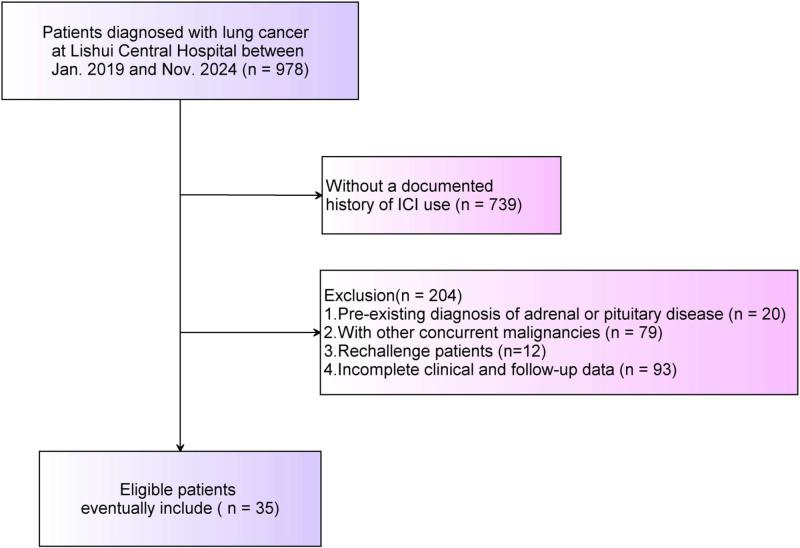
To investigate the clinical characteristics and treatment efficacy in advanced lung cancer patients with adrenal insufficiency (AI) induced by immune checkpoint inhibitors (ICIs). A retrospective study was conducted on advanced lung cancer patients who developed AI following ICI treatment at Lishui Central Hospital between January 2019 and November 2024. Patients from both the Oncology and Respiratory & Critical Care Departments were included. Clinical data, laboratory results, imaging findings, and the association between secondary AI onset and treatment efficacy were analyzed. A total of 35 patients were included in the study. Of these, 2 patients (5.7%) achieved complete response, 8 patients (22.9%) achieved partial response, 24 patients (68.6%) had stable disease and 1 case (2.9%) showed progressive disease. The overall response rate was 31.8%, with a duration of response of 100%. The median progression-free survival (PFS) for all patients was 10.9 months (95% CI: 6.959-14.841). PFS significantly differed between patients who developed secondary AI within 3 months of ICI initiation and those who developed it later (8.0 months vs 11.0 months, P = .033). Secondary AI is a rare but significant immune-related adverse event associated with ICIs. Advanced lung cancer patients with secondary AI tend to exhibit a more favorable response to immunotherapy. The timing of AI onset appears to critically influence ICI efficacy, with late-onset AI (>3 months) correlating with markedly prolonged PFS - a novel prognostic association not previously reported.
探讨免疫检查点抑制剂(ICI)诱导的晚期肺癌患者肾上腺功能不全(AI)的临床特征及治疗疗效。对2019年1月至2024年11月在丽水市中心医院接受ICI治疗后发生AI的晚期肺癌患者进行回顾性研究。纳入肿瘤内科和呼吸与重症医学科的患者。分析临床资料、实验室检查结果、影像学表现以及继发性AI发生与治疗疗效之间的关系。本研究共纳入35例患者。其中,2例(5.7%)达到完全缓解,8例(22.9%)达到部分缓解,24例(68.6%)病情稳定,1例(2.9%)疾病进展。总缓解率为31.8%,缓解持续时间为100%。所有患者的中位无进展生存期(PFS)为10.9个月(95%CI:6.959 - 14.841)。ICI开始治疗后3个月内发生继发性AI的患者与之后发生的患者之间的PFS有显著差异(8.0个月对11.0个月,P = 0.033)。继发性AI是一种罕见但与ICI相关的重要免疫相关不良事件。发生继发性AI的晚期肺癌患者对免疫治疗往往表现出更有利的反应。AI发病时间似乎对ICI疗效有至关重要的影响,AI发病较晚(>3个月)与PFS显著延长相关——这是一个此前未报道的新的预后关联。



 Zotero 插件