
ECHO队列研究中孕期环境酚类混合物与儿童睡眠质量的关系
Environmental phenol mixture during pregnancy and child sleep quality in the ECHO cohort.
作者信息
Geiger Sarah D, Xun Xiaoshuang, Zhang Cai, Chandran Aruna, Madan Kritika, Kim Grace, Naveed Fatima, Woodbury Megan, Goin Dana E, Eick Stephanie M, Blackwell Courtney K, Mansolf Maxwell, Aung Max, Alshawabkeh Akram, Dabelea Dana, Dunlop Anne L, Ferrara Assiamira, Hash Jonika B, Hedderson Monique, Jansen Erica, LeBourgeois Monique, O'Brien Louise, Zhu Yeyi, Schantz Susan L
机构信息
Beckman Institute for Advanced Science and Technology, University of Illinois at Urbana-Champaign, Urbana, IL, United States.
Department of Kinesiology and Community Health, University of Illinois at Urbana-Champaign, Urbana, IL, United States.
出版信息
Front Pediatr. 2025 Aug 8;13:1533015. doi: 10.3389/fped.2025.1533015. eCollection 2025.
INTRODUCTION
Poor sleep quality in childhood can predict sleep quality throughout the lifecourse and other health outcomes. Endocrine-disrupting chemicals can affect adults' sleep quality, and prenatal phenol exposure impacts fetal development.
OBJECTIVE
To assess associations between prenatal phenol concentrations and child sleep outcomes.
METHODS
We used data from the National Institutes of Health-funded Environmental influences on Child Health Outcomes (ECHO) Cohort ( = 1,198) that were collected from 2008 to 2019 at several sites across the United States. The present analysis was conducted in 2023-2024. Using single-pollutant and mixture models, we examined associations between prenatal phenol concentrations and three key child sleep quality outcomes: sleep problems, disturbance, and impairment. Child sleep outcomes were assessed using the Child Behavior Checklist (CBCL) and the Patient-Reported Outcomes Measurement Information System (PROMIS) Sleep Disturbance and Sleep-Related Impairment scales. Unadjusted and multivariable-adjusted models were examined, with stratified models and interaction terms used to examine interactions with child sex.
RESULTS
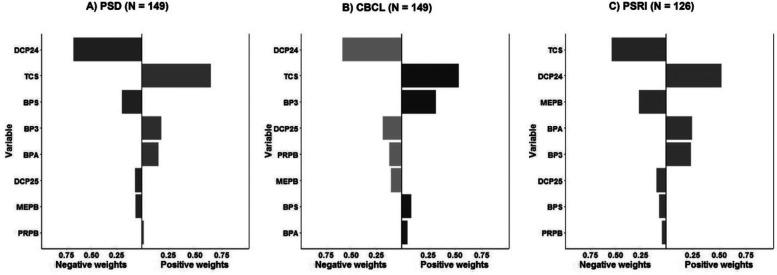
Of the eight phenols assessed, higher prenatal methylparaben concentrations were associated with lower child sleep-related impairment scores ( = -4.79, 95% CI: -9.45 to -0.14). Sex modified the associations for benzophenone-3 and PROMIS sleep disturbance T-scores, where the association was stronger among boys (tertile 3 vs. 1, = 3.20; 95% CI: 0.27-6.14; = 0.033) and did not persist among girls. Bisphenol A was associated with sleep-related impairment among boys (tertile 2 vs. 1, = -5.69; 95% CI: 0.55-10.82; = 0.031). Phenol mixtures were not associated with sleep outcomes overall or by sex.
CONCLUSION
The findings suggest that phenol exposure during pregnancy may be associated with child sleep quality and that child sex modifies this association.
引言
儿童睡眠质量差可预测其一生的睡眠质量及其他健康状况。内分泌干扰化学物质会影响成年人的睡眠质量,孕期接触苯酚会影响胎儿发育。
目的
评估孕期苯酚浓度与儿童睡眠状况之间的关联。
方法
我们使用了美国国立卫生研究院资助的“环境对儿童健康结果的影响”(ECHO)队列研究(n = 1198)的数据,这些数据于2008年至2019年在美国多个地点收集。本分析于2023年至2024年进行。我们使用单污染物模型和混合物模型,研究孕期苯酚浓度与儿童睡眠质量的三个关键结果之间的关联:睡眠问题、睡眠障碍和睡眠损害。儿童睡眠结果使用儿童行为检查表(CBCL)以及患者报告结果测量信息系统(PROMIS)睡眠障碍和睡眠相关损害量表进行评估。我们检查了未调整模型和多变量调整模型,并使用分层模型和交互项来检查与儿童性别的交互作用。
结果
在评估的八种苯酚中,孕期对羟基苯甲酸甲酯浓度较高与儿童睡眠相关损害得分较低相关(β = -4.79,95%CI:-9.45至-0.14)。性别改变了二苯甲酮-3与PROMIS睡眠障碍T评分之间的关联,男孩中的关联更强(三分位数3与1相比,β = 3.20;95%CI:0.27 - 6.14;P = 0.033),而女孩中不存在这种关联。双酚A与男孩的睡眠相关损害相关(三分位数2与1相比,β = -5.69;95%CI:0.55 - 10.82;P = 0.031)。苯酚混合物总体上或按性别与睡眠结果均无关联。
结论
研究结果表明,孕期接触苯酚可能与儿童睡眠质量有关,且儿童性别会改变这种关联。
 Zotero 插件