
缺氧诱导因子(HIF)与lncRNAs在消化系统肿瘤中的相互作用:从分子机制到临床转化
Crosstalk between hypoxia-inducible factor (HIF) and lncRNAs in digestive tumors: from molecular mechanisms to clinical translation.
作者信息
Gan Lifeng, Luo Peiyue, Zou Junrong, Li Wei, Chen Qi, Cheng Le, Zhang Fangtao, Zhong Haidong, Lu Yiran, Zheng Liying, Qian Biao
机构信息
The First Clinical College, Gannan Medical University, Ganzhou, Jiangxi, China.
Department of Urology, The First Affiliated hospital of Gannan Medical University, Ganzhou, Jiangxi, China.
出版信息
Front Cell Dev Biol. 2025 Aug 8;13:1611889. doi: 10.3389/fcell.2025.1611889. eCollection 2025.
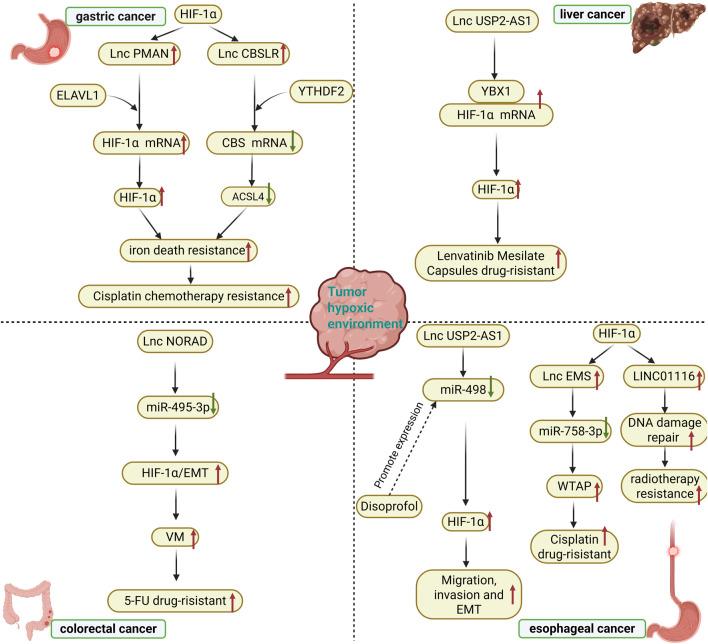
Hypoxia is a characteristic feature of the tumor microenvironment that significantly influences cancer progression and treatment responses. Hypoxia-inducible factor (HIF), a key regulator of hypoxic adaptation, has been demonstrated to modulate hypoxic gene expression profiles and signaling networks, thereby serving as a potential therapeutic target. Long-stranded non-coding RNAs (lncRNAs), defined as non-coding RNAs exceeding 200 nucleotides in length, regulate various cellular processes by modulating gene expression at transcriptional, post-transcriptional, and epigenetic levels. Evidence suggests that lncRNAs can be regulated by HIF at the transcriptional level. Conversely, HIF itself can be modulated by numerous lncRNAs, with alterations in these lncRNAs being associated with tumorigenesis, resulting in a reciprocal regulatory network. Recently, the critical role of lncRNAs in hypoxia-driven cancer progression has been elucidated in digestive tumors, including colorectal, pancreatic, gastric, and hepatocellular carcinomas. An increasing number of studies have revealed the complex interplay between lncRNAs and HIF in regulating various processes such as proliferation, metastasis, apoptosis, and drug resistance. In this paper, we aim to provide a comprehensive summary of recent advances regarding the roles of hypoxia and lncRNAs in digestive system tumors and to illustrate the mechanisms through which lncRNAs interact with hypoxia in tumor cells. This will enhance our understanding of the regulatory roles of lncRNAs in modulating the microenvironment of digestive system tumors, thereby facilitating the development of novel anticancer drugs.
缺氧是肿瘤微环境的一个特征,它显著影响癌症进展和治疗反应。缺氧诱导因子(HIF)是缺氧适应的关键调节因子,已被证明可调节缺氧基因表达谱和信号网络,因此是一个潜在的治疗靶点。长链非编码RNA(lncRNA)被定义为长度超过200个核苷酸的非编码RNA,它通过在转录、转录后和表观遗传水平上调节基因表达来调控各种细胞过程。有证据表明lncRNA在转录水平上可受HIF调控。相反,HIF自身也可被众多lncRNA调节,这些lncRNA的改变与肿瘤发生相关,从而形成一个相互调控的网络。最近,lncRNA在缺氧驱动的癌症进展中的关键作用已在包括结直肠癌、胰腺癌、胃癌和肝细胞癌在内的消化系肿瘤中得到阐明。越来越多的研究揭示了lncRNA与HIF在调节增殖、转移、凋亡和耐药等各种过程中的复杂相互作用。在本文中,我们旨在全面总结缺氧和lncRNA在消化系统肿瘤中作用的最新进展,并阐述lncRNA在肿瘤细胞中与缺氧相互作用的机制。这将增进我们对lncRNA在调节消化系统肿瘤微环境中调控作用的理解,从而推动新型抗癌药物的研发。

 Zotero 插件