
因卡膦酸二钠治疗乳腺癌骨转移患者的安全性及不良事件预测因素:一项回顾性研究
Safety Profile and Predictors of Adverse Events of Incadronate Disodium in Treating Breast Cancer Patients with Bone Metastases: A Retrospective Study.
作者信息
Zhou Shihan, Jiang Mingxia, Liu Jiaxuan, Zhang Mengqi, Li Mingxiao, He Maiyue, Abudureheiyimu Nilupai, Wang Wenna, Guan Xiuwen, Ma Fei, Xu Binghe, Li Qiao
机构信息
Department of Medical Oncology, National Cancer Center/National Clinical Research Center for Cancer/Cancer Hospital, Chinese Academy of Medical Sciences and Peking Union Medical College, Beijing, People's Republic of China.
Department of Medical Oncology, State Key Laboratory of Mocelular Oncology, National Cancer Center/Cancer Hospital, Chinese Academy of Medical Sciences and Peking Union Medical College, Beijing, People's Republic of China.
出版信息
Breast Cancer (Dove Med Press). 2025 Aug 20;17:727-739. doi: 10.2147/BCTT.S523392. eCollection 2025.
PURPOSE
Bone metastasis is a common complication in advanced breast cancer. Bisphosphonates like incadronate disodium have shown potential in reducing bone resorption and skeletal-related events. We therefore performed a retrospective study to evaluate the safety profile of incadronate disodium in breast cancer patients with bone metastases.
PATIENTS AND METHODS
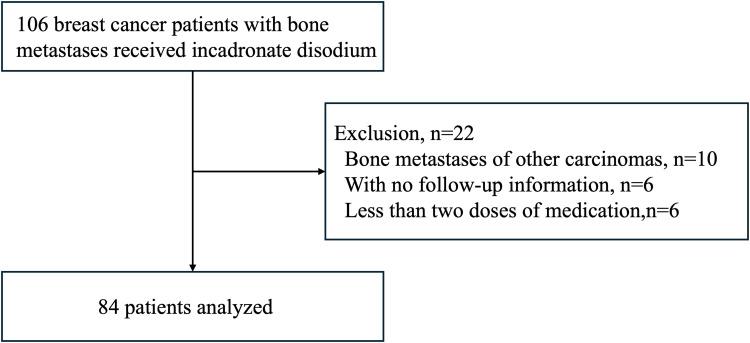
This retrospective study was conducted involving 84 breast cancer patients with bone metastases who received incadronate disodium treatment between February 2022 and August 2024 in our center. The primary endpoint was the incidence of dental-related issues and acute phase reactions, with an analysis of the associated risk factors. The secondary endpoint was the incidence of other adverse events. Adverse events were recorded during treatment and within 90 days post-treatment.
RESULTS
Dental-related issues were observed in 33.3% of patients and only one (1.2%) developed medication-related osteonecrosis of the jaw. Higher risk was significantly associated with prolonged treatment duration (OR = 4.33, 95% CI:1.21-15.50), secondary bone metastases (OR = 6.3, 95% CI:1.58-25.00), and lower hemoglobin levels (OR = 4.16, 95% CI:1.31-13.2) at multivariate analysis. 26.2% patients occurred acute phase reactions. Higher medication doses (OR = 1.41, 95% CI:1.07-2.05), multiple metastatic sites (OR = 4.22, 95% CI:1.39-15.89) and lower hemoglobin levels (OR = 3.27, 95% CI:1.21-9.22) were significant in univariate analysis, but not in multivariate analysis. Rare adverse effects included renal dysfunction (1.2%) and hypocalcemia (4.76%).
CONCLUSION
Incadronate disodium demonstrates a favorable safety profile for treating bone metastases in breast cancer patients. Identified risk factors, such as prolonged treatment duration and lower hemoglobin levels, highlight the need for intensified dental health management and personalized treatment strategies.
目的
骨转移是晚期乳腺癌常见的并发症。像因卡膦酸二钠这样的双膦酸盐已显示出在减少骨吸收和骨相关事件方面的潜力。因此,我们进行了一项回顾性研究,以评估因卡膦酸二钠在乳腺癌骨转移患者中的安全性。
患者与方法
本回顾性研究纳入了84例在2022年2月至2024年8月期间于我们中心接受因卡膦酸二钠治疗的乳腺癌骨转移患者。主要终点是牙科相关问题和急性期反应的发生率,并分析相关危险因素。次要终点是其他不良事件的发生率。在治疗期间及治疗后90天内记录不良事件。
结果
33.3%的患者出现牙科相关问题,仅有1例(1.2%)发生药物相关的颌骨坏死。多因素分析显示,治疗时间延长(OR = 4.33,95%CI:1.21 - 15.50)、继发性骨转移(OR = 6.3,95%CI:1.58 - 25.00)和血红蛋白水平较低(OR = 4.16,95%CI:1.31 - 13.2)与更高风险显著相关。26.2%的患者出现急性期反应。单因素分析显示,药物剂量较高(OR = 1.41,95%CI:1.07 - 2.05)、多个转移部位(OR = 4.22,95%CI:1.39 - 15.89)和血红蛋白水平较低(OR = 3.27,95%CI:1.21 - 9.22)具有统计学意义,但多因素分析中无统计学意义。罕见的不良反应包括肾功能不全(1.2%)和低钙血症(4.76%)。
结论
因卡膦酸二钠在治疗乳腺癌患者骨转移方面显示出良好的安全性。已确定的危险因素,如治疗时间延长和血红蛋白水平较低,凸显了加强牙科健康管理和个性化治疗策略的必要性。

 Zotero 插件