
探索质粒和防御系统在“极端嗜酸菌”中的生态进化作用。
Exploring the eco-evolutionary role of plasmids and defense systems in '' extreme acidophile.
作者信息
Pacheco-Acosta Sebastián, Castro-Toro Gustavo, Rojas-Villalobos Camila, Valenzuela Cesar, Haristoy Juan José, Zapata-Araya Abraham, Moya-Beltrán Ana, Sepúlveda-Rebolledo Pedro, Pérez-Rueda Ernesto, Ulloa Ricardo, Giaveno Alejandra, Issotta Francisco, Díez Beatriz, Beard Simón, Quatrini Raquel
机构信息
Programa de Doctorado en Inmunología y Microbiología, Facultad de Medicina, Universidad San Sebastián, Santiago, Chile.
Centro Científico y Tecnológico de Excelencia Ciencia & Vida, Santiago, Chile.
出版信息
Front Microbiol. 2025 Aug 11;16:1610279. doi: 10.3389/fmicb.2025.1610279. eCollection 2025.
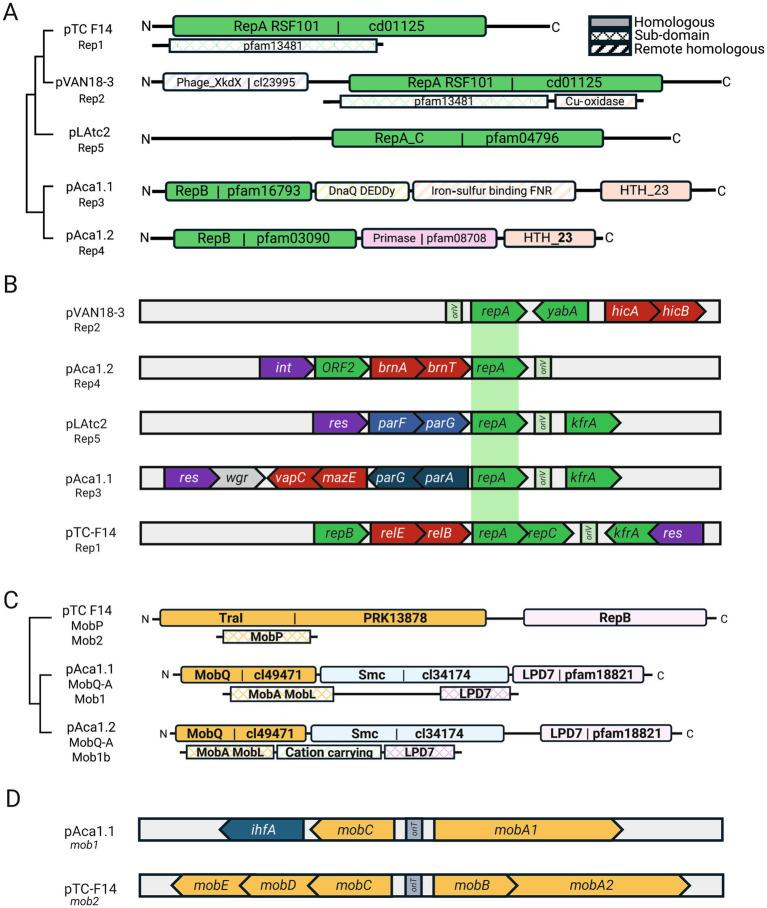
Plasmids are major drivers of microbial evolution, enabling horizontal gene transfer (HGT) and facilitating adaptation through the dissemination of relevant functional genes and traits. However, little is known about plasmid diversity and function in extremophiles. '', a meso-thermo-acidophilic sulfur oxidizer, is a key player in sulfur cycling in natural and industrially engineered acidic environments. Here, we present a bioinformatic analysis of the plasmidome, and associated anti-mobile genetic element (anti-MGE) defense systems (defensome), across genomes of this species and metagenomes from diverse natural and industrial settings harboring ''. We identified >30 distinct plasmids, representing five consistent replication-mobilization families. Plasmids ranged in size between 2.5-65 kb, with gene content and plasmid modularity scaling with element size and copy numbers inversely correlating with size. Plasmids carried variable numbers of hypothetical proteins and transposases, with annotated cargo genes reflecting functional differentiation by habitat. Defensome profiling revealed over 50 anti-MGE systems in sequenced '' isolates, including diverse restriction-modification systems, CRISPR-Cas types IV-A and V-F, and widespread abortive infection and composite defense systems such as Wadjet, Gabija, and Zorya. In environmental populations, an inverse relationship was observed between defensome complexity and plasmidome abundance and diversity, underscoring a pivotal role of the host defensome in modulating persistence, compatibility, and overall plasmid diversity across '' populations. Yet, other plasmids appeared decoupled from both host abundance and defensome complexity, suggesting potential host shifts, environmental persistence, or differential replication under suboptimal growth conditions for the host. Altogether, these findings point to a modular, functionally diverse adaptive plasmidome shaped by environmental pressures, by the interplay with the host's defensome, and likely also by other eco-evolutionary processes at play in natural environments. While these associations are compelling, causal relationships remain to be experimentally validated. These insights broaden our understanding of mobile genetic elements in extreme environments and provide a foundation for plasmid-based vector design and synthetic biology applications in acidophiles, with direct implications to biomining and environmental remediation.
质粒是微生物进化的主要驱动力,能够实现水平基因转移(HGT),并通过传播相关功能基因和性状促进适应性。然而,关于嗜极微生物中质粒的多样性和功能,我们所知甚少。嗜酸氧化硫硫杆菌是一种中温嗜酸硫氧化剂,在自然和工业工程酸性环境中的硫循环中起着关键作用。在此,我们对该物种的基因组以及来自含有嗜酸氧化硫硫杆菌的不同自然和工业环境的宏基因组中的质粒组及相关抗移动遗传元件(anti-MGE)防御系统(防御组)进行了生物信息学分析。我们鉴定出了30多种不同的质粒,代表了五个一致的复制-移动家族。质粒大小在2.5-65 kb之间,基因含量和质粒模块性随元件大小而变化,拷贝数与大小呈负相关。质粒携带数量不等的假设蛋白和转座酶,注释的货物基因反映了不同生境的功能分化。防御组分析揭示了测序的嗜酸氧化硫硫杆菌分离株中有50多种抗MGE系统,包括多种限制修饰系统、IV-A型和V-F型CRISPR-Cas,以及广泛存在的流产感染和复合防御系统,如瓦吉特、加比娅和佐里亚。在环境群体中,观察到防御组复杂性与质粒组丰度和多样性之间呈反比关系,这突出了宿主防御组在调节嗜酸氧化硫硫杆菌群体中的持久性、兼容性和整体质粒多样性方面的关键作用。然而,其他质粒似乎与宿主丰度和防御组复杂性均脱钩,这表明可能存在宿主转移、环境持久性或在宿主生长条件次优时的差异复制。总之,这些发现表明存在一个由环境压力、与宿主防御组的相互作用以及可能还由自然环境中其他生态进化过程塑造的模块化、功能多样的适应性质粒组。虽然这些关联很有说服力,但因果关系仍有待实验验证。这些见解拓宽了我们对极端环境中移动遗传元件的理解,并为嗜酸菌中基于质粒的载体设计和合成生物学应用提供了基础,对生物采矿和环境修复具有直接意义。




 Zotero 插件