
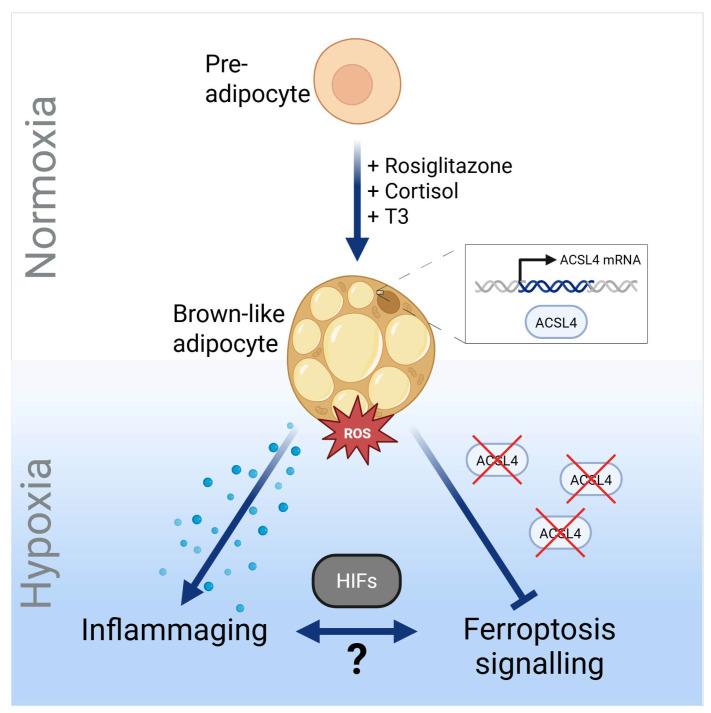
在类棕色脂肪生成过程中获得了通过ACSL4介导的铁死亡的能力,并且该能力受缺氧影响。
The Capability to Undergo ACSL4-Mediated Ferroptosis Is Acquired During Brown-like Adipogenesis and Affected by Hypoxia.
作者信息
Mandl Markus, Heuboeck Elisabeth, Benedikt Peter, Huber Florian, Mamunchak Olga, Grossmann Sonja, Kotnik Michaela, Hamzic-Jahic Esma, Bhogal Charnkamal Singh, Lipp Anna-Maria, Raml Edeltraud, Zwerschke Werner, Wabitsch Martin, Voelkl Jakob, Zierer Andreas, Bernhard David
机构信息
Institute for Physiology and Pathophysiology, Department of Pathophysiology, Johannes Kepler University Linz, Krankenhausstrasse 5, 4020 Linz and Altenberger Strasse 69, 4040 Linz, Austria.
Clinical Research Institute for Cardiovascular and Metabolic Diseases, Medical Faculty, Johannes Kepler University Linz, Altenberger Strasse 69, 4040 Linz, Austria.
出版信息
Cells. 2025 Aug 13;14(16):1247. doi: 10.3390/cells14161247.
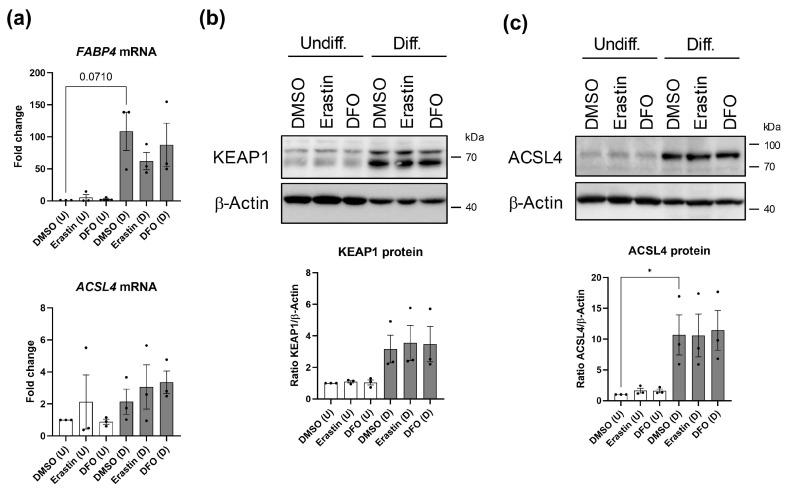
Adipose tissue enlargement in obesity leads to hypoxia, which may promote premature aging. This study aimed to understand the hypoxic response in 3D cultures of SGBS cells, a model for brown-like adipose tissue expressing uncoupling protein 1 (UCP1). Single-nucleus RNA sequencing of SGBS organoids revealed a heterogeneous composition and sub-population-specific responses to hypoxia. The analysis identified a cluster of transcriptional repression, indicating dying cells, and implied a role of ferroptosis in this model. Further experiments with SGBS cells and white adipose tissue-derived stem/progenitor cells showed that Acyl-CoA synthetase long-chain family member 4 (ACSL4), a key enzyme in ferroptosis, is expressed only in the presence of browning factors. Hypoxia downregulated ACSL4 protein in SGBS organoids but induced an inflammaging phenotype. Analysis of brown-like epicardial adipose tissue from cardiac surgery patients revealed a significant positive correlation of ACSL4 mRNA with UCP1 and hypoxia-inducible pro-inflammatory markers, while ACSL4 protein appeared to be inversely correlated. In conclusion, this study demonstrates that adipocytes' capability to undergo ACSL4-mediated ferroptosis is linked to brown-like adipogenesis, suggesting an opportunity to modulate ferroptotic signaling in adipose tissue. The dual role of hypoxia by inhibiting ACSL4 but promoting inflammaging indicates a relationship between ferroptosis and aging that warrants further investigation.
肥胖时脂肪组织增大导致缺氧,这可能会促进早衰。本研究旨在了解SGBS细胞三维培养物中的缺氧反应,SGBS细胞是一种表达解偶联蛋白1(UCP1)的棕色样脂肪组织模型。对SGBS类器官进行单核RNA测序,揭示了其异质性组成以及对缺氧的亚群特异性反应。分析确定了一组转录抑制,表明细胞正在死亡,并暗示铁死亡在该模型中的作用。对SGBS细胞和白色脂肪组织来源的干/祖细胞进行的进一步实验表明,铁死亡中的关键酶酰基辅酶A合成酶长链家族成员4(ACSL4)仅在存在褐变因子时表达。缺氧下调了SGBS类器官中ACSL4蛋白的表达,但诱导了炎症衰老表型。对心脏手术患者的棕色样心外膜脂肪组织分析显示,ACSL4 mRNA与UCP1和缺氧诱导的促炎标志物呈显著正相关,而ACSL4蛋白似乎呈负相关。总之,本研究表明脂肪细胞发生ACSL4介导的铁死亡的能力与棕色样脂肪生成有关,提示有机会调节脂肪组织中的铁死亡信号。缺氧通过抑制ACSL4但促进炎症衰老的双重作用表明铁死亡与衰老之间的关系值得进一步研究。




 Zotero 插件