
哪些因素有助于或阻碍老年人进行年度健康检查以检测和管理认知障碍?一项以实施研究综合框架为指导的范围综述
What Helps or Hinders Annual Wellness Visits for Detection and Management of Cognitive Impairment Among Older Adults? A Scoping Review Guided by the Consolidated Framework for Implementation Research.
作者信息
Okpalauwaekwe Udoka, Franks Hannah, Kuo Yong-Fang, Raji Mukaila A, Passy Elise, Tzeng Huey-Ming
机构信息
Department of Academic Family Medicine, College of Medicine, University of Saskatchewan, Saskatoon, SK S7M 3Y5, Canada.
Health System, The University of Texas Medical Branch, Galveston, TX 77555, USA.
出版信息
Nurs Rep. 2025 Aug 12;15(8):295. doi: 10.3390/nursrep15080295.
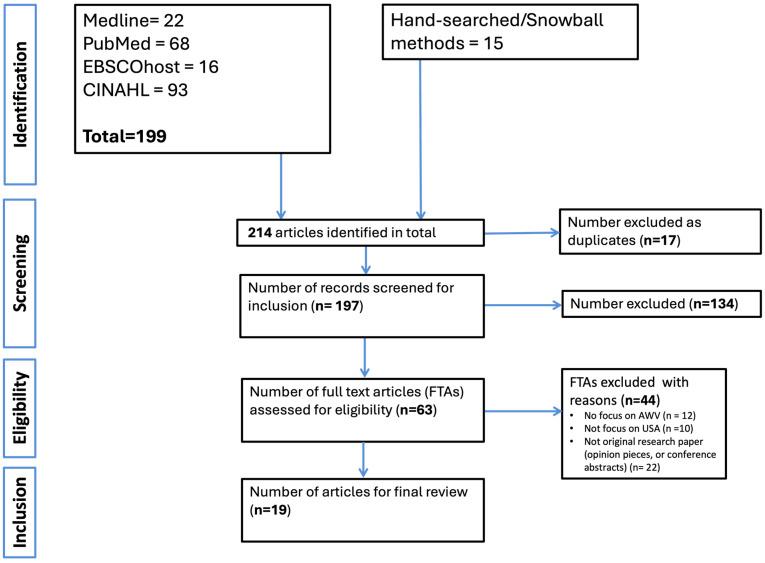
The U.S. Medicare Annual Wellness Visit (AWV) offers a structured opportunity for cognitive screening and personalized prevention planning among older adults. Yet, implementation of AWVs, particularly for individuals with cognitive impairment, remains inconsistent across primary care or other diverse care settings. We conducted a scoping review using the Consolidated Framework for Implementation Research (CFIR) to explore multilevel factors influencing the implementation of the Medicare AWV's cognitive screening component, with a focus on how these processes support the detection and management of cognitive impairment among older adults. We searched four databases and screened peer-reviewed studies published between 2011 and March 2025. Searches were conducted in Ovid MEDLINE, PubMed, EBSCOhost, and CINAHL databases. The initial search was completed on 3 January 2024 and updated monthly through 30 March 2025. All retrieved citations were imported into EndNote 21, where duplicates were removed. We screened titles and abstracts for relevance using the predefined inclusion criteria. Full-text articles were then reviewed and scored as either relevant (1) or not relevant (0). Discrepancies were resolved through consensus discussions. To assess the methodological quality of the included studies, we used the Joanna Briggs Institute critical appraisal tools appropriate to each study design. These tools evaluate rigor, trustworthiness, relevance, and risk of bias. We extracted the following data from each included study: Author(s), year, title, and journal; Study type and design; Data collection methods and setting; Sample size and population characteristics; Outcome measures; Intervention details (AWV delivery context); and Reported facilitators, barriers, and outcomes related to AWV implementation. The first two authors independently coded and synthesized all relevant data using a table created in Microsoft Excel. The CFIR guided our data analysis, thematizing our findings into facilitators and barriers across its five domains, viz: (1) Intervention Characteristics, (2) Outer Setting, (3) Inner Setting, (4) Characteristics of Individuals, and (5) Implementation Process. Among 19 included studies, most used quantitative designs and secondary data. Our CFIR-based synthesis revealed that AWV implementation is shaped by interdependent factors across five domains. Key facilitators included AWV adaptability, Electronic Health Record (EHR) integration, team-based workflows, policy alignment (e.g., Accountable Care Organization participation), and provider confidence. Barriers included vague Centers for Medicare and Medicaid Services (CMS) guidance, limited reimbursement, staffing shortages, workflow misalignment, and provider discomfort with cognitive screening. Implementation strategies were often poorly defined or inconsistently applied. Effective AWV delivery for older adults with cognitive impairment requires more than sound policy and intervention design; it demands organizational readiness, structured implementation, and engaged providers. Tailored training, leadership support, and integrated infrastructure are essential. These insights are relevant not only for U.S. Medicare but also for global efforts to integrate dementia-sensitive care into primary health systems. Our study has a few limitations that should be acknowledged. First, our scoping review synthesized findings predominantly from quantitative studies, with only two mixed-method studies and no studies using strictly qualitative methodologies. Second, few studies disaggregated findings by race, ethnicity, or geography, reducing our ability to assess equity-related outcomes. Moreover, few studies provided sufficient detail on the specific cognitive screening instruments used or on the scope and delivery of educational materials for patients and caregivers, limiting generalizability and implementation insights. Third, grey literature and non-peer-reviewed sources were not included. Fourth, although CFIR provided a comprehensive analytic structure, some studies did not explicitly fit in with our implementation frameworks, which required subjective mapping of findings to CFIR domains and may have introduced classification bias. Additionally, although our review did not quantitatively stratify findings by year, we observed that studies from more recent years were more likely to emphasize implementation facilitators (e.g., use of templates, workflow integration), whereas earlier studies often highlighted systemic barriers such as time constraints and provider unfamiliarity with AWV components. Finally, while our review focused specifically on AWV implementation in the United States, we recognize the value of comparative analysis with international contexts. This work was supported by a grant from the National Institute on Aging, National Institutes of Health (Grant No. 1R01AG083102-01; PIs: Tzeng, Kuo, & Raji).
美国医疗保险年度健康检查(AWV)为老年人提供了一个进行认知筛查和个性化预防规划的结构化机会。然而,AWV的实施,尤其是针对认知障碍患者的实施,在初级保健或其他不同的护理环境中仍然不一致。我们使用实施研究综合框架(CFIR)进行了一项范围审查,以探讨影响医疗保险AWV认知筛查部分实施的多层次因素,重点关注这些过程如何支持老年人认知障碍的检测和管理。我们搜索了四个数据库,并筛选了2011年至2025年3月发表的同行评审研究。搜索在Ovid MEDLINE、PubMed、EBSCOhost和CINAHL数据库中进行。初始搜索于2024年1月3日完成,并每月更新一次,直至2025年3月30日。所有检索到的引文都导入到EndNote 21中,在那里删除了重复项。我们使用预定义的纳入标准筛选标题和摘要的相关性。然后对全文进行审查,并评分为相关(1)或不相关(0)。通过共识讨论解决差异。为了评估纳入研究的方法质量,我们使用了适合每个研究设计的乔安娜·布里格斯研究所批判性评价工具。这些工具评估严谨性、可信度、相关性和偏倚风险。我们从每项纳入研究中提取了以下数据:作者、年份、标题和期刊;研究类型和设计;数据收集方法和环境;样本量和人群特征;结果测量;干预细节(AWV实施背景);以及报告的与AWV实施相关的促进因素、障碍和结果。前两位作者使用Microsoft Excel创建的表格独立编码和综合所有相关数据。CFIR指导我们的数据分析,将我们的发现归纳为其五个领域的促进因素和障碍,即:(1)干预特征,(2)外部环境,(3)内部环境,(4)个体特征,以及(5)实施过程。在19项纳入研究中,大多数使用定量设计和二手数据。我们基于CFIR的综合分析表明,AWV的实施受到五个领域相互依存因素的影响。关键促进因素包括AWV的适应性、电子健康记录(EHR)整合、基于团队的工作流程、政策一致性(如负责医疗组织的参与)以及提供者的信心。障碍包括医疗保险和医疗补助服务中心(CMS)的指导模糊、报销有限、人员短缺、工作流程不一致以及提供者对认知筛查的不适。实施策略往往定义不明确或应用不一致。为认知障碍老年人有效提供AWV不仅需要完善的政策和干预设计;还需要组织准备、结构化实施和积极参与的提供者。量身定制的培训、领导支持和综合基础设施至关重要。这些见解不仅与美国医疗保险相关,也与将痴呆症敏感护理纳入初级卫生系统的全球努力相关。我们的研究有一些局限性需要承认。首先,我们的范围审查主要综合了定量研究的结果,只有两项混合方法研究,没有严格使用定性方法的研究。其次,很少有研究按种族、民族或地理区域对结果进行分类,这降低了我们评估公平相关结果的能力。此外,很少有研究提供关于所使用的具体认知筛查工具或患者及护理人员教育材料的范围和提供情况的足够详细信息,限制了普遍性和实施见解。第三,未包括灰色文献和非同行评审来源。第四,尽管CFIR提供了一个全面的分析结构,但一些研究并未明确符合我们的实施框架,这需要将结果主观映射到CFIR领域,可能会引入分类偏差。此外,尽管我们的审查没有按年份对结果进行定量分层,但我们观察到近年来的研究更有可能强调实施促进因素(如模板的使用、工作流程整合),而早期研究往往突出时间限制和提供者对AWV组件不熟悉等系统性障碍。最后,虽然我们的审查专门关注美国的AWV实施,但我们认识到与国际背景进行比较分析的价值。这项工作得到了美国国立卫生研究院国家衰老研究所的一项资助(资助号1R01AG083102 - 01;首席研究员:曾、郭、拉吉)。

 Zotero 插件