
肿瘤微环境与靶向治疗在慢性淋巴细胞白血病中的作用
The Role of Tumor Microenvironment and Targeted Therapy in Chronic Lymphocytic Leukemia.
作者信息
Saleh Khalil, Arbab Ahmadreza, Khalife Nadine, Khoury Rita, Ibrahim Rebecca, Hachem Mohamad Ali, Khalil Cynthia, Bou Orm Cendrella, Sawan Joud, Lafarge Geoffroy, Masri Nohad, Tikriti Zamzam, Chahine Claude, Le Cesne Axel
机构信息
International Department, Gustave Roussy Cancer Campus, 94800 Villejuif, France.
Department of Biopathology, Gustave Roussy Cancer Campus, 94800 Villejuif, France.
出版信息
Curr Issues Mol Biol. 2025 Aug 1;47(8):604. doi: 10.3390/cimb47080604.
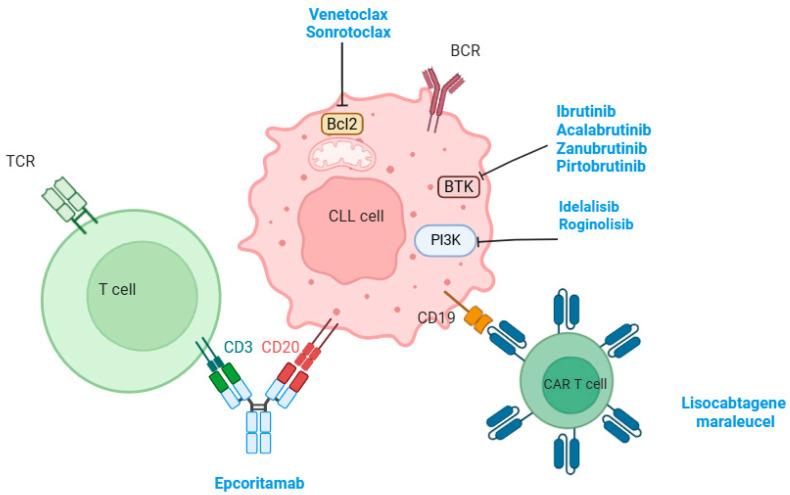
Chronic lymphocytic leukemia (CLL) is the most common leukemia in adults. It is characterized by the clonal proliferation of mature B cells. The tumor microenvironment (TME) seems to play a crucial role in the survival and proliferation of tumor cells. Multiple new classes of drugs had been approved for the management of patients with CLL, reshaping the treatment paradigm. The most important classes are Bruton's tyrosine kinase (BTK) inhibitors and BCL-2 inhibitors. Both of them are approved as a first-line treatment in patients with CLL requiring treatment. The role of BTK and BCL-2 in the signaling pathways of the TME is very important. The aim of this review is to summarize the major components of the TME and the available data regarding targeted therapies in CLL.
慢性淋巴细胞白血病(CLL)是成人中最常见的白血病。它的特征是成熟B细胞的克隆性增殖。肿瘤微环境(TME)似乎在肿瘤细胞的存活和增殖中起关键作用。多种新型药物已被批准用于治疗CLL患者,重塑了治疗模式。最重要的药物类别是布鲁顿酪氨酸激酶(BTK)抑制剂和BCL-2抑制剂。它们都被批准作为需要治疗的CLL患者的一线治疗药物。BTK和BCL-2在TME信号通路中的作用非常重要。本综述的目的是总结TME的主要成分以及关于CLL靶向治疗的现有数据。
 Zotero 插件