
免疫检查点抑制剂联合细胞毒性化疗对广泛期小细胞肺癌患者生存获益的真实世界证据:德洲会真实世界数据项目(TREAD)06
Real-world evidence on the survival benefit of immune checkpoint inhibitors in combination with cytotoxic chemotherapy for patients with extensive-disease small-cell lung cancer: the Tokushukai Real World Data Project (TREAD) 06.
作者信息
Fukui Tomoya, Imamura Yoshinori, Kakutani Takuya, Uryu Kiyoaki, Shimoyama Rai, Hayashi Maki, Okuda Tadahisa, Kataoka Koshi, Taguri Masataka, Minami Hironobu
机构信息
Department of Respiratory Medicine, Shonan Kamakura General Hospital, 1370-1 Okamoto, Kamakura-Shi, Kanagawa, 247-8533, Japan.
University of Fukui Hospital, Cancer Care Promotion Center, 23-3 Matsuoka-Shimoaizuki, Eiheiji-Cho, Yoshida-Gun, Fukui, 910-1193, Japan.
出版信息
BMC Cancer. 2025 Aug 27;25(1):1379. doi: 10.1186/s12885-025-14701-z.
BACKGROUND
Small-cell lung cancer (SCLC) is an aggressive malignancy with a poor prognosis. Despite the initial chemosensitivity, survival for extensive-disease (ED) SCLC remains limited. Immune checkpoint inhibitors (ICIs) in combination with chemotherapy have recently been redefined as the standard of care. We evaluated the efficacy of ICI combination therapy in clinical trials translated into real-world clinical practice for patients with ED-SCLC.
METHODS
This retrospective cohort study analyzed data from the Tokushukai REAl World Data Project. Patients with ED-SCLC who received first-line platinum-based chemotherapy between April 2010 and March 2022 were included in this study. Overall survival (OS) was estimated using the Kaplan-Meier method, and associations with clinical variables were analyzed using Cox proportional hazards regression.
RESULTS
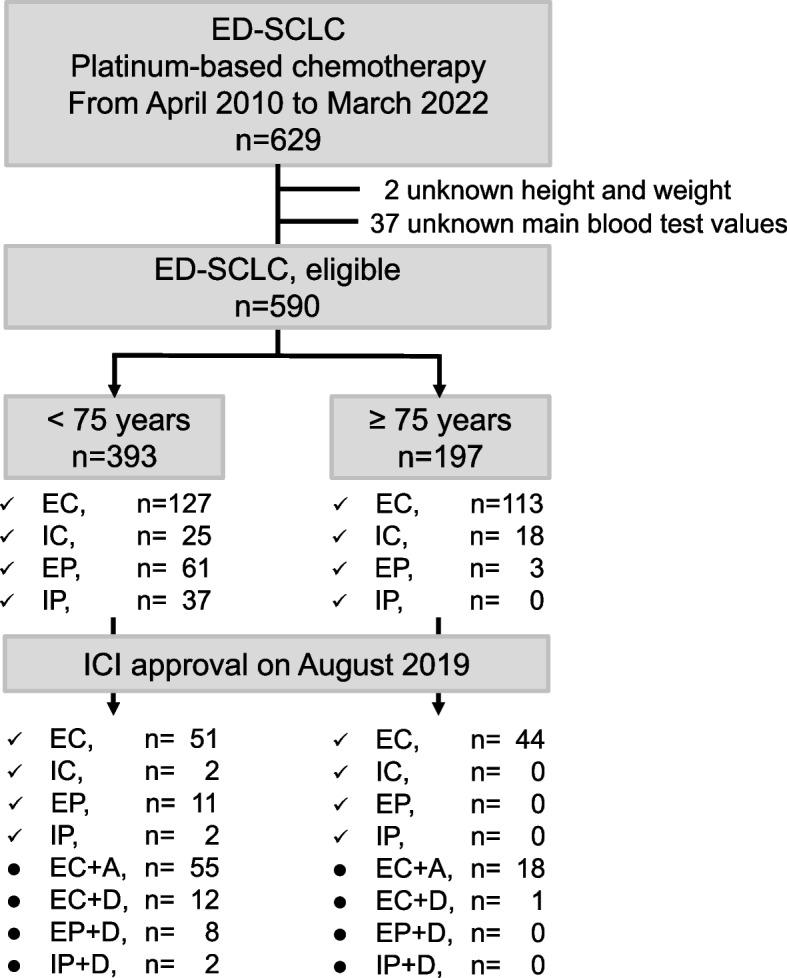
Among 590 patients (median age, 71 years; range, 40-90 years), 197 (33.4%) were aged ≥ 75 years. Following ICI approval in Japan in August 2019, 206 patients received first-line treatment, of whom 96 received ICI combination therapy. ICI-treated patients had significantly improved OS compared to chemotherapy alone (median 13.0 vs. 9.7 months; p = 0.011), with a pronounced benefit in those aged < 75 years (15.0 vs. 10.0 months; p = 0.022) but not in those aged ≥ 75 years (8.9 vs. 8.6 months; p = 0.647). The inverse probability of treatment weighting (IPTW) method resulted in an HR of 0.666 (95% confidence interval [CI] 0.483-0.919) in the overall cohort of patients. ICI combination therapy was an independent factor for improved OS (HR, 0.589; 95% CI, 0.447-0.776).
CONCLUSIONS
ICI combination therapy improved survival in real-world patients with ED-SCLC, aligning with the results of pivotal clinical trials. However, their limited efficacy in older adults underscores the need for tailored treatment strategies.
背景
小细胞肺癌(SCLC)是一种侵袭性恶性肿瘤,预后较差。尽管初始化疗敏感性较好,但广泛期(ED)SCLC患者的生存期仍然有限。免疫检查点抑制剂(ICI)联合化疗最近已被重新定义为标准治疗方案。我们评估了ICI联合治疗在转化为ED-SCLC患者实际临床实践的临床试验中的疗效。
方法
这项回顾性队列研究分析了德洲会真实世界数据项目的数据。本研究纳入了2010年4月至2022年3月期间接受一线铂类化疗的ED-SCLC患者。采用Kaplan-Meier法估计总生存期(OS),并使用Cox比例风险回归分析与临床变量的关联。
结果
在590例患者(中位年龄71岁;范围40-90岁)中,197例(33.4%)年龄≥75岁。2019年8月ICI在日本获批后,206例患者接受了一线治疗,其中96例接受了ICI联合治疗。与单纯化疗相比,接受ICI治疗的患者OS显著改善(中位生存期13.0个月对9.7个月;p = 0.011),年龄<75岁的患者获益显著(15.0个月对10.0个月;p = 0.022),而年龄≥75岁的患者则无显著差异(8.9个月对8.6个月;p = 0.647)。治疗权重逆概率(IPTW)方法在整个患者队列中的HR为0.666(95%置信区间[CI] 0.483-0.919)。ICI联合治疗是OS改善的独立因素(HR,0.589;95% CI,0.447-0.776)。
结论
ICI联合治疗改善了实际临床中ED-SCLC患者的生存期,与关键临床试验结果一致。然而,其在老年人中的疗效有限,凸显了制定个性化治疗策略的必要性。

 Zotero 插件