
驾驭脑类器官成熟:从基准框架到多模态生物工程策略
Navigating Brain Organoid Maturation: From Benchmarking Frameworks to Multimodal Bioengineering Strategies.
作者信息
Huang Jingxiu, Zhu Yingli, Tang Jiong, Liu Yang, Lu Ming, Zhang Rongxin, Sun Alfred Xuyang
机构信息
State Key Laboratory of Oncology in South China, Sun Yat-sen University Cancer Center, Guangzhou 510060, China.
Signature Research Program in Neuroscience and Behavioral Disorders, Duke-NUS Graduate Medical School Singapore, 8 College Road, Singapore 169857, Singapore.
出版信息
Biomolecules. 2025 Aug 4;15(8):1118. doi: 10.3390/biom15081118.
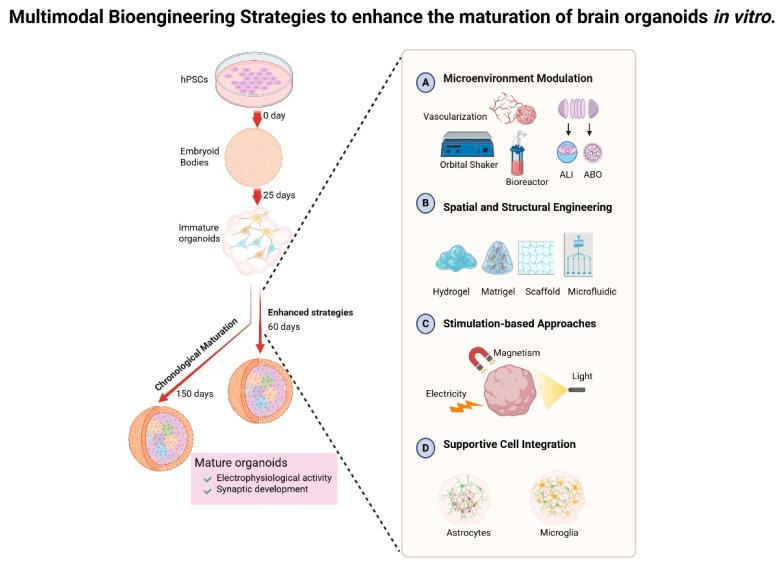
Brain organoid technology has revolutionized in vitro modeling of human neurodevelopment and disease, providing unprecedented insights into cortical patterning, neural circuit assembly, and pathogenic mechanisms of neurological disorders. Critically, human brain organoids uniquely recapitulate human-specific developmental processes-such as the expansion of outer radial glia and neuromelanin-that are absent in rodent models, making them indispensable for studying human brain evolution and dysfunction. However, a major bottleneck persists: Extended culture periods (≥6 months) are empirically required to achieve late-stage maturation markers like synaptic refinement, functional network plasticity, and gliogenesis. Yet prolonged conventional 3D culture exacerbates metabolic stress, hypoxia-induced necrosis, and microenvironmental instability, leading to asynchronous tissue maturation-electrophysiologically active superficial layers juxtaposed with degenerating cores. This immaturity/heterogeneity severely limits their utility in modeling adult-onset disorders (e.g., Alzheimer's disease) and high-fidelity drug screening, as organoids fail to recapitulate postnatal transcriptional signatures or neurovascular interactions without bioengineering interventions. We summarize emerging strategies to decouple maturation milestones from rigid temporal frameworks, emphasizing the synergistic integration of chronological optimization (e.g., vascularized co-cultures) and active bioengineering accelerators (e.g., electrical stimulation and microfluidics). By bridging biological timelines with scalable engineering, this review charts a roadmap to generate translationally relevant, functionally mature brain organoids.
脑类器官技术彻底改变了人类神经发育和疾病的体外建模,为皮质模式形成、神经回路组装以及神经系统疾病的致病机制提供了前所未有的见解。至关重要的是,人类脑类器官独特地概括了啮齿动物模型中不存在的人类特有的发育过程,如外侧放射状胶质细胞的扩张和神经黑色素,这使得它们对于研究人类大脑进化和功能障碍不可或缺。然而,一个主要瓶颈仍然存在:根据经验,需要延长培养期(≥6个月)才能实现突触精细化、功能网络可塑性和神经胶质生成等晚期成熟标志物。然而,长时间的传统3D培养会加剧代谢应激、缺氧诱导的坏死和微环境不稳定,导致组织成熟异步——电生理活跃的表层与退化的核心并置。这种不成熟/异质性严重限制了它们在模拟成人发病疾病(如阿尔茨海默病)和高保真药物筛选中的效用,因为在没有生物工程干预的情况下,类器官无法概括出生后的转录特征或神经血管相互作用。我们总结了将成熟里程碑与严格的时间框架脱钩的新兴策略,强调时间优化(如血管化共培养)和主动生物工程加速器(如电刺激和微流体)的协同整合。通过将生物时间线与可扩展工程联系起来,本综述绘制了一条生成与转化相关、功能成熟的脑类器官的路线图。


 Zotero 插件