
天然产物作为耐甲氧西林金黄色葡萄球菌莽草酸脱氢酶抑制剂的表征:动力学和分子动力学模拟以及生物活性研究
Characterization of Natural Products as Inhibitors of Shikimate Dehydrogenase from Methicillin-Resistant : Kinetic and Molecular Dynamics Simulations, and Biological Activity Studies.
作者信息
Corral-Rodríguez Noé Fabián, Moreno-Contreras Valeria Itzel, Sierra-Campos Erick, Valdez-Solana Mónica, Cisneros-Martínez Jorge, Téllez-Valencia Alfredo, Avitia-Domínguez Claudia
机构信息
Facultad de Medicina y Nutrición, Universidad Juárez del Estado de Durango, Av. Universidad y Fanny Anitua S/N, Durango 34000, Mexico.
Facultad de Ciencias Químicas, Universidad Juárez del Estado de Durango Campus Gómez Palacio, Avenida Artículo 123 S/N, Fracc. Filadelfia, Gómez Palacio 35010, Mexico.
出版信息
Biomolecules. 2025 Aug 6;15(8):1137. doi: 10.3390/biom15081137.
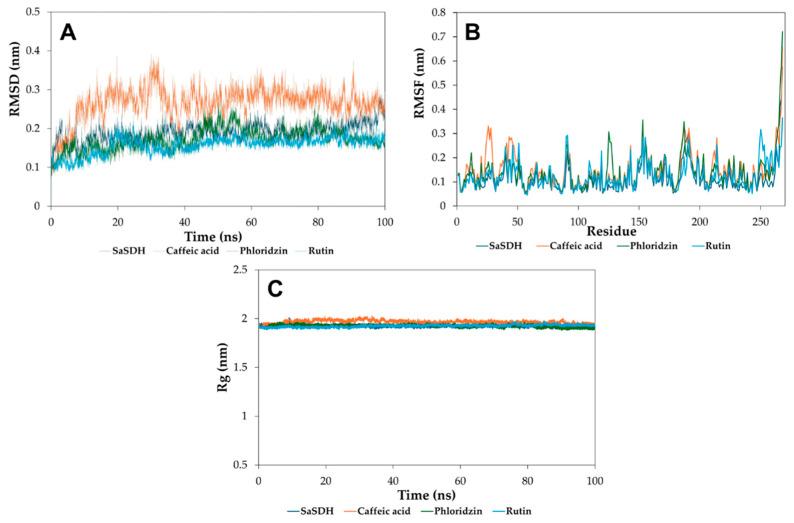
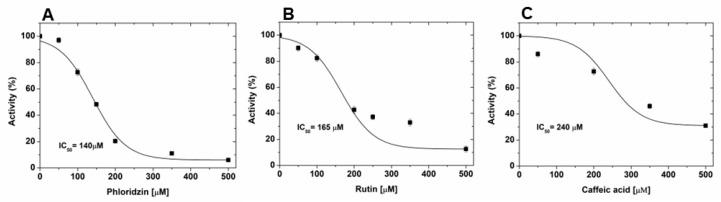
Antibiotic resistance is considered to be one of the most complex health obstacles of our time. Methicillin-resistant (MRSA) represents a global health challenge due to its broad treatment resistance capacity, resulting in high mortality rates. The shikimate pathway (SP) is responsible for the biosynthesis of chorismate from glycolysis and pentose phosphate pathway intermediates. This pathway plays a crucial role in producing aromatic amino acids, folates, ubiquinone, and other secondary metabolites in bacteria. Notably, SP is absent in humans, which makes it a specific and potential therapeutic target to explore for discovering new antibiotics against MRSA. The present study characterized in vitro and in silico natural products as inhibitors of the shikimate dehydrogenase from methicillin-resistant (SDH). The results showed that, from the set of compounds studied, phloridzin, rutin, and caffeic acid were the most potent inhibitors of SDH, with IC values of 140, 160, and 240 µM, respectively. Furthermore, phloridzin showed a mixed-type inhibition mechanism, whilst rutin and caffeic acid showed non-competitive mechanisms. The structural characterization of the SDH-inhibitor complex indicated that these compounds interacted with amino acids from the catalytic site and formed stable complexes. In biological activity studies against MRSA, caffeic acid showed an MIC of 2.2 mg/mL. Taken together, these data encourage using these compounds as a starting point for developing new antibiotics based on natural products against MRSA.
抗生素耐药性被认为是我们这个时代最复杂的健康障碍之一。耐甲氧西林金黄色葡萄球菌(MRSA)由于其广泛的耐药能力,成为全球健康挑战,导致高死亡率。莽草酸途径(SP)负责从糖酵解和磷酸戊糖途径中间体生物合成分支酸。该途径在细菌中芳香族氨基酸、叶酸、泛醌和其他次级代谢产物的产生中起关键作用。值得注意的是,人类不存在SP,这使其成为探索针对MRSA的新抗生素的一个特定且潜在的治疗靶点。本研究对耐甲氧西林金黄色葡萄球菌莽草酸脱氢酶(SDH)的体外和计算机模拟天然产物抑制剂进行了表征。结果表明,在所研究的化合物中,根皮苷、芦丁和咖啡酸是SDH最有效的抑制剂,IC值分别为140、160和240 μM。此外,根皮苷表现出混合型抑制机制,而芦丁和咖啡酸表现出非竞争性机制。SDH-抑制剂复合物的结构表征表明,这些化合物与催化位点的氨基酸相互作用并形成稳定的复合物。在针对MRSA的生物活性研究中,咖啡酸的最低抑菌浓度为2.2 mg/mL。综上所述,这些数据鼓励将这些化合物作为开发基于天然产物的抗MRSA新抗生素的起点。


 Zotero 插件