
成纤维细胞生长因子在毛囊生长中作用的最新进展
Recent Advances in the Role of Fibroblast Growth Factors in Hair Follicle Growth.
作者信息
Wang Junchao, Wang Lusheng, Gao Shuang, Li Xiaokun
机构信息
School of Pharmaceutical Sciences, Wenzhou Medical University, Wenzhou 325035, China.
National Clinical Research Center for Ocular Diseases, Eye Hospital, Wenzhou Medical University, Wenzhou 325027, China.
出版信息
Biomolecules. 2025 Aug 20;15(8):1198. doi: 10.3390/biom15081198.
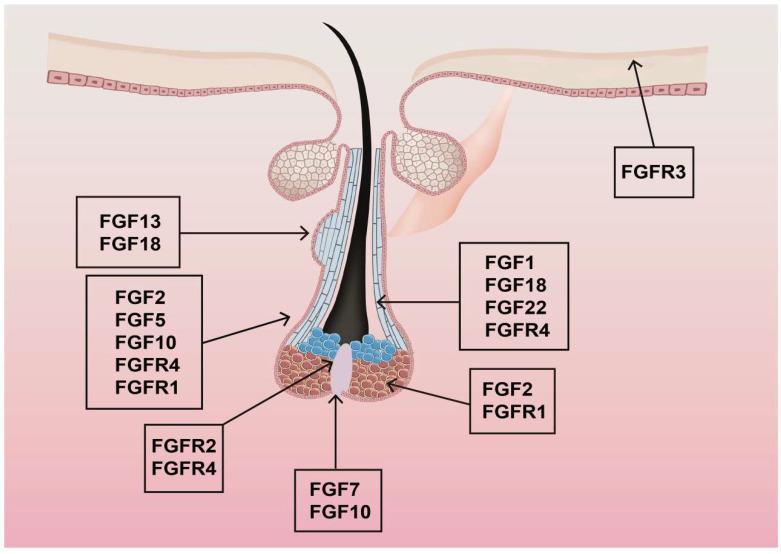
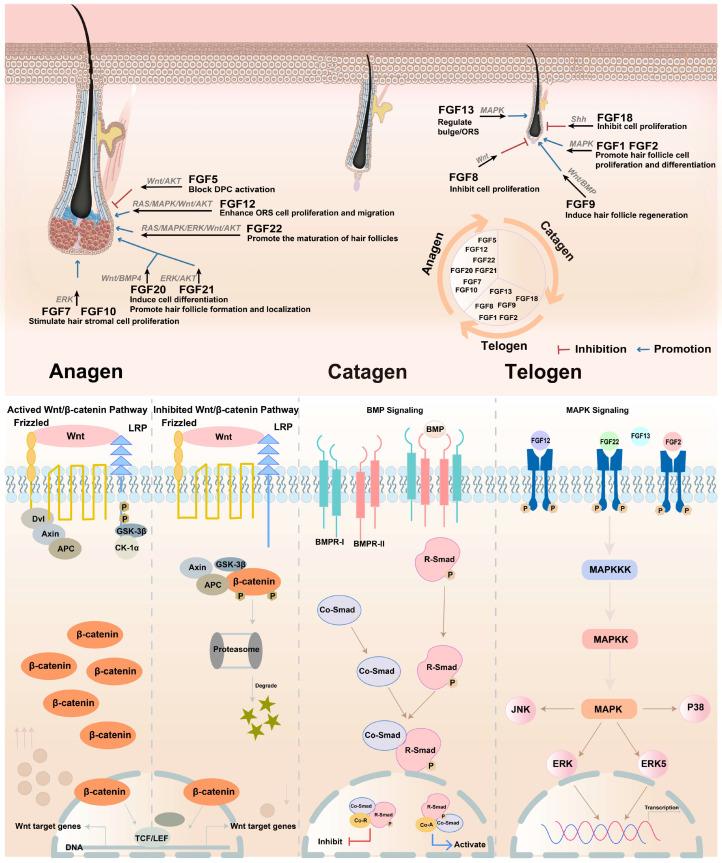
Hair follicles are essential to hair formation and cyclic regeneration, experiencing growth and degeneration, and quiescence phases involving complex signaling pathways. Among these, fibroblast growth factors (FGFs) play a critical role in follicular morphogenesis, but the role of FGF receptor signaling in hair follicle development remains underexplored. Current treatments for hair loss, such as medical, surgical, light-based, and nutraceutical interventions, are often expensive, require long-term commitment, and are associated with substantial side effects. This review discusses the mechanisms and biological functions of the FGF signaling pathway within the hair follicle growth cycle, providing an overview of how these elements influence hair follicle dynamics and the pathogenesis of alopecia. Manipulating the FGF signaling pathway could offer new therapeutic options for androgenetic alopecia and other hair loss conditions, potentially exceeding current treatment modalities in efficacy and safety.
毛囊对于毛发形成和周期性再生至关重要,经历生长、退化以及涉及复杂信号通路的静止期。其中,成纤维细胞生长因子(FGFs)在毛囊形态发生中起关键作用,但FGF受体信号在毛囊发育中的作用仍未得到充分探索。目前治疗脱发的方法,如药物、手术、光疗和营养补充剂干预,通常费用昂贵,需要长期坚持,且伴有大量副作用。本综述讨论了毛囊生长周期内FGF信号通路的机制和生物学功能,概述了这些因素如何影响毛囊动态以及脱发的发病机制。操纵FGF信号通路可为雄激素性脱发和其他脱发病症提供新的治疗选择,在疗效和安全性方面可能超越当前的治疗方式。


 Zotero 插件