
用于临床相关性的生物打印血管化构建体:为实现生物学成熟而设计水凝胶系统
Bioprinting Vascularized Constructs for Clinical Relevance: Engineering Hydrogel Systems for Biological Maturity.
作者信息
Son Jeonghyun, Li Siyuan, Jeong Wonwoo
机构信息
Department of Bioengineering, Stanford University, Stanford, CA 94305, USA.
Department of Biomedical Engineering, Ulsan National Institute of Science and Technology (UNIST), Ulsan 44919, Republic of Korea.
出版信息
Gels. 2025 Aug 12;11(8):636. doi: 10.3390/gels11080636.
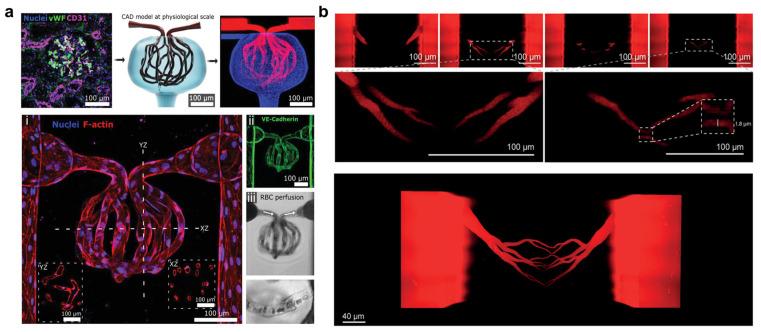
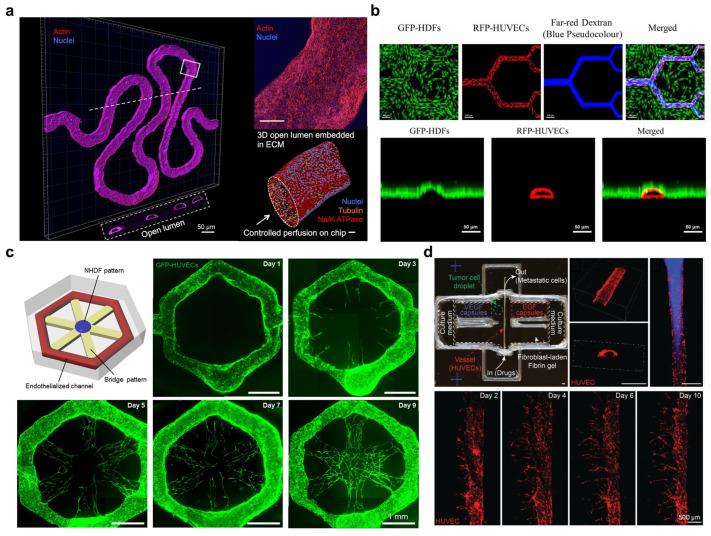
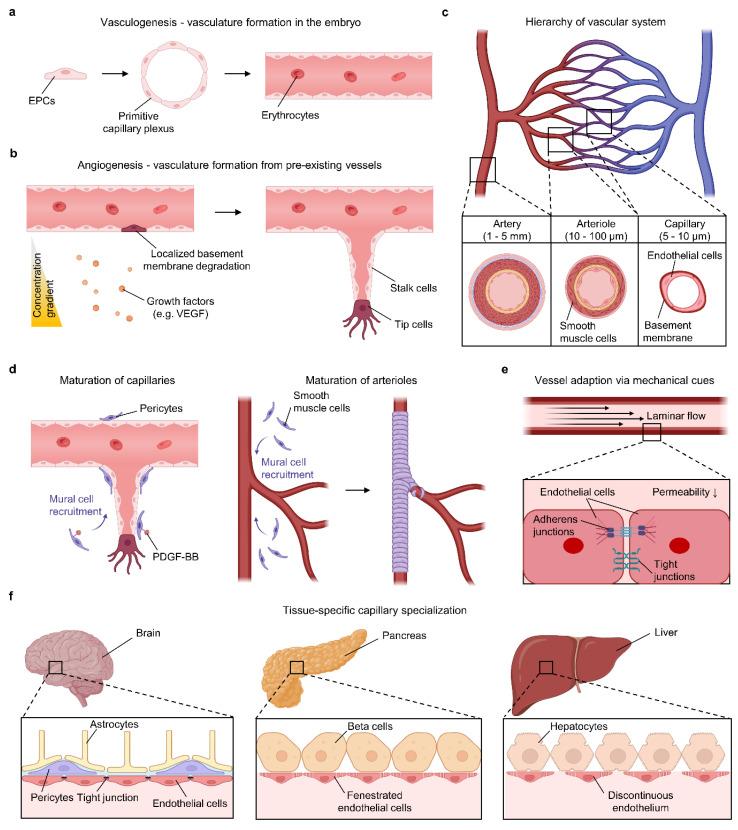
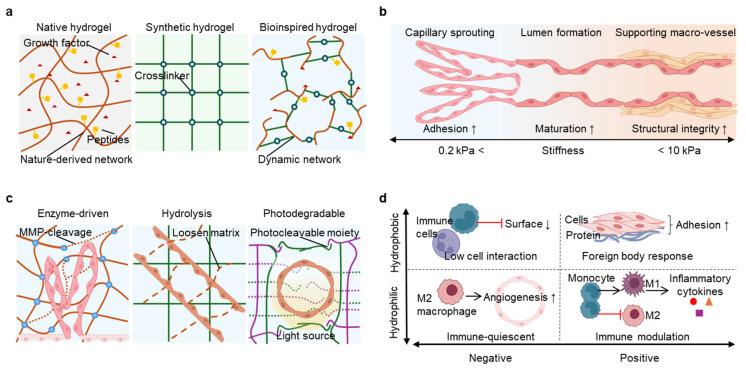
Vascularization remains a critical challenge in tissue engineering, limiting graft survival, integration, and clinical translation. Although bioprinting enables spatial control over vascular architectures, many existing approaches prioritize geometric precision over biological performance. Bioprinted vasculature can be understood as a dynamic and time-dependent system that requires tissue-specific maturation. Within this framework, hydrogel systems act as active microenvironments rather than passive scaffolds. Hydrogel platforms vary from natural matrices and synthetic polymers to bioinspired or stimuli-responsive systems, each offering tunable control over stiffness, degradation, and biochemical signaling needed for vascular maturation. The design requirements of large and small vessels differ in terms of mechanical demands, remodeling capacity, and host integration. A key limitation in current models is the absence of time-resolved evaluation, as critical processes such as lumen formation, pericyte recruitment, and flow-induced remodeling occur progressively and are not captured by static endpoints. Advancements in bioprinting technologies are evaluated based on their capacity to support hydrogel-mediated vascularization across varying length scales and structural complexities. A framework for functional assessment is proposed, and translational challenges related to immunogenicity, scalability, and regulatory requirements are discussed. Such integration of hydrogel-driven biological cues and bioprinting fidelity is critical to advancing vascularized constructs toward clinical translation.
血管化仍然是组织工程中的一个关键挑战,限制了移植物的存活、整合及临床转化。尽管生物打印能够对血管结构进行空间控制,但许多现有方法更注重几何精度而非生物学性能。生物打印的血管系统可被理解为一个动态且随时间变化的系统,需要组织特异性的成熟过程。在此框架内,水凝胶系统充当的是活跃的微环境而非被动的支架。水凝胶平台多种多样,从天然基质、合成聚合物到仿生或刺激响应系统,每种都能对血管成熟所需的硬度、降解及生化信号传导提供可调节的控制。大血管和小血管的设计要求在机械需求、重塑能力及与宿主的整合方面存在差异。当前模型的一个关键限制是缺乏时间分辨评估,因为诸如管腔形成、周细胞募集和流动诱导重塑等关键过程是逐步发生的,无法通过静态终点来捕捉。生物打印技术的进步是根据其在不同长度尺度和结构复杂性上支持水凝胶介导的血管化的能力来评估的。提出了一个功能评估框架,并讨论了与免疫原性、可扩展性和监管要求相关的转化挑战。这种水凝胶驱动的生物线索与生物打印保真度的整合对于推动血管化构建体向临床转化至关重要。

 Zotero 插件