
血清过氧化物酶体增殖物激活受体反映氧化应激并预测肾小球肾炎患者的肾脏预后。
Serum Peroxiredoxins Reflect Oxidative Stress and Predict Renal Outcomes in Patients with Glomerulonephritis.
作者信息
Wiewiórska-Krata Natalia, Moszczuk Barbara, Tańska Julia, Knioła Emilia, Grywalska Ewelina, Pączek Leszek, Foroncewicz Bartosz, Mucha Krzysztof
机构信息
Laboratory of Cellular and Genetic Therapies, Center for Preclinical Research, Medical University of Warsaw, 02-006 Warsaw, Poland.
ProMix Center (ProteogenOmix in Medicine), Department of Clinical Immunology, Medical University of Warsaw, 02-006 Warsaw, Poland.
出版信息
Int J Mol Sci. 2025 Aug 9;26(16):7708. doi: 10.3390/ijms26167708.
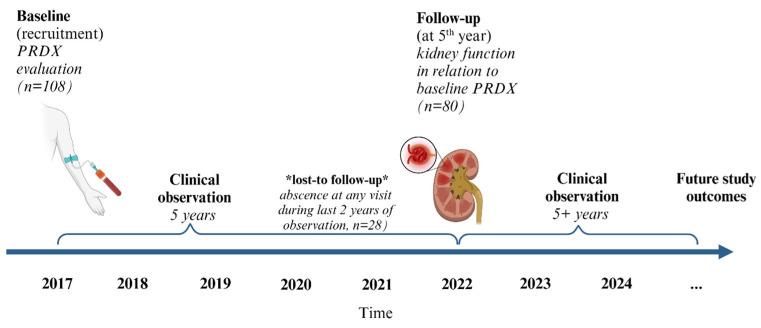
Oxidative stress (OS), defined as an imbalance between pro-oxidant and antioxidant mechanisms, contributes to DNA and protein oxidation as well as cellular injury, and plays a pivotal role in the pathogenesis of chronic kidney disease (CKD). Peroxiredoxins (PRDXs) are key antioxidant enzymes that regulate intracellular peroxide levels and maintain redox homeostasis. Beyond its renal implications, OS is closely intertwined with hypertension and atherosclerosis, both common comorbidities that accelerate CKD progression. As previously reported, serum concentrations of PRDXs 1-5 may help to differentiate between IgA nephropathy (IgAN), membranous nephropathy (MN), and lupus nephritis (LN). This study aimed to assess the utility of baseline serum PRDX levels in predicting longitudinal changes in kidney function and proteinuria in patients with IgAN, MN, and LN. We analyzed data from 80 patients (IgAN, n = 36; MN, n = 23; LN, n = 21) drawn from an initial cohort of 108 in whom baseline serum concentrations of PRDX 1-5 were measured. Patients were stratified into low, medium, and high PRDX level groups at baseline, and associations between these strata and longitudinal changes in eGFR and proteinuria were assessed over a follow-up period of up to five years. Across all groups, the follow-up eGFR was significantly associated with low baseline serum PRDX 1, 2, 3, and 5 ( = 0.043; = 0.001; = 0.036; = 0.007, respectively). Significant associations were also observed between 24 h follow-up proteinuria and low baseline serum PRDX 2, 3, and 5 ( = 0.025; = 0.025; = 0.005, respectively), medium PRDX 4 ( = 0.010), and high PRDX 2 ( = 0.019). No significant associations were found within the study groups; however, these associations were more pronounced in IgAN and MN patients. These findings suggest a potential role for PRDXs in predicting and monitoring CKD progression, especially eGFR decline.
氧化应激(OS)被定义为促氧化剂和抗氧化剂机制之间的失衡,它会导致DNA和蛋白质氧化以及细胞损伤,并在慢性肾脏病(CKD)的发病机制中起关键作用。过氧化物酶(PRDXs)是调节细胞内过氧化物水平并维持氧化还原稳态的关键抗氧化酶。除了对肾脏的影响外,OS还与高血压和动脉粥样硬化密切相关,这两种常见的合并症都会加速CKD的进展。如先前报道,PRDXs 1-5的血清浓度可能有助于区分IgA肾病(IgAN)、膜性肾病(MN)和狼疮性肾炎(LN)。本研究旨在评估基线血清PRDX水平在预测IgAN、MN和LN患者肾功能和蛋白尿的纵向变化中的作用。我们分析了来自80名患者(IgAN,n = 36;MN,n = 23;LN,n = 21)的数据,这些患者来自最初的108名队列,其中测量了PRDX 1-5的基线血清浓度。患者在基线时被分为低、中、高PRDX水平组,并在长达五年的随访期内评估这些分层与估算肾小球滤过率(eGFR)和蛋白尿纵向变化之间的关联。在所有组中,随访时的eGFR与低基线血清PRDXs 1、2、3和5显著相关(分别为P = 0.043;P = 0.001;P = 0.036;P = 0.007)。在24小时随访蛋白尿与低基线血清PRDXs 2、3和5(分别为P = 0.025;P = 0.025;P = 0.005)、中PRDX 4(P = 0.010)和高PRDX 2(P = 0.019)之间也观察到显著关联。在研究组内未发现显著关联;然而,这些关联在IgAN和MN患者中更为明显。这些发现表明PRDXs在预测和监测CKD进展,尤其是eGFR下降方面具有潜在作用。


 Zotero 插件