
阿尔茨海默病遗传研究的最新进展与未来方向
Recent Advances and Future Directions in Alzheimer's Disease Genetic Research.
作者信息
Stancheva Mikaela, Toncheva Draga, Karachanak-Yankova Sena
机构信息
Department of Genetics, Faculty of Biology, Sofia University "St. Kliment Ohridski", 1164 Sofia, Bulgaria.
Bulgarian Academy of Sciences, 1000 Sofia, Bulgaria.
出版信息
Int J Mol Sci. 2025 Aug 13;26(16):7819. doi: 10.3390/ijms26167819.
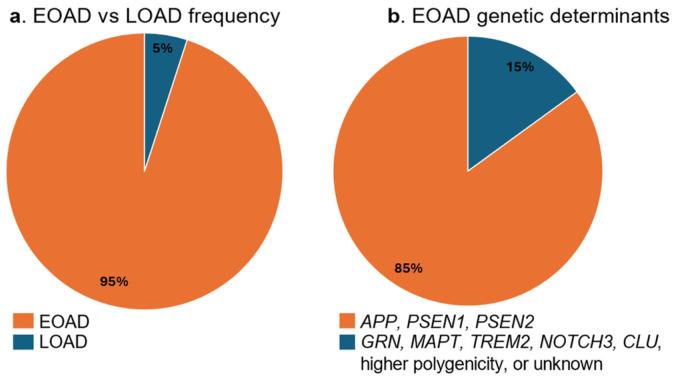
Alzheimer's disease (AD) is a complex neurodegenerative condition which, despite its high prevalence and socioeconomic impact on the world, has an etiology that remains poorly understood. The genetic causes of AD are complex and have been continuously studied for decades. They range from rare pathogenic, highly penetrant mutations in early-onset (EOAD) forms, which account for 5% of the cases to multiple-risk alleles across different genes in late-onset (LOAD) forms. Monogenic causes of EOAD allocate within , , and genes in 10-15% of cases. The most significant risk factor in LOAD heritability is the ε4 allele, as well as numerous loci within genes involved in immunity, endocytosis, lipid metabolism, and amyloid and tau processing. LOAD can also be attributed to the accumulation of somatic mutations, which may be detected by analysis of brain-derived cell-free DNA (cfDNA) in plasma. This review offers a comprehensive overview of the genetic architecture of Alzheimer's disease, with particular focus on the molecular mechanisms underlying both early- and late-onset forms of the condition. An improved understanding of the genetic etiology of AD can aid better prevention, earlier diagnosis, and novel therapeutic approaches. This can be achieved by analyzing understudied populations, performing case-control studies with appropriately matched controls, and surveying brain-derived cell-free DNA in plasma, with the latter having the potential to contribute to the implementation of liquid biopsy in dementology.
阿尔茨海默病(AD)是一种复杂的神经退行性疾病,尽管其在全球范围内具有很高的患病率和社会经济影响,但其病因仍知之甚少。AD的遗传原因很复杂,数十年来一直在持续研究。它们包括早发性(EOAD)形式中罕见的致病性、高外显率突变(占病例的5%),到晚发性(LOAD)形式中不同基因的多个风险等位基因。10-15%的EOAD单基因病因分布在 、 和 基因中。LOAD遗传力中最显著的风险因素是ε4等位基因,以及参与免疫、内吞作用、脂质代谢以及淀粉样蛋白和tau蛋白加工的基因内的众多位点。LOAD也可归因于体细胞突变的积累,这可以通过分析血浆中脑源性游离DNA(cfDNA)来检测。本综述全面概述了阿尔茨海默病的遗传结构,特别关注该疾病早发性和晚发性形式的潜在分子机制。对AD遗传病因的深入理解有助于更好地预防、早期诊断和采用新的治疗方法。这可以通过分析研究不足的人群、进行对照匹配适当的病例对照研究以及检测血浆中的脑源性游离DNA来实现,后者有可能推动液体活检在痴呆学中的应用。


 Zotero 插件