
产生褪黑素的EH2-5通过生理、生化和分子调节增强植物耐盐性。
Melatonin-Producing EH2-5 Enhances Plants Salinity Tolerance Through Physiological, Biochemical, and Molecular Modulation.
作者信息
Kwon Eun-Hae, Ahmad Suhaib, Lee In-Jung
机构信息
Department of Applied Biosciences, Kyungpook National University, Daegu 41566, Republic of Korea.
Department of Engineering Technology, Cullen College of Engineering, University of Houston, Houston, TX 77479, USA.
出版信息
Int J Mol Sci. 2025 Aug 13;26(16):7834. doi: 10.3390/ijms26167834.
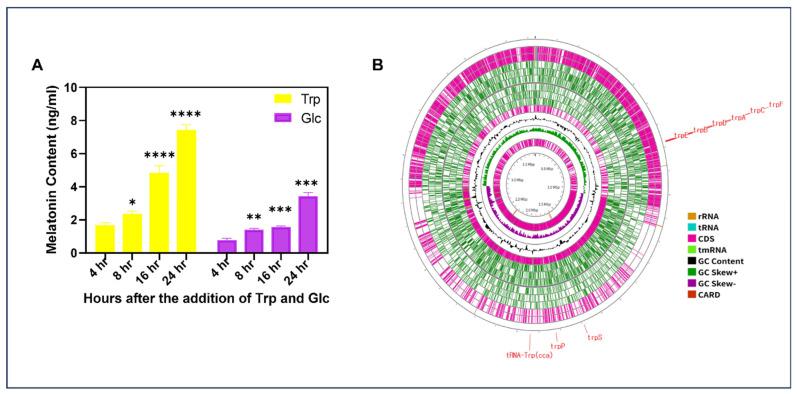
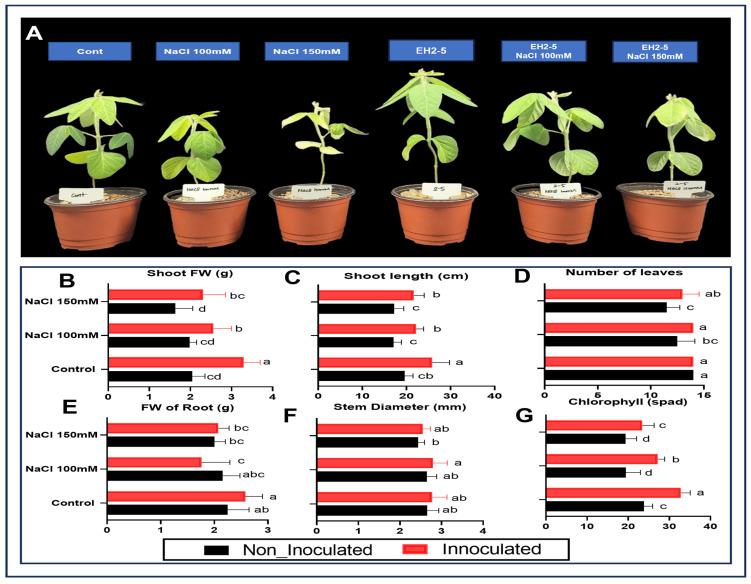
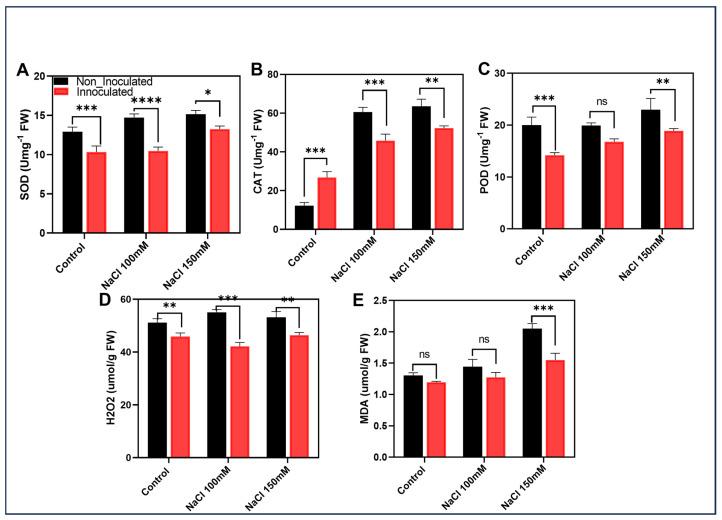
Climate change has intensified extreme weather events and accelerated soil salinization, posing serious threats to crop yield and quality. Salinity stress, now affecting about 20% of irrigated lands, is expected to worsen due to rising temperatures and sea levels. At the same time, the global population is projected to exceed 9 billion by 2050, demanding a 70% increase in food production (UN, 2019; FAO). Agriculture, responsible for 34% of global greenhouse gas emissions, urgently needs sustainable solutions. Microbial inoculants, known as "plant probiotics," offer a promising eco-friendly alternative by enhancing crop resilience and reducing environmental impact. In this study, we evaluated the plant growth-promoting (PGP) traits and melatonin-producing capacity of EH2-5. To assess its efficacy under salt stress, soybean seedlings at the VC stage were inoculated with EH2-5 and subsequently subjected to salinity stress using 150 mM and 100 mM NaCl treatments. Plant growth parameters, the expression levels of salinity-related genes, and the activities of antioxidant enzymes were measured to determine the microbe's role in promoting plant growth and mitigating salt-induced oxidative stress. Here, our study shows that the melatonin-synthesizing EH2-5 (7.48 ng/mL at 24 h after inoculation in Trp spiked LB media) significantly improved host plant ( L.) growth, biomass, and photosynthesis and reduced oxidative stress during salinity stress conditions than the non-inculcated control. Whole genome sequencing of EH2-5 identified key plant growth-promoting and salinity stress-related genes, including znuA, znuB, znuC, and zur (zinc uptake); ptsN, aspA, and nrgB (nitrogen metabolism); and phoH and pstS (phosphate transport). Genes involved in tryptophan biosynthesis and transport, such as trpA, trpB, trpP, and tspO, along with siderophore-related genes yusV, yfhA, and yfiY, were also detected. The presence of multiple stress-responsive genes, including dnaK, dps, treA, cspB, srkA, and copZ, suggests EH2-5's genomic potential to enhance plant tolerance to salinity and other abiotic stresses. Inoculation with EH2-5 significantly enhanced soybean growth and reduced salt-induced damage, as evidenced by increased shoot biomass (29%, 41%), leaf numbers (12% and 13%), and chlorophyll content (40%, 21%) under 100 mM and 150 mM NaCl compared to non-inoculated plants. These results indicate EH2-5's strong potential as a plant growth-promoting and salinity stress-alleviating rhizobacterium. The EH2-5 symbiosis significantly enhanced a key ABA biosynthesis enzyme-related gene NCED3, dehydration responsive transcription factors DREB2A and NAC29 salinity stresses (100 mM and 150 mM). Moreover, the reduced expression of peroxidase (POD), superoxide dismutase (SOD), and catalase (CAT) by 16%, 29%, and 24%, respectively, and decreased levels of malondialdehyde (MDA) and hydroxy peroxidase (HO) by 12% and 23% were observed under 100 mM NaCl compared to non-inoculated plants. This study demonstrated that EH2-5, a melatonin-producing strain, not only functions effectively as a biofertilizer but also alleviates plant stress in a manner comparable to the application of exogenous melatonin. These findings highlight the potential of utilizing melatonin-producing microbes as a viable alternative to chemical treatments. Therefore, further research should focus on enhancing the melatonin biosynthetic capacity of EH2-5, improving its colonization efficiency in plants, and developing synergistic microbial consortia (SynComs) with melatonin-producing capabilities. Such efforts will contribute to the development and field application of EH2-5 as a promising plant biostimulant for sustainable agriculture.
气候变化加剧了极端天气事件,并加速了土壤盐渍化,对作物产量和质量构成严重威胁。盐胁迫目前影响着约20%的灌溉土地,预计随着气温上升和海平面上升,情况将恶化。与此同时,预计到2050年全球人口将超过90亿,这要求粮食产量增加70%(联合国,2019年;粮农组织)。农业占全球温室气体排放的34%,迫切需要可持续的解决方案。微生物接种剂,即“植物益生菌”,通过增强作物恢复力和减少环境影响,提供了一种有前景的生态友好替代方案。在本研究中,我们评估了EH2-5的促植物生长(PGP)特性和产褪黑素能力。为了评估其在盐胁迫下的功效,在VC阶段的大豆幼苗接种EH2-5,随后使用150 mM和100 mM NaCl处理进行盐胁迫。测量植物生长参数、盐相关基因的表达水平和抗氧化酶的活性,以确定该微生物在促进植物生长和减轻盐诱导的氧化应激中的作用。在此,我们的研究表明,产褪黑素的EH2-5(在添加色氨酸的LB培养基中接种24小时后为7.48 ng/mL)在盐胁迫条件下比未接种的对照显著改善了宿主植物(L.)的生长、生物量和光合作用,并降低了氧化应激。EH2-5的全基因组测序确定了关键的促植物生长和盐胁迫相关基因,包括znuA、znuB、znuC和zur(锌吸收);ptsN、aspA和nrgB(氮代谢);以及phoH和pstS(磷转运)。还检测到参与色氨酸生物合成和转运的基因,如trpA、trpB、trpP和tspO,以及与铁载体相关的基因yusV、yfhA和yfiY。多个应激反应基因的存在,包括dnaK、dps、treA、cspB、srkA和copZ,表明EH2-5具有增强植物对盐度和其他非生物胁迫耐受性的基因组潜力。与未接种的植物相比,接种EH2-5显著增强了大豆生长并减少了盐诱导的损伤,在100 mM和150 mM NaCl条件下,地上部生物量增加(29%,41%)、叶片数量增加(12%和13%)以及叶绿素含量增加(40%,第二处21%)证明了这一点。这些结果表明EH2-5作为一种促植物生长和减轻盐胁迫的根际细菌具有强大的潜力。EH2-5共生显著增强了关键的脱落酸生物合成酶相关基因NCED3、脱水响应转录因子DREB2A和NAC29在盐胁迫(100 mM和150 mM)下的表达。此外,与未接种的植物相比,在100 mM NaCl条件下,过氧化物酶(POD)、超氧化物歧化酶(SOD)和过氧化氢酶(CAT)的表达分别降低了16%、29%和24%,丙二醛(MDA)和羟基过氧化物酶(HO)水平分别降低了12%和23%。本研究表明,产褪黑素菌株EH2-5不仅作为生物肥料有效发挥作用,而且以与施用外源褪黑素相当的方式减轻植物胁迫。这些发现突出了利用产褪黑素微生物作为化学处理可行替代方案的潜力。因此,进一步的研究应集中在增强EH2-5的褪黑素生物合成能力、提高其在植物中的定殖效率以及开发具有产褪黑素能力的协同微生物群落(SynComs)。这些努力将有助于EH2-5作为一种有前景的植物生物刺激剂用于可持续农业的开发和田间应用。

 Zotero 插件