
超越显微镜:将液体活检纳入子宫内膜癌分子病理学时代
Beyond the Microscope: Integrating Liquid Biopsies into the Molecular Pathology Era of Endometrial Cancer.
作者信息
Perez Miguel, Carvajal Luis Lorenzo, Wong Andres, Poppiti Robert, Ruiz-Cordero Roberto, Castellano-Sánchez Amilcar A, Bahmad Hisham F
机构信息
Herbert Wertheim College of Medicine, Florida International University, Miami, FL 33199, USA.
Arkadi M. Rywlin M.D. Department of Pathology and Laboratory Medicine, Mount Sinai Medical Center, Miami Beach, FL 33140, USA.
出版信息
Int J Mol Sci. 2025 Aug 19;26(16):7987. doi: 10.3390/ijms26167987.
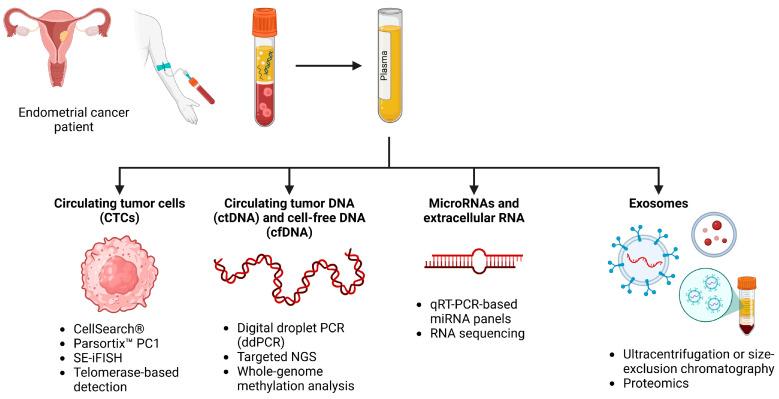
Endometrial cancer (EC) is the most common gynecologic malignancy in developed countries, with a growing incidence and significant molecular heterogeneity that challenges traditional diagnostic and management paradigms. While histopathological assessment remains the gold standard for diagnosis, emerging liquid biopsy technologies provide promising non-invasive alternatives for tumor detection, molecular profiling, and disease monitoring. This review comprehensively explores the current landscape and clinical utility of liquid biopsy analytes-including circulating tumor cells (CTCs), circulating tumor DNA (ctDNA), cell-free DNA (cfDNA), extracellular RNAs, and exosomes-in the context of EC. We discuss the evolving role of pathologists in integrating molecular data with histomorphological features to enhance diagnostic precision, prognostic stratification, and therapeutic decision-making. Novel technologies such as methylation-based assays, tumor-informed ctDNA sequencing, and tumor-educated platelets (TEPs) are highlighted for their diagnostic accuracy and potential for early detection. Furthermore, we summarize key clinical trials and future directions aimed at validating liquid biopsy platforms for routine clinical implementation. As EC care transitions toward a precision oncology model, the integration of liquid biopsy with traditional surgical pathology offers a transformative approach to individualized and personalized patient management.
子宫内膜癌(EC)是发达国家最常见的妇科恶性肿瘤,其发病率不断上升,且具有显著的分子异质性,这对传统的诊断和管理模式构成了挑战。虽然组织病理学评估仍然是诊断的金标准,但新兴的液体活检技术为肿瘤检测、分子分析和疾病监测提供了有前景的非侵入性替代方法。本综述全面探讨了液体活检分析物——包括循环肿瘤细胞(CTC)、循环肿瘤DNA(ctDNA)、游离DNA(cfDNA)、细胞外RNA和外泌体——在EC背景下的当前情况和临床应用。我们讨论了病理学家在将分子数据与组织形态学特征相结合以提高诊断准确性、预后分层和治疗决策方面不断演变的作用。基于甲基化的检测、肿瘤信息ctDNA测序和肿瘤诱导血小板(TEP)等新技术因其诊断准确性和早期检测潜力而受到关注。此外,我们总结了旨在验证液体活检平台用于常规临床应用的关键临床试验和未来方向。随着EC治疗向精准肿瘤学模式转变,液体活检与传统手术病理学的整合为个体化和个性化患者管理提供了一种变革性方法。

 Zotero 插件