
复杂性与单纯性原发性左侧心内膜炎的手术治疗:关于生存、复发性感染和瓣膜耐久性的长期随访见解
Surgery for Complex vs. Simple Native Left-Sided Endocarditis: Insights from an Extended Follow-Up on Survival, Recurrent Infection, and Valve Durability.
作者信息
Shavit Reut, Orvin Katia, Shaked Hila, Rubchevsky Victor, Shapira Yaron, Kornowski Ran, Sharony Ram
机构信息
Department of Cardiothoracic Surgery, Carmel Medical Center, Haifa 3436212, Israel.
Department of Cardiology, Rabin Medical Center, Petah Tikva 4941492, Israel.
出版信息
J Clin Med. 2025 Aug 20;14(16):5870. doi: 10.3390/jcm14165870.
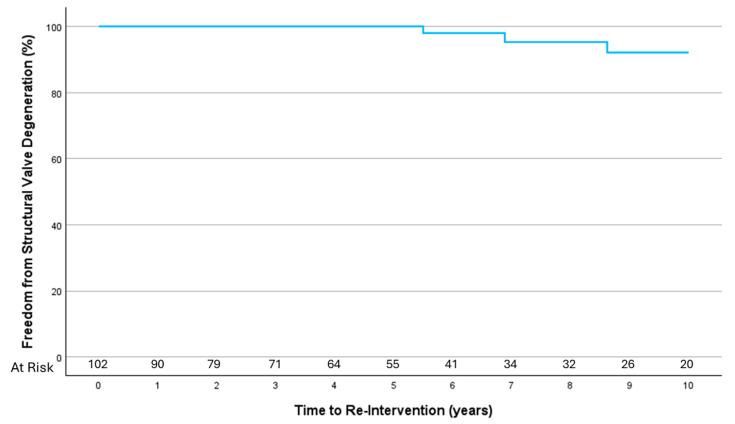
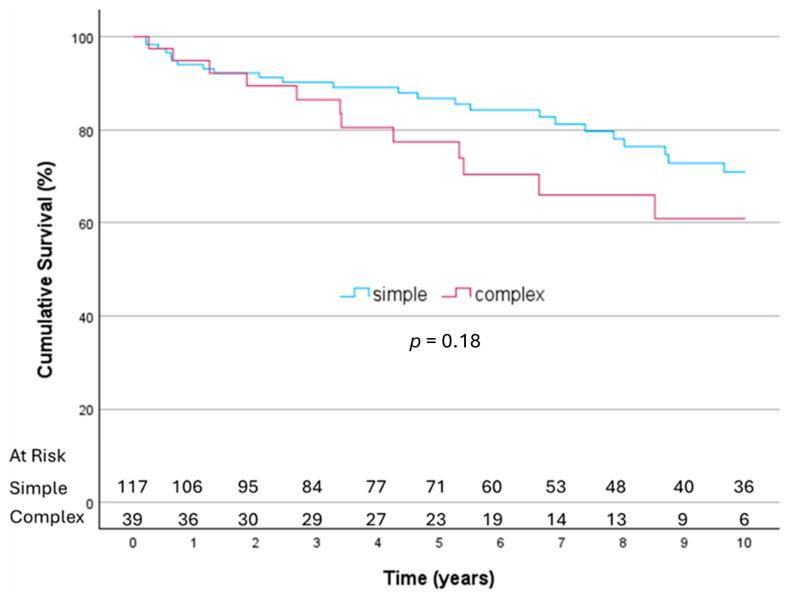
: We compared short- and long-term outcomes of patients with native left-sided infective endocarditis (IE) confined to the valve leaflet ("simple") versus those with perivalvular extension ("complex") over two decades. : From 2005 to 2024, 177 patients (mean age 59.6 ± 13.8 years, 71.8% male) underwent surgery for IE. Patients were classified as having simple ( = 129) or complex IE ( = 48) based on imaging and intraoperative findings. Mean follow-up was 86.5 ± 63.3 months (range: 2-232 months). Outcomes included operative and late mortality, recurrent infection, and reoperation. : Complex IE was associated with worse preoperative status, longer ICU stays, and mechanical ventilation times. Predictors of early mortality included critical preoperative state (OR 6.35, = 0.001), chronic renal failure/dialysis (OR 3.01, = 0.05), and staphylococcal IE (OR 5.62, = 0.002) but not perivalvular extension. Overall survival at 1, 5, 10, 15, and 20 years was 83%, 74.2%, 59.9%, 51.3%, and 40.7%, with no significant difference between groups ( = 0.18). Female gender (HR 1.93, = 0.04) and chronic renal failure (HR 3.5, < 0.01) predicted late mortality. Freedom from re-endocarditis and reoperation d/t relapse of endocarditis was 94.2% and 97.3%, respectively. Freedom from re-intervention d/t structural valve degeneration was 92.1% at 10 years. Repair was performed in 28.2% of cases involving the mitral valve, with 93.1% freedom from reoperation. : Surgery for complex IE is not an independent risk factor for long-term mortality. Rates of recurrent endocarditis and reoperation are remarkably low. Excellent durability of bioprostheses and mitral repair was demonstrated.
我们比较了二十多年来局限于瓣膜小叶(“单纯性”)与有瓣周扩展(“复杂性”)的左心感染性心内膜炎(IE)患者的短期和长期预后。从2005年到2024年,177例患者(平均年龄59.6±13.8岁,71.8%为男性)接受了IE手术。根据影像学和术中发现,患者被分类为患有单纯性IE(n = 129)或复杂性IE(n = 48)。平均随访时间为86.5±63.3个月(范围:2 - 232个月)。预后指标包括手术死亡率和晚期死亡率、反复感染及再次手术。复杂性IE与术前状态较差、ICU住院时间更长及机械通气时间更长相关。早期死亡的预测因素包括术前危急状态(OR 6.35,P = 0.001)、慢性肾衰竭/透析(OR 3.01,P = 0.05)和葡萄球菌性IE(OR 5.62,P = 0.002),但不包括瓣周扩展。1年、5年、10年、15年和20年的总体生存率分别为83%、74.2%、59.9%、51.3%和40.7%,两组之间无显著差异(P = 0.18)。女性(HR 1.93,P = 0.04)和慢性肾衰竭(HR 3.5,P < 0.01)是晚期死亡的预测因素。免于再次心内膜炎和因心内膜炎复发而再次手术的比例分别为94.2%和97.3%。10年时免于因人工瓣膜结构性退变而再次干预的比例为92.1%。在涉及二尖瓣的病例中,28.2%进行了修复,再次手术率为93.1%。复杂性IE手术并非长期死亡的独立危险因素。反复心内膜炎和再次手术的发生率极低。生物瓣膜和二尖瓣修复显示出极好的耐久性。
 Zotero 插件