
童年不良经历、遗传易感性与骨质疏松症风险:一项队列研究
Adverse Childhood Experiences, Genetic Susceptibility, and the Risk of Osteoporosis: A Cohort Study.
作者信息
Shu Yanling, Tu Chao, Liu Yunyun, Song Lulu, Wang Youjie, Wu Mingyang
机构信息
Ministry of Education Key Laboratory of Environment and Health, and State Key Laboratory of Environmental Health (Incubating), School of Public Health, Tongji Medical College, Huazhong University of Science and Technology, No. 13 Hangkong Road, Wuhan 430030, China.
Department of Maternal and Child Health, School of Public Health, Tongji Medical College, Huazhong University of Science and Technology, No. 13 Hangkong Road, Wuhan 430030, China.
出版信息
Medicina (Kaunas). 2025 Jul 30;61(8):1387. doi: 10.3390/medicina61081387.
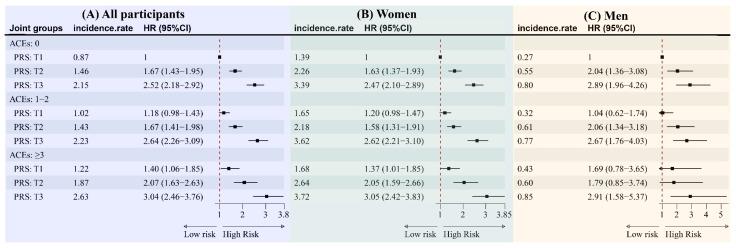
Emerging evidence indicates that individuals exposed to adverse childhood experiences (ACEs) face elevated risks for various chronic illnesses. However, the association between ACEs and osteoporosis risk remains underexplored, particularly regarding potential modifications by genetic susceptibility. This prospective cohort study aims to examine the relationship of ACEs with incident osteoporosis and investigate interactions with polygenic risk score (PRS). This study analyzed 124,789 UK Biobank participants initially free of osteoporosis. Cumulative ACE burden (emotional neglect, emotional abuse, physical neglect, physical abuse, sexual abuse) was ascertained through validated questionnaires. Multivariable-adjusted Cox proportional hazards models assessed osteoporosis risk during a median follow-up of 12.8 years. Moderation analysis examined genetic susceptibility interactions using a standardized PRS incorporating osteoporosis-related SNPs. Among 2474 incident osteoporosis cases, cumulative ACEs showed dose-response associations with osteoporosis risk (adjusted hazard ratio [HR] = 1.07, 95% confidence interval [CI] 1.04-1.11; high ACEs [≥3 types] vs. none: HR = 1.26, 1.10-1.43). Specifically, emotional neglect (HR = 1.14, 1.04-1.25), emotional abuse (HR = 1.14, 1.03-1.27), physical abuse (HR = 1.17, 1.05-1.30), and sexual abuse (HR = 1.15, 1.01-1.31) demonstrated comparable effect sizes. Sex-stratified analysis revealed stronger associations in women. Joint exposure to high ACEs/high PRS tripled osteoporosis risk (HR = 3.04, 2.46-3.76 vs. low ACEs/low PRS) although G × E interaction was nonsignificant (P-interaction = 0.10). These results suggest that ACEs conferred incremental osteoporosis risk independent of genetic predisposition. These findings support the inclusion of ACE screening in osteoporosis prevention strategies and highlight the need for targeted bone health interventions for youth exposed to ACEs.
新出现的证据表明,童年经历不良(ACEs)的个体面临各种慢性疾病的风险升高。然而,ACEs与骨质疏松症风险之间的关联仍未得到充分研究,特别是关于遗传易感性的潜在修饰作用。这项前瞻性队列研究旨在探讨ACEs与新发骨质疏松症的关系,并研究与多基因风险评分(PRS)的相互作用。本研究分析了124,789名最初无骨质疏松症的英国生物银行参与者。通过经过验证的问卷确定累积ACE负担(情感忽视、情感虐待、身体忽视、身体虐待、性虐待)。多变量调整的Cox比例风险模型评估了在中位随访12.8年期间的骨质疏松症风险。调节分析使用纳入骨质疏松症相关单核苷酸多态性的标准化PRS检查遗传易感性相互作用。在2474例新发骨质疏松症病例中,累积ACEs与骨质疏松症风险呈剂量反应关系(调整后的风险比[HR]=1.07,95%置信区间[CI]1.04-1.11;高ACEs[≥3种类型]与无ACEs:HR=1.26,1.10-1.43)。具体而言,情感忽视(HR=1.14,1.04-1.25)、情感虐待(HR=1.14,1.03-1.27)、身体虐待(HR=1.17,1.05-1.30)和性虐待(HR=1.15,1.01-1.31)显示出相当的效应大小。按性别分层分析显示女性中的关联更强。高ACEs/高PRS的联合暴露使骨质疏松症风险增加两倍(HR=3.04,2.46-3.76与低ACEs/低PRS相比),尽管基因×环境相互作用不显著(交互P值=0.10)。这些结果表明,ACEs赋予了独立于遗传易感性的骨质疏松症风险增加。这些发现支持在骨质疏松症预防策略中纳入ACE筛查,并强调需要针对暴露于ACEs的青少年进行有针对性的骨骼健康干预。

 Zotero 插件