
克隆特异性变异对甜菜坏死黄脉病毒和甜菜黄化病毒传播及相关取食行为的影响。
Clone-Specific Variation in Influences Transmission of BMYV and BYV and Associated Feeding Behavior.
作者信息
Noël Grégoire, Glacet Lallie, Then Christiane, Francis Frédéric
机构信息
Laboratory of Functional and Evolutionary Entomology, University of Liège, Gembloux Agro-Bio Tech, 5030 Gembloux, Belgium.
出版信息
Insects. 2025 Jul 30;16(8):784. doi: 10.3390/insects16080784.
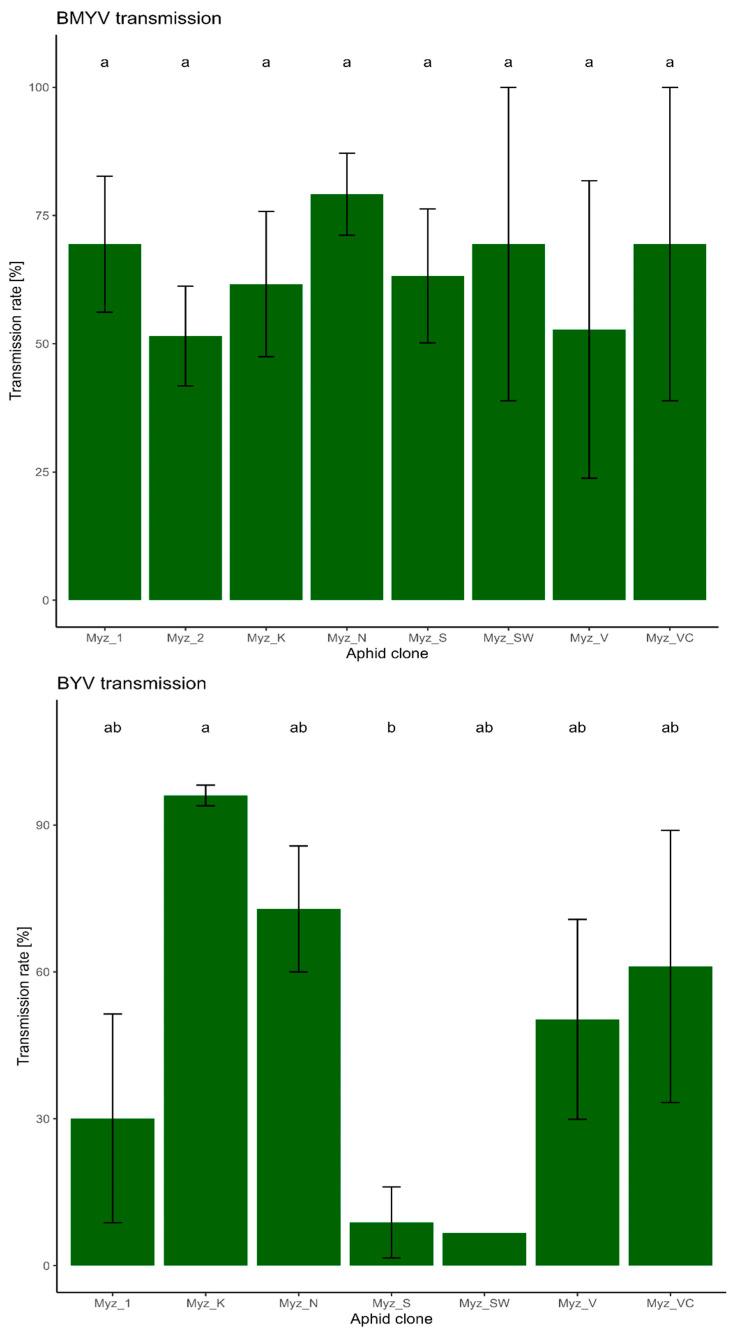
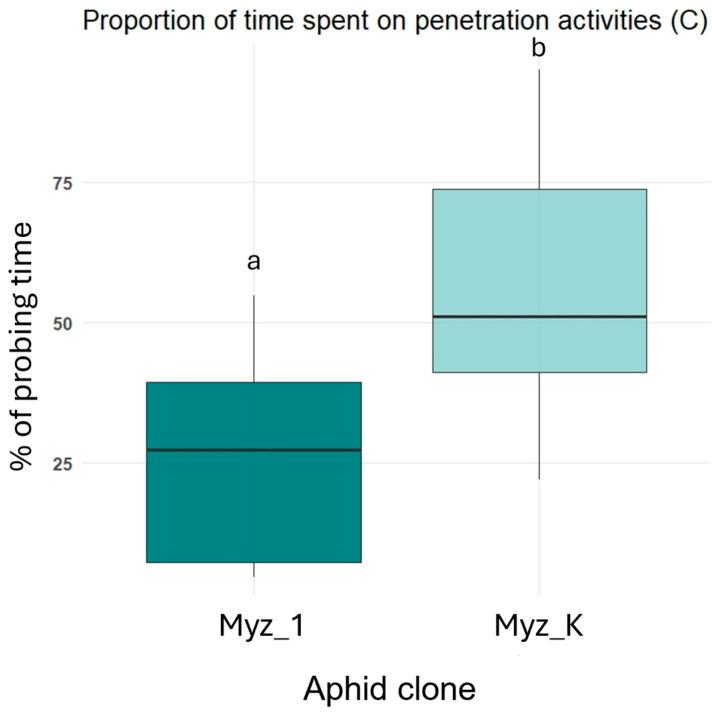
Sugar beet ( ssp. ) is a vital crop, contributing to nearly a quarter of global sugar production, but faces significant challenges from biotic stressors, particularly aphids, which transmit damaging yellowing viruses such as Beet Yellow Virus (BYV) and Beet Mild Yellowing Virus (BMYV). Following the partial ban of neonicotinoids in Europe, viral infections in sugar beet have surged, highlighting the need for a deeper understanding of aphid-mediated virus transmission mechanisms. This study aims to evaluate the transmission efficiency of BYV and BMYV through different clones of the aphid vector from sugar beet seed companies across Europe, and to analyze the feeding behaviors of efficient clones to identify factors influencing virus transmission. The transmission rates of yellowing viruses by clones ranged from 52% to 79% for BMYV (mean 65%) and 7% to 96% for BYV (mean 47%). While no significant differences in BMYV transmission efficiency were observed among clones, a significant difference was detected between two BYV-carrying clones. Moreover, the BYV-carrying clone exhibited prolonged penetration activities during its feeding phase compared to the BMYV-carrying clone, suggesting a potential behavioral influence on transmission efficiency. This study highlights the importance of considering aphid clone influence in the development of sugar beet resistance.
糖用甜菜(亚种)是一种重要作物,贡献了全球近四分之一的食糖产量,但面临着生物胁迫因素带来的重大挑战,尤其是蚜虫,它们会传播有害的黄化病毒,如甜菜黄化病毒(BYV)和甜菜轻度黄化病毒(BMYV)。在欧洲对新烟碱类农药实施部分禁令后,糖用甜菜的病毒感染激增,这凸显了深入了解蚜虫介导的病毒传播机制的必要性。本研究旨在评估BYV和BMYV通过来自欧洲各地糖用甜菜种子公司的不同蚜虫载体克隆的传播效率,并分析高效克隆的取食行为,以确定影响病毒传播的因素。BMYV的黄化病毒克隆传播率在52%至79%之间(平均65%),BYV的传播率在7%至96%之间(平均47%)。虽然在克隆之间未观察到BMYV传播效率的显著差异,但在两个携带BYV的克隆之间检测到了显著差异。此外,与携带BMYV的克隆相比,携带BYV的克隆在取食阶段表现出更长时间的穿刺活动,这表明对传播效率存在潜在的行为影响。本研究强调了在糖用甜菜抗性培育中考虑蚜虫克隆影响的重要性。

 Zotero 插件